Puchong Factory Sold at 45% Premium: What It Signals
Building materials maker Ajiya Bhd, through its wholly owned subsidiary Ajiya Safety Glass, is selling its freehold industrial land and factory in Puchong to healthcare products manufacturer Esprit Care in a cash deal priced about 45% above the asset's latest market valuation. The group expects a gain from the disposal. The transaction highlights two trends: manufacturers treating owner occupied plants as balance sheet assets that can be unlocked, and healthcare related manufacturing looking for compliant production space in the Klang Valley. This article examines the premium, the valuation gap and what it means for owners, buyers and tenants.
Key Takeaways
- Ajiya Bhd, through its wholly owned subsidiary Ajiya Safety Glass Sdn Bhd, is selling its freehold industrial land and factory in Puchong, Selangor.
- The buyer is Esprit Care Sdn Bhd, a healthcare products manufacturer equally owned by Wong Han Choong and other parties, and the sale and purchase agreement was signed on Thursday.
- The deal is for cash and is priced about 45% above the asset's latest market valuation of the property.
- The group expects to record a gain from the disposal, showing that an owner occupied plant can function as a balance sheet asset rather than only a production facility.
- Puchong sits in a mature Klang Valley industrial corridor where land supply is limited, keeping freehold industrial assets attractive to owner occupier manufacturers.
Industrial property deals are usually read as stories about buyers. In this transaction, the seller is the more interesting party. Building materials manufacturer Ajiya Bhd announced that its wholly owned subsidiary, Ajiya Safety Glass Sdn Bhd, has signed a sale and purchase agreement with healthcare products manufacturer Esprit Care Sdn Bhd to dispose of freehold industrial land and a factory in Puchong, Selangor. The transaction is for cash, and the price is about 45% above the asset's latest market valuation. The group also expects to record a gain from the exercise.
What makes this deal worth studying is not the headline number but the two structural trends it reveals. First, manufacturers are beginning to treat their own factories as assets that can be monetised. Second, healthcare and medical related manufacturing is actively looking for compliant production space in the Klang Valley. The sections below unpack the deal from three angles: the seller, the buyer and the wider market.
A Cash Deal Between Two Manufacturers
The seller: a building materials maker unlocking value
Ajiya is a local building materials manufacturer, and the asset being sold was held by its subsidiary, Ajiya Safety Glass, as part of the group's production network. When a manufacturer sells industrial property that it has been using, it usually points to one of two things: a need to reorganise its production footprint, or a decision by management to release capital tied up in land and buildings and redirect it towards the core business or other uses with better returns.
The cash nature of the deal matters. Compared with share swaps or staggered payments, an all cash transaction gives the seller immediate liquidity and reduces execution risk. Industrial land and buildings often sit on the books at historical cost, so when a sale is concluded close to market level, the gap between book value and the capital actually recovered shows up in the accounts in a single period.
The buyer: a healthcare products maker expanding
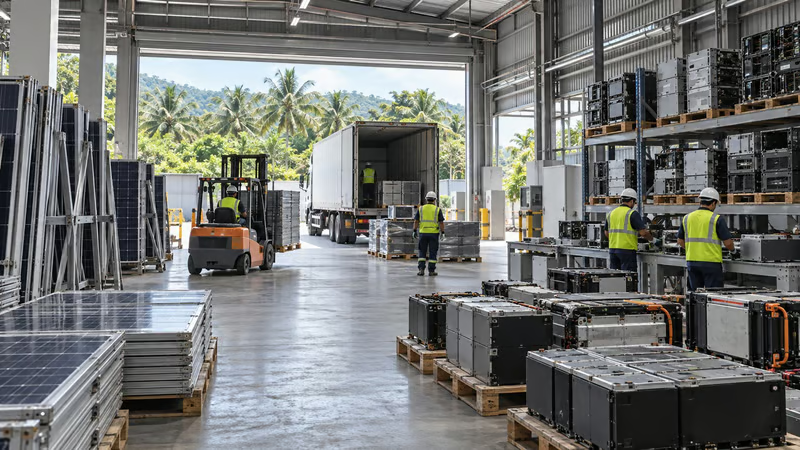
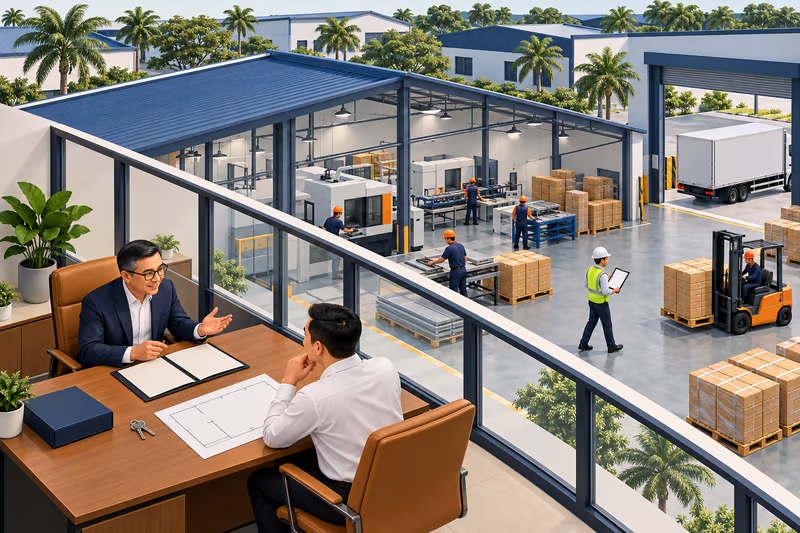
Esprit Care Sdn Bhd is a healthcare products manufacturer, reported to be equally owned by Wong Han Choong and other parties. Healthcare and medical related manufacturing has requirements that differ from general light industry. Cleanliness, temperature and humidity control, segregation of production and storage zones, and waste handling often follow stricter internal standards. When such a company finds a suitable ready built factory in a mature industrial area, it tends to prefer buying over long term leasing, because fit out and equipment investment needs a long payback period.
This helps explain why a buyer would pay above valuation. For an owner occupier, the real cost is not just the purchase price. It also includes the time spent searching for a suitable location, the cost of modification, and the opportunity cost of delayed production. If the location and specifications fit, a premium is often acceptable.
What the 45% Premium Really Says
Valuation is not the same as market value
The fact that the price is about 45% above the latest market valuation is the most useful signal for peers. Valuations are professional judgements based on historical transactions, location and building condition, and they contain a timing gap. If transactions in the area have been thin in recent years, the valuation model has few comparable references, and pricing naturally lags real demand. When the buyer is an owner occupier, the bidding logic is not what nearby units fetched, but what the site is worth to that specific operation.
In other words, the premium does not necessarily mean the whole market has risen by 45%. It more likely reflects two things: this asset class has long suffered from a lack of comparable open market transactions, which keeps valuations conservative, and genuine buyers are willing to pay extra for location, tenure and time saved.
The scarcity of Puchong as a location
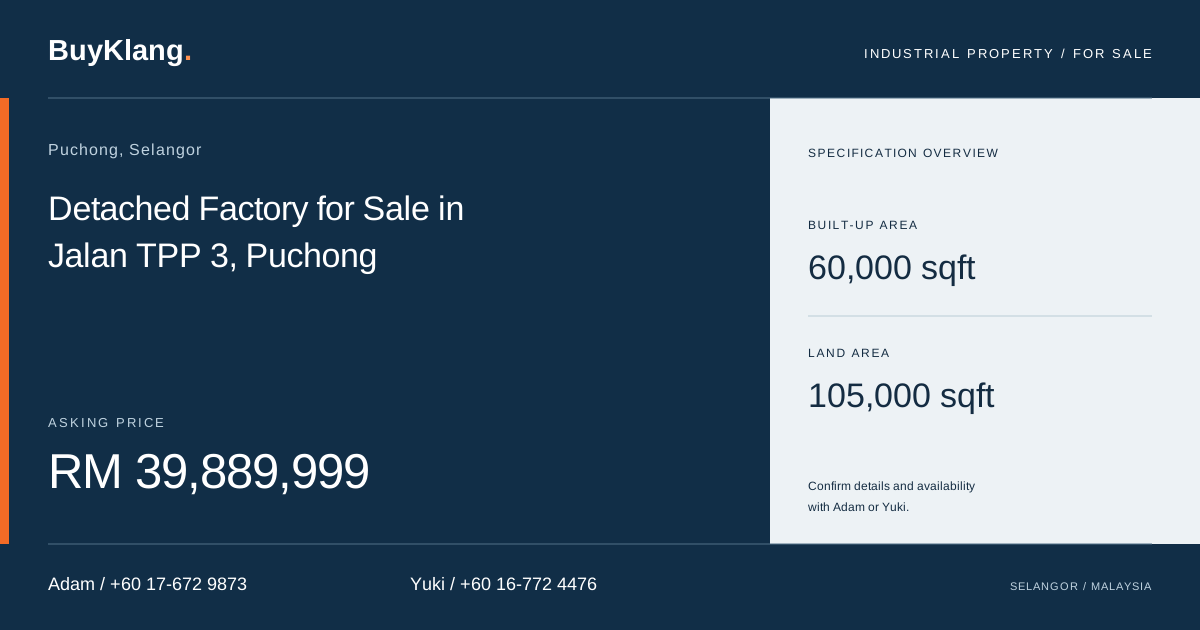
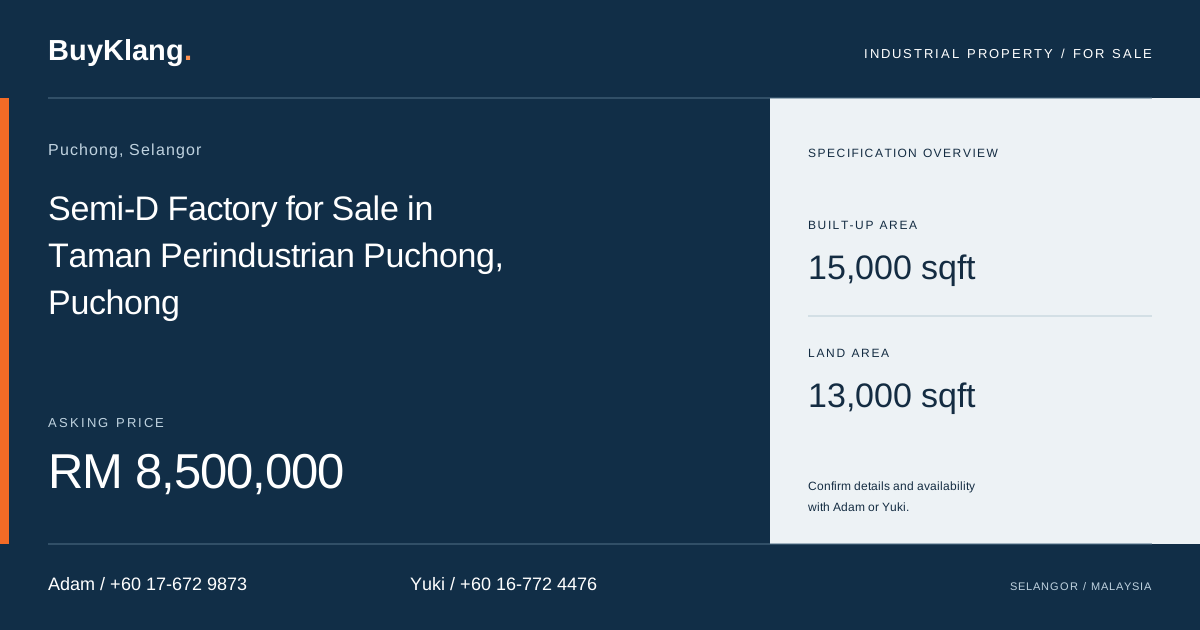
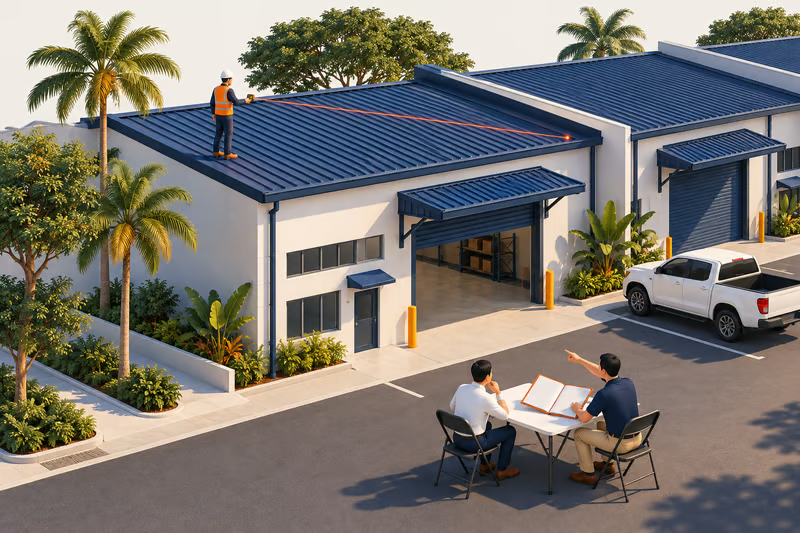
Puchong sits in the mature southern corridor of the Klang Valley, where residential, commercial and light industrial uses have developed side by side for years. New industrial land supply is limited. Freehold industrial assets are even rarer in such areas, because much of the earlier industrial land was granted on leasehold terms with varying remaining tenures. For a manufacturer planning to occupy a site for the long term, freehold tenure removes the uncertainty of lease renewal, which matters greatly over an investment payback period of ten years or more.
Mature areas also come with transport links, labour pools and supply chain networks already in place, so a company does not have to build an ecosystem from scratch. These invisible advantages rarely appear in a valuation report in full, but they do appear in what a buyer is willing to pay.
Three Implications for Klang Valley Industrial Property
1. Mature industrial areas are being re rated
In recent years, attention has centred on data centres, logistics warehousing and new industrial parks. The quieter mature industrial areas have been under less scrutiny, yet limited supply creates upward pressure on values. When a well located factory in such an area comes to market and the buyer is an owner occupier, the chance of a price above valuation rises. For companies holding similar assets, this means book values may have been understated for some time.
2. Owner occupiers still set the price floor
Investment buyers look at yields and exit routes, and their bids tend to be disciplined. Owner occupiers look at operating efficiency and long term cost, and they have more room to bid. This is why, in selected mature locations, industrial asset pricing is often driven by occupier buyers. For a seller seeking a better price, choosing the right counterparty matters more than choosing the right moment.
3. Healthcare manufacturing demand deserves attention
Healthcare product manufacturing has a useful characteristic for landlords. Once a product line is set, space and capacity needs are relatively stable and do not swing with seasons the way trading or e commerce warehousing does. Such tenants and buyers are steadier counterparties and are therefore more likely to accept a higher unit cost in exchange for compliant space and long term security. For industrial park owners and factory landlords, this is a tenant category worth studying seriously.
Practical Advice
If you own a factory
First, review the valuation basis of your asset periodically. If your factory sits in a mature industrial area with good tenure and there have been no comparable transactions for years, the existing valuation may lag the market. Second, clarify your own operational needs before deciding whether to sell, sell part, or continue holding. Third, if you still need to produce at the same site after a sale, whether a leaseback arrangement is possible should be settled before negotiations begin. The news does not disclose whether this particular deal includes such an arrangement, and that is a point for the industry to watch.
If you are buying a factory
First, factor time cost into your bid. The wait for a suitable factory to come to market is often more expensive than the premium itself. Second, verify land use and building compliance, especially for companies in food, healthcare or medical related production, where the cost of converting a non compliant building can far exceed expectations. Third, assess tenure and remaining lease terms, because freehold and short leasehold differ significantly in long term financial planning.
If you are a tenant
Once a factory in a mature industrial area is bought by an owner occupier, the supply available for rent shrinks and negotiating room at renewal may narrow. If your lease expires within the next year or two, assessing relocation and renewal options early gives you more room to manoeuvre than reacting at the last minute. It also pays to watch for similar sized factories changing hands nearby, because a change of owner often comes with a reset of rental terms.
Closing Thoughts
On the surface, this Puchong factory transaction is an asset transfer between two manufacturers. In practice, it reveals how industrial property is being repriced: valuations lag, supply in mature areas is scarce, and owner occupiers are willing to pay for certainty. For companies that own factories, it is a reminder to revisit asset values. For companies looking for space, it is a signal to move decisively.
Whether you plan to buy, sell or rent a factory or warehouse, comparing location, tenure, specifications and your own operational needs on a single sheet is always more meaningful than looking at price alone. BuyKlang is dedicated to helping every client find the right factory or warehouse, and helping each client find a suitable factory is the mission behind BuyKlang.my.
Factories and Warehouses in Port Klang
Archived catalogue records with power, ceiling height and floor loading for every unit: