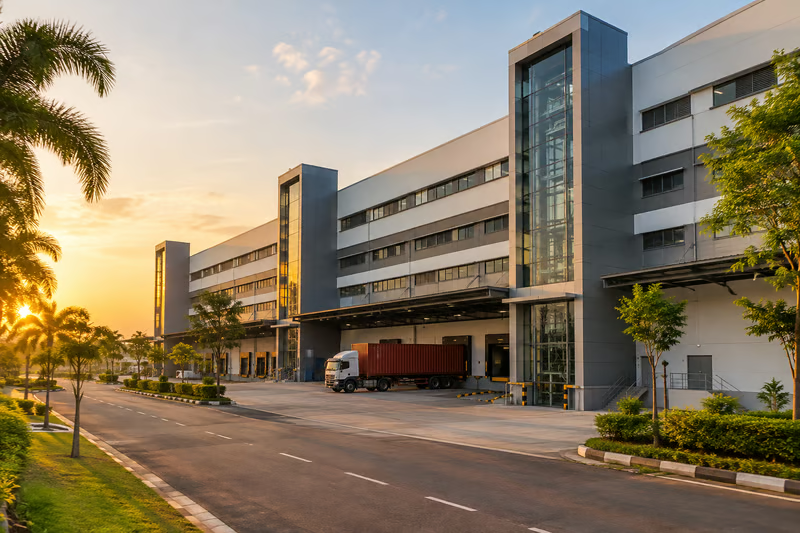
Act 446 Malaysia: Worker Hostel Rules, CLQ and the JTK Accommodation Certificate
Act 446 requires any employer housing even one worker to hold a JTK Certificate for Accommodation. This guide sets out the minimum standards, fees, CLQ rules and penalties, and what they mean when you rent or buy a factory.
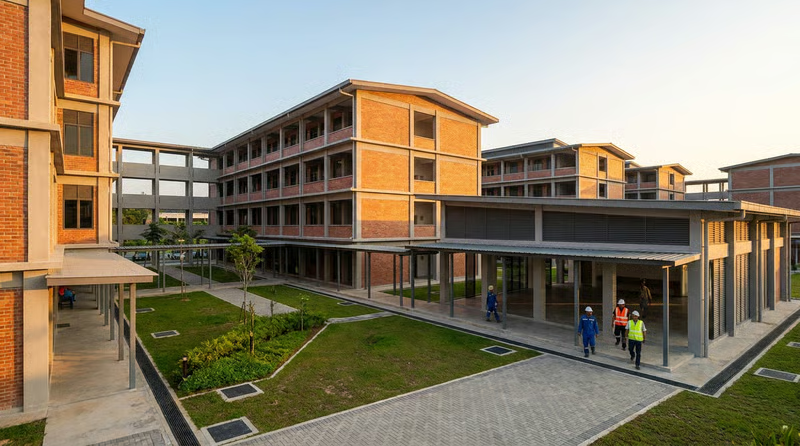
Act 446, the Employees' Minimum Standards of Housing, Accommodations and Amenities Act 1990 as amended by Act A1604 (in force 1 June 2020, with the housing regulations in force from 1 September 2020), requires every employer in Peninsular Malaysia or Labuan that houses even one worker to hold a Certificate for Accommodation from the Department of Labour (JTKSM) and to meet the 2020 minimum standards, including 3 m² of sleeping area per worker in a dormitory, a single bed of at least 1.7 m² each, and one toilet and one bathroom for every 15 workers. To get the certificate, apply online for each address on JTKSM's Sistem Akta 446 portal (akta446.mohr.gov.my) with your SSM record, the tenancy agreement, SPA or CF/CCC, a floor plan and, where the building needs it (cabins, a change of use or renovation), the local council's (PBT) approval, then pay the processing fee: RM100 for housing 10 workers or fewer, RM300 for more. Housing workers without a certificate is an offence with a fine of up to RM50,000.
Key Takeaways
- Act 446 covers every employer that houses even one employee in Peninsular Malaysia or Labuan, in any sector. The housing needs a Certificate for Accommodation from the Labour Department (JTKSM) before anyone moves in. There is no "5 workers" threshold.
- The minimum standards are fixed numbers: 3 sq m of sleeping area per worker in a dormitory, 3.6 sq m of bedroom per worker elsewhere, a 1.7 sq m single bed each, and 1 bathroom and toilet per 15 workers (1 per 6 outside a dormitory).
- The certificate fee is RM100 for housing of 10 employees or fewer and RM300 above that. A centralised labour quarters (CLQ) operator pays RM2,000 or RM5,000.
- Housing workers without a certificate carries a fine of up to RM50,000 per offence. Directors can be charged with the company, and charges stack: one glove group faced 30 in 2020.
- For factory tenants and buyers, the real gate is often the council. Where the building needs it (cabins, a change of use such as warehouse to hostel, or renovation), JTK expects the local authority's (PBT) approval with the application.
Act 446 is the Employees' Minimum Standards of Housing, Accommodations and Amenities Act 1990. Since the 2019 amendment, any employer in Peninsular Malaysia or Labuan that houses an employee must first obtain a Certificate for Accommodation from JTKSM and keep the housing at the minimum standards set by the 2020 regulations. A worker hostel can be run by the employer or by a CLQ operator, and both need the certificate.
This guide is for factory and warehouse owners and tenants who house production workers. Every figure comes from the Act, its regulations or JTKSM's applicant guide, linked where it first appears.
What Is Act 446 (Akta 446)?
Act 446 began in 1990 as the Workers' Minimum Standards of Housing and Amenities Act and for three decades mainly covered estates and mines. The 2019 amendment (Act A1604) renamed it, added Part IIIA on "accommodations" for every employee not working on an estate, and extended it to Labuan. Act A1604 was due to take effect on 1 June 2020, but the government deferred enforcement to 1 September 2020, the day the regulations that put numbers on it also took effect.
The "worker hostel rules and regulations" in Malaysia therefore sit in four documents:
| Instrument | What it sets | In force |
|---|---|---|
| Act 446, Part IIIA (sections 24A to 24N) | Certificate requirement, duties, penalties | 1 June 2020, enforced from 1 September 2020 |
| P.U.(A) 250/2020 Accommodation and Centralized Accommodation Regulations | Space, beds, lockers, toilet ratios, common facilities | 1 September 2020 |
| P.U.(A) 248/2020 Processing Fees Regulations | Certificate fees | 1 September 2020 |
| P.U.(A) 249/2020 Maximum Rental or Charges Regulations | Most an employer may collect from a worker: RM100 a month, raised to RM150 by P.U.(A) 49/2026 | 1 September 2020; RM150 from 1 March 2026 |
Sabah and Sarawak have their own labour departments, so employers there should check with JTK Sabah or JTK Sarawak.
Who Must Comply With Act 446?
Employers who house their own workers
Section 24D(1) reads: "No accommodation shall be provided to an employee unless certified with a Certificate for Accommodation." "Accommodation" means any permanent or temporary building or structure used for human habitation, including a house, hut, shed or roofed enclosure. So:
- There is no minimum headcount. One worker in a rented terrace house counts as much as 300 in a dormitory.
- Local and foreign workers are both covered, although enforcement has centred on foreign worker housing in manufacturing.
- Every address needs its own application, according to JTKSM's applicant guide.
CLQ operators
The Act defines "centralized accommodation" as a building housing employees of one or more employers, run by a "centralized accommodation provider". This is what the market calls a CLQ (penginapan pekerja berpusat). An employer housing only its own staff is not a CLQ provider, however large the hostel. The CLQ operator holds its own certificate and faces heavier penalties.
Factory landlords
A landlord who only leases a factory or house is not named in Part IIIA. Landlords are still exposed, because the employer's application needs the tenancy agreement and council approvals, and section 24H bans using a building "unfit for human habitation". If workers may not live on site, say so in the lease. If they may, set out who obtains which approval and who pays.
Act 446 Minimum Standards: Space, Beds and Toilets
From P.U.(A) 250/2020 and the JTKSM applicant guide:
| Requirement | Dormitory | Non-dormitory (bedrooms) |
|---|---|---|
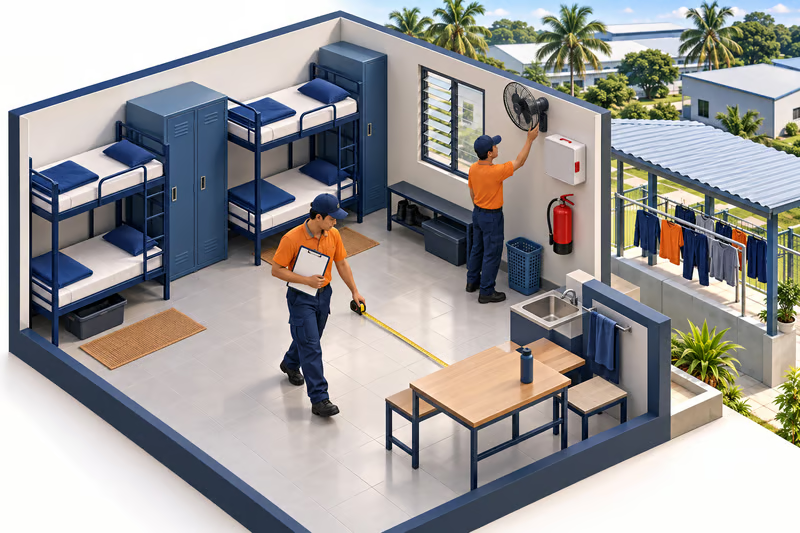
| Floor area per worker | Sleeping area of at least 3 sq m | Bedroom of at least 3.6 sq m |
| Bathroom and toilet (separate or combined) | 1 for every 15 workers | 1 for every 6 workers |
| Bed (not shared) | Single bed of at least 1.7 sq m; at least 0.7 m between the two beds of a double-decker | Same |
| Bedding (not shared) | Mattress at least 4 inches (10.2 cm) thick, pillow, blanket | Same |
| Locker (not shared) | Lockable cupboard at least 0.35 m x 0.35 m x 0.9 m for valuables including the passport, accessible at any time | Same |
| Shared areas | Rest area, dining area with chairs and tables, kitchen area, clothes-drying area | Same |
| Fittings and supplies | Fan in each rest, dining and sleeping area; lamp in every area; first aid kit; dustbin; water and electricity | Same |
Worked example: how many workers fit?
A dormitory with 90 sq m of sleeping area holds at most 30 workers (90 divided by 3), and 30 workers need at least 2 bathroom-and-toilet units (30 divided by 15). Double-decker beds help fit the beds in but do not change the 3 sq m rule, which is about floor area per worker. JTK officers assess the real layout, so treat this as a first screen.
Duties beyond the numbers
- Separate housing for men and women, plus fire safety and electrical wiring that meet the relevant laws (section 24J).
- A person in charge who inspects at least twice a month and keeps records (section 24L).
- Notice to JTK within 30 days after workers move in (section 24E).
The regulations set no ceiling height, window size or ventilation rate. Those come from the building by-laws your council applies when it approves plans, so ask your architect or draughtsman.

How to Apply for the Certificate for Accommodation
Applications go through the Sistem Akta 446 portal. JTKSM's guide sets out the steps:
| Step | What you do | Notes |
|---|---|---|
| 1 | Get council (PBT) approval for the building as accommodation where needed | Required for cabins, a change of use or renovation works; otherwise the CF or CCC, or the tenancy or SPA, supports the application |
| 2 | Apply on the portal for each address | One application per address |
| 3 | Prepare documents | SSM registration; tenancy agreement, SPA or CCC; floor plan by a registered draughtsman; council approval letter; photos inside and out |
| 4 | Submit the printed acknowledgement, documents and fee at the nearest labour office | The 2020 guide asks for a bank draft, postal order or money order |
| 5 | JTK inspects and decides | No processing time is fixed in law; ask your labour office |
| 6 | Collect the certificate | Director, partner or owner, or an authorised representative |
| 7 | Notify JTK of occupation within 30 days | Section 24E |
The council approval depends on the building: a temporary building permit for cabins, a change-of-use approval for converting a commercial building (the guide's own example is "warehouse to hostel"), or a renovation approval where works are needed.
Certificate fees under P.U.(A) 248/2020
| Applicant | Housing capacity | Processing fee |
|---|---|---|
| Employer | 10 employees or fewer | RM100 |
| Employer | More than 10 employees | RM300 |
| CLQ provider | 500 employees or fewer | RM2,000 |
| CLQ provider | More than 500 employees | RM5,000 |
The fee is not refundable. The Act and regulations do not state how long a certificate is valid, so read the conditions on your certificate and confirm renewal with JTK. The certificate is tied to the approved building and capacity, so check with JTK before adding workers or changing the layout.
CLQ vs Employer-Provided Hostel
| Own hostel (on site or rented building) | Centralised labour quarters (CLQ) | |
|---|---|---|
| Certificate holder | Employer, per address | CLQ operator, per building |
| Application fee | RM100 or RM300 | RM2,000 or RM5,000 (operator pays) |
| Council approval | Employer arranges, with landlord consent if leased | Operator holds it |
| Penalty for no certificate | Up to RM50,000 | Up to RM50,000, up to 1 year in jail, or both |
| Rent collected from workers | Capped at RM150 per worker a month (RM100 before 1 March 2026), by wage deduction | Same cap; CLQ charges above it are the employer's cost |
The cap, RM150 a month since 1 March 2026 under P.U.(A) 49/2026 (JTKSM FAQ), comes from section 24G and P.U.(A) 249/2020 and covers housing provided "by the employer or any centralized accommodation provider". That is why total occupancy cost, factory rent plus worker housing, is the number to compare when you shortlist factories. For the Port Klang belt, see our Klang CLQ compliance guide and the piece on worker housing demand around Klang factories.
State planning rules can restrict on-site hostels
Where workers may live is a planning decision, not JTK's. Penang's Temporary Labour Quarters guideline, in force from 1 January 2024, allows worker housing in existing industrial buildings only until 31 December 2027, only with an OC or CCC, and never in or next to chemical or high-risk factories; workers must then move to a CLQ. Selangor councils such as MBSA, MBDK, MBSJ and MBPJ apply their own rules, so ask the planning department before budgeting for an on-site hostel.

Act 446 Penalties
| Offence | Section | Maximum penalty |
|---|---|---|
| Employer houses an employee without a certificate | 24D(3) | Fine up to RM50,000 |
| CLQ provider houses employees without a certificate | 24D(4) | Fine up to RM50,000, jail up to 1 year, or both |
| No notice to JTK within 30 days | 24E(2) | Fine up to RM10,000 |
| Building unfit for human habitation | 24H(2) | Fine up to RM50,000 |
| Employer breaches the minimum standards | 33 (general penalty) | Fine up to RM50,000, plus up to RM1,000 a day while it continues |
| CLQ provider breaches the minimum standards | P.U.(A) 250/2020 | Fine up to RM1,000, jail up to 6 months, or both |
- Directors are exposed. Under section 29A, directors and managers can be charged with the company and are deemed guilty if it is convicted, unless they prove lack of knowledge or due diligence.
- Charges stack. In December 2020 the Human Resources Ministry said a glove maker and two subsidiaries would face 30 charges under Act 446, up to RM50,000 each. Some reports say "RM50,000 per worker"; the Act says per offence, but exposure still grows with workers and addresses.
- Compounds are common. Section 28A allows a compound of up to 50% of the maximum fine. By 30 November 2021, JTKSM had found 46.71% of 37,662 employers inspected not complying, issuing 817 compounds and charging 134 in court.
What Act 446 Means When You Rent or Buy a Factory
A hostel inside the factory: the order of approvals
- Planning position. Ask the council whether accommodation is allowed on the lot and what it needs: change of use, a temporary permit or new building plans.
- Approved plans and CCC. A hostel block or mezzanine that never appeared on the approved plans is the most common gap. Our guide to the CCC for factory buyers shows how to verify it.
- Fire safety. Conversions go through the council's building plan process with Bomba input. See how fire safety rules affect factory leases.
- Then the JTK certificate, and the 30-day notice once workers move in.
For tenants: lease clauses
- Written landlord consent to house workers, with the permitted area and maximum occupants.
- A use clause that matches the council approval. Housing workers in a factory leased for industrial use only breaches the lease as well as council rules.
- Who obtains and pays for the approvals, works and certificate, plus a rent-free fit-out period if the works are yours.
- Copies of the CCC and approved plans from the landlord.
- An approval term at least as long as the lease if the council approval is temporary.
Our checklist before renting a factory covers the rest, from power supply to floor loading.
For buyers: due diligence on an existing hostel
Ask the seller for the JTK certificate, the council approval for the hostel part and the CCC covering it. An unapproved hostel passes to you with the building, and you may have to stop using it, regularise it or demolish it. When comparing factories for sale in Selangor or industrial land in Selangor for a purpose-built hostel, price in the approval route and timeline.
Off-site options
If the factory cannot take a hostel, budget for rented housing (which needs a certificate in your name) or CLQ beds. Shift work makes distance matter: a factory for rent in Shah Alam, Kapar or Port Klang near approved housing can cost less overall than a cheaper unit far from it. Our find me a factory service shortlists with this in mind.
Act 446 Compliance Checklist
- List every address where you house workers, including rented houses.
- Confirm council approval for each building as accommodation, and a CCC where needed.
- Measure: 3 sq m sleeping area per worker in a dormitory, 3.6 sq m bedroom elsewhere.
- Count bathrooms and toilets: 1 per 15 (dormitory) or 1 per 6.
- Provide a 1.7 sq m bed (0.7 m bunk clearance), 4-inch mattress, pillow, blanket and lockable cupboard per worker.
- Check rest, dining, kitchen and drying areas, fans, lamps, first aid kit, water and power.
- Separate men and women; check fire safety and wiring.
- Apply on the Akta 446 portal (RM100 or RM300) and notify JTK within 30 days of occupation.
- Appoint a person in charge who inspects twice a month.
- Cap housing deductions at RM150 per worker a month and get written landlord consent if leased.
Fire safety is one of the most common deal-breakers: our fire certificate guide for factories and warehouses explains which premises need a Bomba FC, renewal and what to check before you sign.
For the full sequence of permits, from land use to the operating licence, see our factory approvals map for Malaysia.
FAQ
What does CLQ mean in Malaysia?
CLQ stands for centralised labour quarters: a building that houses the workers of one or more employers and is run by a centralised accommodation provider under Act 446. The CLQ operator holds its own Certificate for Accommodation from JTKSM, and the employer still pays any charge above the RM150 a month that may be deducted from a worker.
What does Act 446 require for a factory worker hostel in Malaysia?
Any employer that houses even one worker needs a Certificate for Accommodation from JTKSM and must meet the 2020 minimum standards: 3 m² of sleeping area per worker in a dormitory, a single bed of at least 1.7 m² each, one toilet and one bathroom per 15 workers, plus basic amenities. Converting factory or warehouse space into a hostel also needs change-of-use approval from the council. Housing workers without a certificate can be fined up to RM50,000.
How do I get the JTK accommodation certificate (Certificate for Accommodation)?
Apply online for each address on the Sistem Akta 446 portal (akta446.mohr.gov.my) with your SSM record, the tenancy agreement, SPA or CF/CCC, a floor plan and photos, plus the council (PBT) approval where the building needs one (cabins, a change of use or renovation). Pay the non-refundable processing fee under P.U.(A) 248/2020: RM100 for 10 workers or fewer, RM300 for more. Notify JTK within 30 days once workers move in.
Is there a minimum number of workers before Act 446 applies?
No. Section 24D(1) bars providing any accommodation to an employee without a Certificate for Accommodation, and sets no minimum headcount. Only the fee changes: RM100 for 10 employees or fewer, RM300 above that.
What is the minimum space per worker under Act 446?
A dormitory needs at least 3 sq m of sleeping area per worker; other housing needs a bedroom of at least 3.6 sq m per worker (P.U.(A) 250/2020). Each worker also needs a single bed of at least 1.7 sq m. Bathrooms and toilets are 1 per 15 workers in a dormitory and 1 per 6 elsewhere.
Can I build or convert a worker hostel inside my factory?
Possibly, but the council decides first. You need its approval for the building as accommodation, usually through change of use, a temporary permit or amended plans, with fire safety checked, before JTK will process the certificate. Some states restrict this: Penang allows it in existing industrial buildings only until 31 December 2027.
What is the difference between a CLQ and a worker hostel?
A CLQ houses employees of one or more employers and is run by a separate operator, who holds the certificate. A hostel an employer runs for its own staff is not a CLQ, and the employer holds the certificate. A CLQ operator without a certificate faces up to RM50,000, up to 1 year in jail, or both.
Can employers charge workers rent for hostel accommodation?
Yes, up to RM150 per worker a month since 1 March 2026 (RM100 before that), deducted from wages, under section 24G, P.U.(A) 249/2020 and its 2026 amendment. The cap applies whether workers live in the employer's hostel or a CLQ, so costs above RM150 fall on the employer.
What is the fine for breaching Act 446?
Housing a worker without a certificate carries a fine of up to RM50,000 per offence for the employer. Breaching the minimum standards falls under the general penalty of up to RM50,000 plus up to RM1,000 a day. Directors can be charged with the company, and each breach can be a separate charge.
Does a factory landlord need the Act 446 certificate?
No, the duty belongs to the employer or CLQ operator. But the employer's application needs the tenancy agreement and council approvals for the building, so the landlord's consent and documents are part of the process. State in the lease whether workers may live on site and who handles approvals.
Buying or renting, talk to us
Send us the numbers that decide the shortlist: required amps, built-up area, floor loading, preferred area and target date. We reply with what actually exists, including units that are not advertised publicly. For 800A to 4,000A+ requirements, see high-power factories in Selangor.
| Agent | Licence | Mobile / WhatsApp | |
|---|---|---|---|
| Adam | 60176729873 | +60 17-672 9873 | |
| Yuki | 60167724476 | +60 16-772 4476 |
Factories and Warehouses in Port Klang
Live listings with power, ceiling height and floor loading for every unit: