How to Rent a Factory in Malaysia: 7 Steps and 22 Things to Check Before Renting
How to rent a factory or warehouse in Malaysia in seven steps, with a 22-point checklist of what to check before renting: land use, KTK risk, CCC, Bomba, TNB power, floor loading, flood history, DOE, Act 446, deposits, 6% SST and stamp duty.

Key Takeaways
- Renting a factory in Malaysia takes seven steps: write down your specs, shortlist and view, check the building and paperwork, sign a letter of offer, pay the deposits, sign and stamp the tenancy agreement, then take over the unit with a recorded condition report.
- Before you sign, check 22 things in four groups: legal use (land category, zoning, KTK status, CCC), safety and licences (Bomba fire certificate, council licence, DOE, Act 446), building specs (TNB amps, floor loading, clear height, loading bays, truck access, flood history) and lease terms.
- A factory on agricultural land without conversion is a KTK. Selangor recorded 6,690 KTK on 5,352 lots in October 2024, and its regularisation programme runs until 31 December 2027.
- TNB low-voltage supply goes up to 1,000 kVA maximum demand; above that you need 11kV or higher with a substation. Ask for the TNB supply approval and bill, not just the switchboard.
- The usual upfront package is a 2-month security deposit, a 1-month utility deposit and 1 month's rent in advance: RM120,000 on RM30,000 a month, before stamp duty and service tax.
- Rent carries 6% service tax from 1 January 2026, and tenancy stamp duty is RM1 to RM7 per RM250 of annual rent depending on the term, paid by the tenant.
How do you rent a factory in Malaysia, and what should you check first? Define your power, space and loading needs, view units against them, then verify the legal use (land category, zoning, CCC or CF, no KTK issue), the fire certificate and council licence for your activity, and the TNB supply, floor loading, clear height and flood record before you sign a letter of offer. Then pay the usual 2 + 1 + 1 month deposits, stamp the tenancy agreement within 30 days and record the unit's condition at handover. A cheap unit that cannot be licensed or powered is worth nothing to a tenant.
How to rent a factory in Malaysia: 7 steps
- Write down what your operation needs. TNB power supply in amps, ceiling height, floor loading, loading bays, yard and trailer access, and the land use your activity needs (light, medium or heavy industry).
- Shortlist and view. Compare units against those specifications, not only the rent. An agent who co-brokes can also show you units marketed by other agents.
- Check the building and the paperwork. Use the 22-point checklist below: land search, land use and council approval for your activity, CCC, Bomba fire certificate, actual TNB supply, physical specs and flood history.
- Agree the terms and sign a letter of offer. Rent, deposits, tenancy period, renewal option, repairs, reinstatement and any fit-out the landlord will do. An earnest deposit is usually paid at this stage.
- Pay the deposits. The usual package is a two-month security deposit, a one-month utility deposit and one month's rent in advance. Landlords often ask for more when the tenant uses a lot of water or power, runs a dirty or polluting process, is a newly registered or small company, or is a foreign company; when the landlord pays for fit-out such as three-phase power, offices, a crane or floor strengthening; when heavy machinery or high floor loads may damage the floor; when the business stores flammable goods, chemicals, batteries or plastic resin; when CTOS or CCRIS shows unpaid debts or court cases; and when the unit comes with equipment such as cold rooms, cranes, goods lifts or a substation. Large or listed companies can sometimes negotiate less.
- Sign and stamp the tenancy agreement. The agreement must be stamped within 30 days, and the tenant pays the stamp duty unless agreed otherwise. If the landlord charges SST, 6% service tax is added to the rent. Rates and a worked example are in section 11.
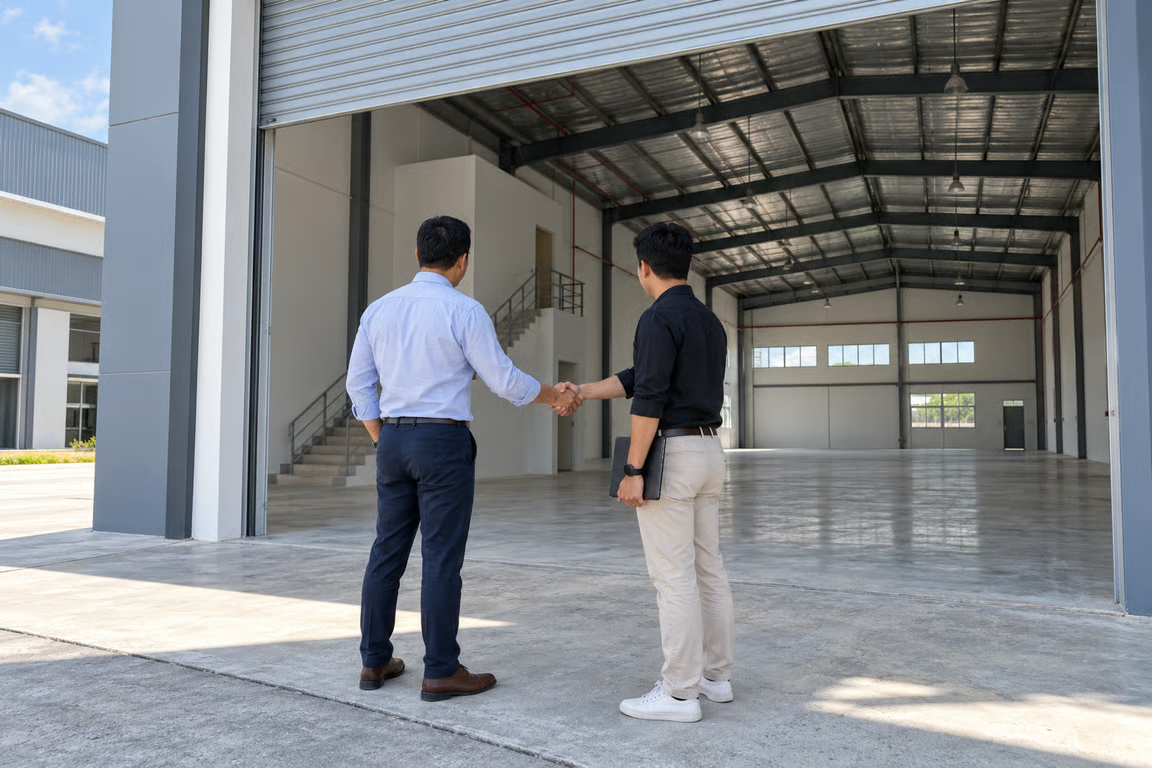
- Take over the unit. Do a joint inspection with the landlord, record the condition with dated photos and meter readings, and collect all keys. This is what settles the deposit fairly when you move out.
What to check before renting a factory or warehouse
The checks below follow the order in which problems become expensive: legal use first, then safety and licences, then building specs, then the lease.
1. Legal use: land category, zoning and KTK risk
Land category and express condition on the title
Under section 52 of the National Land Code (Act 828), alienated land falls into one of three categories of use: agriculture, building or industry. The title also carries an express condition, such as "Perusahaan" or "Kilang", that states what the land may be used for. A factory should sit on industry land, or on land whose category and condition were varied by the state under section 124.
How to verify: ask for a copy of the title and run an official land search (carian rasmi) at the land office. The search shows the registered owner, the category, the express condition, any charge to a bank, caveats and any restriction in interest.
Zoning in the local plan
The council's local plan (Rancangan Tempatan) zones each lot for light, medium or heavy industry, and your process has to fit that zone. A plating or plastic recycling line is unlikely to be licensed in a light-industry zone. Check the zoning with the planning department of the council: MBSA in Shah Alam, MBDK in Klang, MBSJ in Subang Jaya and Puchong, MBPJ in Petaling Jaya.
KTK: factories built on agricultural land
A KTK (kilang tanpa kebenaran) is a factory built on agricultural land without conversion or planning approval. Selangor runs a compliance programme for these premises from 1 September 2024 to 31 December 2027. Owners had to apply by 31 December 2025 or within 12 months of receiving Notice 7A under section 128 of the National Land Code. Otherwise they face forfeiture. A KTK tenant cannot get a normal factory licence and can lose the premises mid-lease. Our guide to Selangor's KTK programme and Notice 7A explains how to spot one.
Red flag: an agricultural title, a rent well below the area's normal level, or a landlord who says the licence "can be settled later".
2. CCC or CF, and approved plans versus what is built
Every factory needs proof that the building was completed according to approved plans. Since April 2007 this is the Certificate of Completion and Compliance (CCC), certified by the principal submitting person. Older buildings carry a Certificate of Fitness for Occupation (CF) issued by the council. Our explainer on what a CCC is covers the difference.
The certificate only covers what was approved, so compare the approved building plan with the unit:
- Extensions and canopies: a covered yard or side extension added later needs its own approval.
- Mezzanine floors and offices: an unapproved mezzanine affects floor loading, fire escape routes and the licence.
- Change of use: a building approved as a warehouse may need fresh approval to run a production line.
Red flag: no CCC or CF, or a building far larger than the approved plan.
3. Business licence and permitted use for your activity
The council licence (lesen premis or lesen perniagaan) is issued to the occupier, not the landlord, for a stated activity. Councils usually ask for the title, the CCC or CF and a Bomba support letter before they issue it. Before signing, confirm with the council that your exact activity (food processing, chemical storage, printing, recycling) can be licensed at that address. Some activities also need DOE approvals or a manufacturing licence; check with the agency concerned.
Red flag: the previous tenant ran a different activity and the landlord cannot show any licence ever issued for the premises.
4. Fire certificate and Bomba
Under section 28 of the Fire Services Act 1988 (Act 341), designated premises must hold a fire certificate, and the certificate has to be renewed every year. Whether a factory or warehouse counts as designated premises depends on its use and size under the Fire Services (Designated Premises) Order, so ask the local Bomba office about the specific unit.
What to check on site:
- The current fire certificate and its expiry date, if the premises is designated.
- Sprinkler system, hose reels, hydrants, alarm panel and extinguishers, with service tags that are in date.
- Fire exits and escape routes that are not blocked by racking or partitions.
- Whether your goods raise the fire risk: high racking, plastics, solvents or lithium batteries can need a higher sprinkler standard.
Red flag: an expired certificate, sprinkler valves shut, or a landlord who says a fire certificate "is not needed" without asking Bomba.
5. Power supply: amps, maximum demand and substation
Power is the specification you cannot fix quickly after signing. TNB classifies supply as follows:
| TNB supply | Maximum demand range | Typical use |
|---|---|---|
| 415V three-phase, direct metered | Up to 72 kVA (100A) | Small terrace units, light assembly |
| 400/230V CT-metered (low voltage) | Up to 1,000 kVA | Most semi-detached and detached factories |
| 11kV | 1,000 to 5,000 kVA | Large plants with their own substation |
| 22kV | 1,000 to 10,000 kVA | Large plants (offered only in parts of Johor and Perak) |
| 33kV | 5,000 to 25,000 kVA | Very heavy industry |
Source: TNB supply classification. At 415V three-phase, 1,000A is roughly 700 kVA.
To verify the supply, ask for the TNB supply approval (the approved capacity, which is the number that counts) and the TNB bill (the recorded maximum demand), and check the main incoming breaker on site.
If you need more, note that TNB's Electricity Supply Application Handbook requires an electrical consultant engineer registered with the Board of Engineers to apply for any load above 100A. A new substation also means handing the substation land to TNB by transfer or lease at a nominal RM10. Agree in writing who pays for an upgrade and who owns the equipment when the lease ends. Work out your load with the factory power calculator, and see our TNB amperage guide for typical figures by industry.
Red flag: a listing that quotes a big switchboard but no approved supply, or a maximum demand on the bill far below what you need with no upgrade plan.
6. Floor loading, clear height, loading bays and truck access
Floor loading
Ask for the design floor load from the structural drawings or the landlord's engineer, usually stated in kN/m². Compare it with your heaviest machine, racking leg loads and forklift wheel loads using the floor loading calculator. Upper floors and mezzanines are usually far weaker than the ground slab, and cracked or patched slabs show past overloading.
Clear height
Listings often quote the apex height. What matters is the clear height under the lowest obstruction (beams, sprinkler pipes, lights, crane rails). Measure it and check that your racking, forklift reach and sprinkler clearance fit.
Loading bays and dock levellers
Count the loading bays, measure the doors, and test every dock leveller and roller shutter in front of the landlord. Confirm who services them. If you need specific heights, power or doors, the find a factory by specs tool filters units on these numbers.
Truck access and turning
Drive the route a 40-foot container trailer would take, from the access road through the gate to the turning space. Check for road weight limits and residential streets where councils restrict lorries.
Red flag: trailers have to reverse in from a public road, or the slab shows wide cracks where the last tenant had heavy machines.
7. Drainage, flood history and water supply
Check the drains and road levels; a factory lower than the road floods first. Ask neighbours about past floods, look for water marks on walls and switchboards, and check the area on the JPS public flood information portal. Our Selangor industrial flood risk guide explains how flood history affects insurance.
For water-heavy processes, check the meter size and pressure, and confirm all utility arrears are cleared before handover.
Red flag: water marks above floor level, switchboards mounted at floor level, or an insurer that refuses flood cover for the address.
8. DOE requirements for your process
Environmental rules attach to your activity, so they are the tenant's responsibility:
- Scheduled waste: under the Environmental Quality (Scheduled Wastes) Regulations 2005, a waste generator must notify DOE of new categories and quantities within 30 days of generating them. Waste may be stored on site for up to 180 days, and no more than 20 tonnes may be accumulated without DOE approval.
- Industrial effluent: the Environmental Quality (Industrial Effluent) Regulations 2009 require written notification to DOE before work that creates a new effluent discharge or changes a treatment system.
- Air emissions: boilers, ovens and other fuel-burning equipment fall under separate clean air rules. Check the notification needed with the DOE state office before you install anything.
Red flag: abandoned drums, stained soil or pipes running into the monsoon drain. Make the landlord clear them before handover and record it in writing.
9. Worker hostel: Act 446
If you house workers, the Workers' Minimum Standards of Housing and Amenities Act 1990 (Act 446) applies. Since its 2019 amendment it has covered all employment sectors since 1 September 2020. Non-compliant employers face a maximum fine of RM50,000 for each offence. The employer applies for a Certificate of Accommodation through the JTKSM Act 446 portal. Partitioning part of a factory into a dormitory also needs council and Bomba approval. Read our Act 446 hostel guide for factory tenants before you plan any on-site housing.
Red flag: existing dormitory rooms inside the factory with no approval and no Certificate of Accommodation.
10. Insurance
The landlord usually insures the building against fire; the tenant insures stock, machinery, renovations (contractor's all risks during fit-out), public liability and business interruption. Check that the lease says who insures what, that your real process is disclosed so it does not void the landlord's policy, and that flood cover is available. Our guide to who insures what between landlord and tenant has the full split and the lease clause, and Lulu Loke's fire insurance guide explains what a tenant's policy should cover.
11. Lease terms: deposits, SST, stamp duty, repairs and reinstatement
Ownership and authority
Confirm through the land search that the landlord is the registered owner, check SSM records if it is a company, and ask whether a chargee bank must consent to the tenancy. For leasehold land, compare the remaining term with your tenancy plus renewal. Have a lawyer review the title.
Earnest deposit, deposits and utility arrears
The deposit package and the cases where landlords ask for more are set out in step 5 above. Two points cause most disputes:
- Earnest deposit: paid with the letter of offer to hold the unit, and normally credited to the security deposit or first month's rent when the agreement is signed. If you pull out, it is usually forfeited, so make the offer subject to the checks in this guide (for example, the council confirming your activity can be licensed).
- Utility arrears: the landlord should settle all TNB, water and sewerage bills before handover. Ask for the latest paid bills, and make vacant possession conditional on the accounts being cleared.
Quit rent and assessment are normally the landlord's cost unless the agreement says otherwise.
Service tax on rent
Service tax on rental of non-residential property is 6% from 1 January 2026, down from 8% in July to December 2025. The same MOF announcement exempts SME tenants with annual sales up to RM1.5 million, and exempts newly established SMEs from service tax on rent for one year from their registration date. Ask the landlord whether it charges SST and whether your company qualifies for the exemption.
Stamp duty on the tenancy agreement
LHDN's stamp duty guideline sets the duty per RM250 of annual rent (or part of it):
| Tenancy term | Duty per RM250 of annual rent | Example: RM30,000 a month (RM360,000 a year) |
|---|---|---|
| Up to 1 year | RM1 | RM1,440 |
| Over 1 to 3 years | RM3 | RM4,320 |
| Over 3 to 5 years | RM5 | RM7,200 |
| Over 5 years | RM7 | RM10,080 |
The tenant pays duty on the original agreement and the landlord on the duplicate. Stamp the agreement within 30 days of signing. A term of more than three years is a lease that must also be registered at the land office on Form 15A.
Worked example, RM30,000 a month, 3-year tenancy: RM60,000 security deposit + RM30,000 utility deposit + RM30,000 advance rent + RM4,320 stamp duty = RM124,320, plus RM1,800 a month service tax if SST applies.
Repairs: landlord versus tenant
| Item | Usually landlord | Usually tenant | Agree in writing |
|---|---|---|---|
| Roof, structure, external walls | Yes | Roof leaks found at handover | |
| Main drains and external works | Yes | Blocked drains from tenant waste | |
| Internal day-to-day repairs | Yes | ||
| Tenant's own fit-out and offices | Yes | ||
| Dock levellers, roller shutters | Servicing and breakdown cost | ||
| Overhead crane, cold room, substation | Annual inspections and repairs | ||
| Fire system servicing | Who pays the annual service | ||
| Quit rent and assessment | Yes |
This is common practice, not law. The signed agreement decides.
Reinstatement
Most agreements require the unit back in its original condition, fair wear and tear excepted. The signed handover record from step 7 is your baseline, so list in the agreement which fit-outs (offices, partitions, power upgrades) can stay.

Printable checklist: 22 checks before renting a factory or warehouse
| # | Item | Why it matters | How to verify | Red flag |
|---|---|---|---|---|
| 1 | Land category and express condition | Industry use must be allowed on the title | Official land search | Agricultural title |
| 2 | Zoning in the local plan | Your process must fit light, medium or heavy zone | Council planning department | Heavy process in a light zone |
| 3 | KTK status | KTK units face enforcement and forfeiture | Title category, council records | "Licence can be settled later" |
| 4 | CCC or CF | Proof the building was completed and approved | Copy of CCC or CF | None available |
| 5 | Approved plans vs built | Unapproved extensions block licences | Compare approved plan on site | Extra floors, enclosed yards |
| 6 | Council licence for your activity | You cannot operate without it | Ask the council before signing | No licence ever issued here |
| 7 | Fire certificate | Required for designated premises, renewed yearly | Certificate and expiry date; ask Bomba | Expired or "not needed" |
| 8 | Fire system condition | Must match your storage risk | Service tags, test alarm | Shut valves, old tags |
| 9 | TNB approved supply | Machines cannot run without it | TNB supply approval letter | Big switchboard, small approval |
| 10 | Maximum demand and substation | Shows real capacity and upgrade path | TNB bill, site check | No upgrade plan |
| 11 | Floor loading | Overloading cracks slabs, voids repairs | Structural drawings, kN/m² | Cracked or patched slab |
| 12 | Clear height | Decides racking levels and storage volume | Measure to lowest obstruction | Only apex height quoted |
| 13 | Loading bays and dock levellers | Throughput and safety | Count, measure, test | Broken levellers, no service record |
| 14 | Truck access and turning | 40-foot trailers must get in and turn | Drive the route | Reversing in from a public road |
| 15 | Drainage and flood history | Floods stop production and raise insurance | JPS portal, neighbours, wall marks | Water marks, low-lying site |
| 16 | Water supply | Some processes need volume and pressure | Meter size, latest bill | Arrears, low pressure |
| 17 | DOE requirements | Waste and effluent rules attach to you | Check with DOE state office | Abandoned drums, stained soil |
| 18 | Act 446 hostel | Fines of up to RM50,000 per offence | Certificate of Accommodation | Unapproved dormitory |
| 19 | Insurance | Wrong disclosure can void a claim | Lease insurance clause, insurer | No flood cover available |
| 20 | Landlord ownership and bank consent | Only the owner can grant a valid tenancy | Land search, SSM, bank consent | Name mismatch, no consent |
| 21 | Deposits, 6% SST, stamp duty | Upfront cash and tax cost | Letter of offer, LHDN rates | Cash-only, unstamped agreement |
| 22 | Repairs and reinstatement | Avoids disputes over deposit refund | Repair schedule, condition record | Vague "tenant repairs all" clause |
Area checklists
The checklist above works anywhere in the Klang Valley. For area-specific points, see the Shah Alam factory inspection checklist, the Pulau Indah Industrial Park guide and the Klang factory and warehouse rent comparison by zone. To compare units, browse factories for rent in Selangor.
Before you sign, check the paperwork costs too: our factory tenancy agreement and stamp duty guide covers the 2025 stamp duty rates, the 6% service tax on rent and the clauses that matter in industrial leases.
Fire safety is one of the most common deal-breakers: our fire certificate guide for factories and warehouses explains which premises need a Bomba FC, renewal and what to check before you sign.
For the full budget beyond rent or price, see our cost to set up a factory in Malaysia guide: move-in, fit-out, power upgrade, approvals and running costs.
FAQ
How do I rent a factory in Malaysia?
Write down your power, space and loading needs, shortlist and view units, then check the land use, CCC, fire certificate, TNB supply and specs. Sign a letter of offer, pay the deposits, sign and stamp the tenancy agreement within 30 days, and record the unit's condition at handover.
What should I check before renting a factory or warehouse?
Check legal use first (land category, zoning, KTK status, CCC or CF), then the fire certificate, council licence, TNB supply, floor loading, clear height, loading access and flood history. Finish with the lease: ownership, deposits, 6% service tax, stamp duty, repairs and reinstatement.
How much deposit do I need to rent a factory in Malaysia?
The usual package is a two-month security deposit, a one-month utility deposit and one month's rent in advance. Landlords often ask for more for heavy water or power users, dirty or polluting processes, new or small companies, foreign companies, landlord-funded fit-out, heavy machinery, fire-risk goods, poor CTOS or CCRIS records, or units that come with equipment such as cold rooms or cranes. Large or listed companies can sometimes negotiate less.
Who pays stamp duty on a factory tenancy agreement, and is stamping compulsory?
Under LHDN's guideline the tenant pays on the original and the landlord on the duplicate, unless agreed otherwise, at RM1, RM3, RM5 or RM7 per RM250 of annual rent for terms up to 1, 3, 5 or over 5 years. Stamp within 30 days of signing. An unstamped agreement cannot be admitted as evidence in court.
What happens if the tenancy is longer than 3 years?
A term of more than three years is a lease under the National Land Code. Besides stamping, it must be registered at the land office on Form 15A. Many tenants sign a shorter term with a renewal option instead, so check with your lawyer which suits your fit-out investment.
How do I know if a factory is legal to operate in?
Run an official land search to confirm the land is industry or converted, ask for the CCC or CF and compare the approved plan with what is built. Then ask the council whether your activity can be licensed there. An agricultural title with no conversion may mean a KTK.
Does a rented factory need a Bomba fire certificate?
Designated premises must hold a fire certificate under section 28 of the Fire Services Act 1988, renewed every year. Whether a unit is designated depends on its use and size, so ask the local Bomba office. Councils also usually ask for a Bomba support letter before issuing a business licence.
Can I house workers in a rented factory?
Only with approvals. The employer needs a Certificate of Accommodation from JTKSM under Act 446, and converting factory space into a hostel also needs council and Bomba approval. Fines go up to RM50,000 per offence.
Buying or renting, talk to us
Send us the numbers that decide the shortlist: required amps, built-up area, floor loading, preferred area and target date. We reply with what actually exists, including units that are not advertised publicly. For 800A to 4,000A+ requirements, see high-power factories in Selangor.
| Agent | Licence | Mobile / WhatsApp | |
|---|---|---|---|
| Adam | 60176729873 | +60 17-672 9873 | |
| Yuki | 60167724476 | +60 16-772 4476 |
Factories and Warehouses in Port Klang
Live listings with power, ceiling height and floor loading for every unit: