Factory Approvals in Malaysia: Land Use, Planning Permission, DOE and Manufacturing Licence
A step-by-step map of the approvals a new factory in Selangor needs, from land conversion and planning permission to DOE notifications and the MIDA manufacturing licence, with who issues each and what to prepare.
Key Takeaways
- A new factory in Selangor passes through about a dozen approvals in a fixed order: industrial land use, planning permission (KM), building plans, CCC, TNB supply, Bomba and DOE, then operating permits such as the council's industrial licence.
- A MIDA manufacturing licence is needed once a manufacturer has shareholders' funds of RM2.5 million or more, or 75 or more full-time employees (Industrial Coordination Act 1975). Smaller firms can apply for an exemption letter.
- DOE wants written notification at least 30 days before work that creates an air emission or effluent source, and new scheduled waste notified within 30 days. Since the 2024 amendment, scheduled waste offences carry up to 5 years' jail and fines of up to RM10 million.
- TNB requires a new substation above 350 kVA (about 505A), with lead times of 3 to 12 months. Bomba requires an annual fire certificate for designated premises, such as a sprinklered single-storey factory of 2,001 m² or more.
- MBDK's industrial licence checklist covers 10 agencies and a complete file is processed in 30 days. Renting an approved factory skips the six building approvals; you still need the licences tied to your business.
To start a factory in Selangor, the land must be in the industry category, the local council must grant planning permission (Kebenaran Merancang) and approve building plans through its One Stop Centre (OSC), and the building needs a CCC, TNB supply, Bomba approval and DOE clearance. To operate, you then need the council's industrial licence, a MIDA manufacturing licence if you have RM2.5 million in shareholders' funds or 75 full-time staff, and DOSH certificates for regulated machinery.
Each approval relies on the one before it: plans cannot be approved on land whose title does not allow a factory, a CCC cannot be issued for a building that departs from its plans, and the council checks the building's approvals before licensing an industry. This map covers Selangor; KL and Negeri Sembilan apply the same federal laws with different council procedures.
Master table: factory approvals in Selangor
| # | Approval | Issuing body | When you need it | What to prepare |
|---|---|---|---|---|
| 1 | Industry land category and express condition (or conversion) | State Authority via district land office | Before building; verify at purchase | Title search, quit rent receipt, conversion application |
| 2 | Planning permission (KM) | Local council (PBT), via OSC | Before development or a material change of use | Layout plan, development proposal, land documents |
| 3 | Building plan approval | Council building department, via OSC | Before construction or extensions | Architectural, structural, M&E and fire drawings |
| 4 | CCC (Form F) | Principal Submitting Person (architect or engineer) | On completion, before occupation | Stage certificates G1 to G21 |
| 5 | Electricity supply | TNB | Apply at design stage | Maximum demand; consultant engineer above 100A; substation land above 350 kVA |
| 6 | Fire certificate | Bomba (JBPM) | Designated premises, yearly | Endorsed plans, test records |
| 7 | EIA approval | DOE | Prescribed activities only | EIA report by registered consultant |
| 8 | Air and effluent notifications | DOE state office | 30 days before the work | Forms; control system designed by a professional engineer |
| 9 | Scheduled waste notification | DOE (eSWIS) | Within 30 days of generation | Waste inventory, storage area, licensed contractor |
| 10 | Manufacturing licence or exemption | MIDA for MITI | RM2.5m shareholders' funds or 75 staff | InvestMalaysia online application |
| 11 | Industrial and signboard licence | Council licensing department | Before trading | Agency confirmations, CCC, title or tenancy |
| 12 | Certificate of Fitness for plant | DOSH (JKKP) | Before using boilers, pressure vessels, power-driven cranes | Design verification, installation permit |
| 13 | Certificate for Accommodation | JTKSM (Act 446) | Before housing any employee | Council approval of the housing, RM100 or RM300 fee |
| 14 | Halal certificate (voluntary) | JAKIM, via MYeHALAL | Food, OEM or logistics firms using the halal logo | Halal assurance system, trained staff |
| 15 | LMW or free zone status (optional) | Royal Malaysian Customs | Export-oriented makers | Security and inventory systems |
Steps 1 to 6 attach to the land and building; steps 7 to 15 attach to your business. That split is why renting an approved factory is faster.
Step 1: Land category, express condition and conversion
Every Selangor title records a category of land use (agriculture, building or industry) and express conditions. Under the National Land Code (Act 828), breaching them can lead to forfeiture. Owners change them by applying to vary the category or conditions (section 124), combining that with a subdivision or amalgamation (section 124A), or surrendering and re-alienating the land (section 204D). PLANMalaysia Selangor's procedure confirms that section 124A and 204D applications run through the council's OSC together with planning permission and building plans. See our land conversion guide and the Klang agricultural-to-industrial land guide.
Factories on agricultural land (KTK). Selangor's regularisation programme for unauthorised factories runs from 1 September 2024 to 31 December 2027. Factories in the KTK inventory before 28 August 2019 had to apply by 31 December 2025, or within 12 months of a Notice 7A, and successful applicants get 30% off the conversion premium (DUN Selangor answer). Read our KTK explainer before buying or renting one.
Step 2: Planning permission (Kebenaran Merancang) through the OSC
Planning permission (KM) is the council's approval, with or without conditions, to carry out development under the Town and Country Planning Act 1976 (Act 172). The council's One Stop Centre receives the application through the OSC 3.0 Plus system, circulates it to technical agencies (PLANMalaysia Selangor among them) and issues the decision. Development includes a material change in the use of a building, so turning a warehouse into a food plant can need a fresh KM. There is no Selangor-wide processing time; ask the council's OSC for an estimate when you submit.
Step 3: Building plan approval
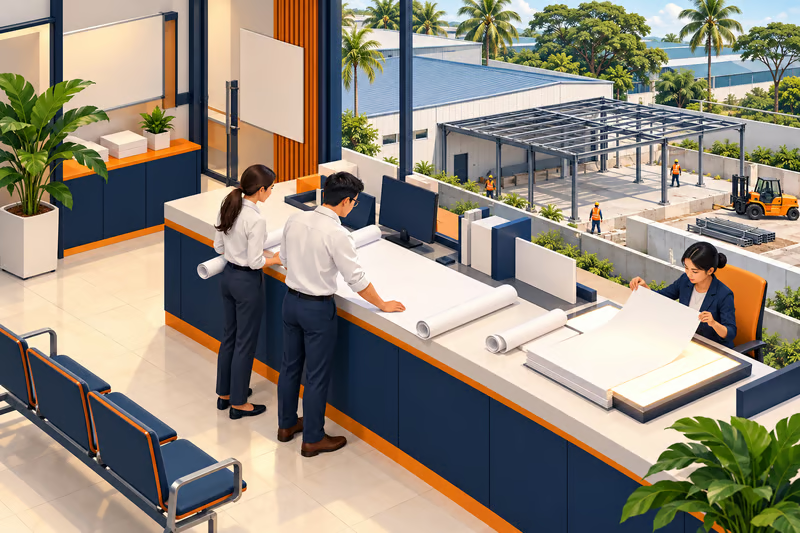
The council approves building plans under the Street, Drainage and Building Act 1974 (Act 133) and the Uniform Building By-Laws 1984. A professional architect, professional engineer or registered building draughtsman submits them (Board of Architects Malaysia), and the fire installation drawings go to Bomba for endorsement before work starts. Extensions, mezzanines and canopies need approved plans too; unapproved additions are a common problem when older factories are sold or mortgaged.
Step 4: CCC (Certificate of Completion and Compliance)
Since 12 April 2007, the CCC (Form F) has been issued by the Principal Submitting Person, backed by stage certificates G1 to G21, instead of the council's Certificate of Fitness (CF). No one may occupy a building without one. Our CCC guide for factory buyers shows how to verify it.
Step 5: TNB electricity supply
TNB's Electricity Supply Application Handbook (ESAH 3.1) sets the supply scheme by maximum demand:
| Maximum demand | Supply arrangement | Typical lead time |
|---|---|---|
| Below 100 kVA (about 145A) | Low voltage from the existing network | Check with TNB |
| 100 to 350 kVA | TNB decides after a system study | Depends on the study |
| Above 350 kVA (about 505A) | Cable from a new substation on your land | 3 to 12 months at 400V |
| 1,000 kVA and above (about 1,440A) | 11kV, consumer owns the transformers | 6 to 12 months |
Loads above 100A must be applied for by an Electrical Consultant Engineer, and the substation site must be planned into the layout at the KM stage. Size your load with the factory power calculator and read our TNB substation guide.
Step 6: Bomba plan approval and fire certificate
Bomba endorses the fire drawings at plan stage, and after completion every "designated premises" needs a fire certificate (FC) under section 28 of the Fire Services Act 1988, renewed yearly. On JBPM's schedule, that includes a sprinklered single-storey factory of 2,001 m² and above, any factory of three storeys or more, and warehouses above 7,000 m³. The fee is RM400 (RM620 for hazardous processes). The owner of designated premises without an FC faces a fine of up to RM50,000, up to 5 years' jail, or both, and JBPM announced full enforcement from 2026 (Bernama via Astro Awani). Tenants must notify Bomba before a material change, such as storing chemicals.
Step 7: DOE requirements (Environmental Quality Act 1974)
EIA, for prescribed activities only. The EIA Order 2015 lists them. Industrial examples include chemical production of 100 tonnes a day or more, cement grinding of 200 tonnes a day or more, and industrial estates of 20 hectares or more. Second Schedule activities also need public display. Most single factories in existing parks fall outside the lists, but check your process.
Written notification. The Clean Air Regulations 2014 require written notification to DOE at least 30 days before constructing a building that may create a new emission source, or changing plant or an air pollution control system. That system must be designed by a professional engineer, with a declaration and as-built drawings due within 30 days of starting operations. The Industrial Effluent Regulations 2009 set the same 30-day notice for new effluent sources.
Scheduled waste. Under the Scheduled Wastes Regulations 2005, each new waste category must be notified within 30 days of generation (now through eSWIS), and waste may be stored on site for up to 180 days and 20 tonnes. A DOE licence for prescribed premises applies only to listed types, such as palm oil mills and waste treatment facilities.
The 2024 amendment. The Environmental Quality (Amendment) Act 2024 (Act A1712) received Royal Assent on 27 May 2024 and was gazetted on 6 June 2024, with commencement set by the Minister. It raised penalties:
| Offence | Penalty under Act A1712 |
|---|---|
| Prescribed premises without a licence (s.18) | RM25,000 to RM250,000, up to 5 years' jail, or both |
| Work without DOE's prior written approval (new s.19(2)) | RM25,000 to RM250,000, up to 5 years' jail, or both |
| EIA breach (s.34A) | Up to 5 years' jail and RM100,000 to RM1 million |
| Scheduled waste offences (s.34B) | Up to 5 years' jail and RM100,000 to RM10 million |
A further amendment bill, announced by DOE in May 2026, mainly gives Sabah and Sarawak powers over scheduled waste.
Step 8: Manufacturing licence (Industrial Coordination Act 1975)
MIDA's guideline sets the rules:
| Criterion | Requirement |
|---|---|
| Licence needed | Shareholders' funds of RM2.5 million and above, or 75 or more full-time paid employees |
| Exemption | Below both thresholds; apply on form ICA10 for an exemption letter |
| Capital Investment Per Employee | At least RM140,000 |
| Malaysian workforce | At least 80% of full-time staff |
| Skills or value added | At least 25% managerial, technical and supervisory staff, or 40% value added |
| Where to apply | InvestMalaysia portal, self-assessment and self-declaration |
A full-time employee works at least six hours a day and 20 days a month. Rice milling, crude palm oil milling and raw rubber processing are exempt. MIDA notes that exempted companies can still apply for import duty exemptions on machinery and raw materials.

Step 9: The council's industrial licence
This is usually the tenant's first licence. MBDK's checklist for a temporary industrial and signboard licence (form JPL.B-10/2024) lists confirmations from 10 agencies: Bomba, DOSH, DOE, the council's environmental services, police, Customs, APAD, the district land office, and the council's building and planning departments. A complete file is processed within 30 days (MBDK checklist). MBSA, MBSJ and MBPJ run similar systems with their own forms.
Step 10: DOSH registration for machinery
The Factories and Machinery Act 1967 was repealed by Act 835. Since 1 June 2024, steam boilers, unfired pressure vessels and power-driven lifting machinery need installation permission and a Certificate of Fitness (CF) under the Occupational Safety and Health Act 1994. DOSH told The Star in September 2026 that a lifting machinery CF lasts 15 months and operating without one can cost up to RM100,000. Our factory specs guide explains how to check a crane.
Step 11: Worker accommodation (Act 446)
An employer that houses any employee needs a Certificate for Accommodation from JTKSM before anyone moves in: RM100 for up to 10 employees, RM300 above that, with fines of up to RM50,000 per offence. JTKSM acts only after the council approves the building for accommodation. See our Act 446 hostel guide.
Step 12: Halal certification for food factories
Halal certification is voluntary but needed for the Malaysian halal logo. JAKIM applications go through MYeHALAL on the Halal Malaysia portal, with categories for food products, OEM, logistics and slaughterhouses. The audit covers layout, storage and segregation, so plan before fit-out. See our JAKIM halal factory guide.
Step 13: Customs status (LMW, licensed warehouse, free zone)
A Licensed Manufacturing Warehouse under section 65A of the Customs Act 1967 lets export-oriented manufacturers bring in materials with duty suspended. A free zone, such as the Port Klang Free Zone on Pulau Indah, is a separate regime with its own customs gate. Our PKFZ guide compares the options.
How renting an approved factory shortcuts this
If the landlord has completed steps 1 to 6, you inherit the industrial title, approved plans, CCC, TNB supply and usually the fire certificate. You skip the land, planning, construction and power stages that take months or years, and go straight to the council licence, DOE notifications, DOSH, MIDA and Act 446 items in your own name. The shortcut only works if the building's approvals are genuine and match your use.
Checklist before you sign:
- Title shows the industry category and an express condition allowing a factory.
- Approved plans cover every extension, mezzanine and canopy.
- CCC (or CF for older buildings) matches the unit.
- TNB amps cover your maximum demand with headroom.
- Current fire certificate if the building is designated premises.
- No KTK notice, Notice 7A or council enforcement letter.
- Your process fits the approved use, so no new KM is needed.
- Crane and pressure vessel CFs are current.
Browse factories for rent in Selangor, or send us your requirements and we will shortlist units whose approvals already fit your process.
FAQ
Do I need a manufacturing licence to start a factory in Malaysia?
Only if your company has shareholders' funds of RM2.5 million or more, or 75 or more full-time employees, under the Industrial Coordination Act 1975. Below both, you can apply to MIDA for an exemption letter on form ICA10. Every factory still needs the council's industrial licence, which is separate.
How long do factory approvals take in Selangor?
Some steps have fixed periods: DOE needs written notice 30 days before work on emission or effluent sources, MBDK processes a complete licence file in 30 days, and TNB quotes 3 to 12 months for a 400V supply with a new substation. Planning permission and building plan timelines vary by council and project size, so ask the OSC for an estimate.
What is the difference between planning permission (KM) and building plan approval?
Planning permission under Act 172 decides whether the development or use is allowed on that land, covering use, density and access. Building plan approval under Act 133 checks the building itself against the Uniform Building By-Laws. In Selangor both go through the council's OSC, and KM normally comes first.
Does my factory need DOE approval?
Every factory falls under the Environmental Quality Act 1974, but few need a full EIA, which applies only to activities listed in the EIA Order 2015. Most factories instead give DOE written notification 30 days before installing emission or effluent sources, and notify scheduled waste within 30 days of generating it.
Who applies for the fire certificate, the landlord or the tenant?
The owner, occupier or management can apply, but the owner is liable if designated premises have no certificate. The tenant must notify Bomba before a material change of use or storage. Agree in the tenancy agreement who renews the certificate and pays for upgrades.
If I rent a factory, which approvals do I still need?
The land category, planning permission, building plans, CCC, TNB supply and usually the fire certificate stay with the landlord's building. You still need your own council industrial licence, DOE notifications for your processes, DOSH certificates for machinery you install, a MIDA licence or exemption if you meet the thresholds, and an Act 446 certificate if you house workers.
What licences do I need from MBDK to run a factory in Klang, and how do I check the CCC and fire certificate?
MBDK issues the industrial and signboard licence; its checklist (form JPL.B-10/2024) needs confirmations from 10 agencies, including Bomba, DOSH and DOE, and a complete file is processed within 30 days. Before you sign, ask the owner for the building's CCC and approved building plan, and for a valid Bomba fire certificate if the premises is designated; check that your activity matches the approved use.
How do I apply for a MIDA manufacturing licence?
Apply for a MIDA manufacturing licence through the InvestMalaysia online application. You need this licence once your company has shareholders' funds of RM2.5 million or more, or 75 or more full-time employees, under the Industrial Coordination Act 1975, while smaller firms can apply for an exemption letter.
Who issues a manufacturing licence?
A manufacturing licence is issued by MIDA for MITI. You need one once a manufacturer has shareholders' funds of RM2.5 million or more, or 75 or more full-time employees under the Industrial Coordination Act 1975, and smaller firms can apply for an exemption letter.
Buying or renting, talk to us
Contact Adam or Yuki to discuss your requirements. Confirm the available service, scope and terms directly before proceeding.
| Agent | Mobile / WhatsApp | |
|---|---|---|
| Adam | 60176729873 | +60 17-672 9873 |
| Yuki | 60167724476 | +60 16-772 4476 |
Factories and Warehouses in Port Klang
Archived catalogue records with power, ceiling height and floor loading for every unit: