Can a Foreign Company Buy or Rent a Factory in Malaysia? 2026 Guide for Overseas Manufacturers
What overseas manufacturers need to know to buy or rent a factory in Malaysia: Selangor RM3m minimum for industrial buildings, KL assessed case by case, when state consent applies, why industrial is 4% not 8% for foreign buyers, MITI licensing thresholds and RPGT on exit.

Key Takeaways
- A foreign-owned company can rent a factory on a tenancy of three years or less without state consent, because it is not registered on the land title, and occupation follows in days to weeks.
- A lease longer than three years must be registered on the land title under section 221 of the National Land Code, typically takes about two months, and requires state consent where foreign shareholding is 51% or more.
- Buying industrial property in Selangor requires a minimum price of RM3,000,000 for industrial buildings in Zones 1, 2 and 3, set by the state circular dated 28 August 2014 and applying to sale and purchase agreements dated 1 September 2014 onward.
- Foreign buyers pay a flat 4% transfer stamp duty on industrial and commercial property since 1 January 2024, not the standard tiered 1% to 4% scale. The 8% rate applies to residential only, so industrial is 4% versus 8% for homes.
- RPGT for foreigners and foreign-owned companies is 30% for the first five years and 10% from year six, and it never reaches zero, unlike Malaysian citizens and PRs who reach 0% from year six.
Can a Foreign Company Buy or Rent a Factory in Malaysia? 2026 Guide for Overseas Manufacturers
Key takeaways
- Renting is far simpler than buying. A tenancy of three years or less is not registered on the land title and does not trigger state consent, so a foreign-owned company can move in once terms are agreed.
- A lease longer than three years must be registered on the title, which typically takes about two months. Worth it when you are funding heavy fit-out.
- Buying carries a state-level minimum price: RM3,000,000 in Selangor for industrial buildings. Kuala Lumpur is a Federal Territory on a separate route, with the industrial category assessed case by case. Below the threshold, foreign acquisition is not approved.
- Foreign buyers pay a flat 4% transfer stamp duty on industrial and commercial property. The 8% rate applies to residential only, so industrial is 4% versus 8% for homes.
- Only companies with 51% or more foreign shareholding need to apply for state consent.
- Manufacturing licence (MITI): required at RM2.5 million shareholders' funds or 75 full-time employees. Below both thresholds you can apply for exemption.
- Price the exit in first: RPGT for foreigners is 30% for the first five years and 10% from year six, and it never reaches zero.
This guide is for overseas manufacturers, and in practice mostly China-based manufacturers, setting up production or warehousing in Kuala Lumpur and Selangor. Figures verified August 2026. Policy changes, so confirm current thresholds with the state authority and a licensed conveyancing lawyer before you commit.
Step one: decide whether to rent or buy
Most first-time entrants ask what a factory costs to buy. On approval complexity, renting first is usually the better route.
| Rent (up to 3 years) | Rent (over 3 years) | Buy | |
|---|---|---|---|
| State consent | Not required | Case by case, registration required | Required at 51%+ foreign shareholding |
| Title registration | No | Yes, about 2 months | Yes |
| Minimum price | None | None | RM3m Selangor, KL case by case |
| Upfront capital | Deposit plus advance rent | Same | Full price plus stamp duty and legal fees |
| Fastest occupation | Days to weeks | About 2 months | 3 to 6 months |
| Suits | Trial production, ramp-up, undecided spec | Heavy fit-out, long commitment | Confirmed capacity, asset ownership |
Practical advice: rent first, buy later. Run production on a sub-three-year tenancy while you verify that the area's power, labour supply and logistics genuinely fit your process. Buy once the line is stable. A meaningful share of incoming manufacturers discover within the first year that their initial choice of area does not suit them, and a tenancy makes that lesson far cheaper.
Renting: the lowest-friction route
Malaysian law splits rental into two categories at the three year line.
Three years or less: a tenancy. Not registrable on the land title and does not trigger state consent. A foreign-owned company signs on substantially the same basis as a local one: company documents, security deposit (commonly two to three months), utilities deposit, and stamp duty on the tenancy agreement. Occupation follows in days to weeks.
More than three years: a lease. Must be in writing and registered under section 221 of the National Land Code. The tenant's name is endorsed on the title, which gives protection against future owners of the land. Registration typically takes about two months subject to documents and approvals. This is the right structure when you are funding cleanrooms, dedicated substations or heavy foundations, because it protects that investment if the landlord sells.
When state consent applies: only where the company has 51% or more foreign shareholding. Malaysian-incorporated companies below that level are generally treated as local.
Browse live stock: factories for rent in Selangor, Klang Valley, warehouses with loading bays.

Buying: thresholds and approvals
Minimum price by state
| Location | Minimum for foreign acquisition |
|---|---|
| Selangor | RM3,000,000 (industrial buildings, Zones 1, 2 and 3) |
| Kuala Lumpur (Federal Territory) | RM1,000,000 commonly cited, industrial category assessed case by case |
Two things worth separating here:
The Selangor figure comes from the state circular dated 28 August 2014 (decided at the State Exco meeting of 20 August 2014) and applies to sale and purchase agreements dated 1 September 2014 onward, covering industrial buildings across Zones 1, 2 and 3. Applications go through LPHS (Lembaga Perumahan dan Hartanah Selangor).
Kuala Lumpur is a Federal Territory rather than a state, so consent runs through the federal Economic Planning Unit instead of a state housing board. That is the biggest procedural difference from Selangor. The RM1,000,000 floor that gets quoted is clearest as a residential benchmark; the industrial category is assessed case by case, so have your conveyancing lawyer confirm the requirement for your specific title and land use category with the land office before you make an offer.
What foreign buyers cannot acquire
- Malay Reserved Land
- Units allocated under a Bumiputera quota in a development
- Low-cost and low-medium-cost factories
- Anything below the state minimum price
Confirm these on the title before viewing. It removes a lot of wasted inspections.
State consent
Under section 433B of the National Land Code, a non-citizen or foreign company may acquire land only with prior approval from the State Authority, and approval may carry a prescribed levy. The trigger is 51% or more foreign shareholding.
EPU approval: usually not required for manufacturers
Under the current acquisition guideline, EPU approval for non-residential property is aimed at transactions that directly reduce Bumiputera or government interest in property worth RM20 million and above, or achieve the same indirectly through a change of control via share acquisition.
For most incoming manufacturers this is good news: manufacturing companies licensed by MITI, or formally exempt from licensing, are generally able to acquire industrial property without separate EPU approval, provided they comply with MITI and related agency requirements.
Stamp duty: flat 4% on industrial for foreign buyers
Since 1 January 2024, foreign buyers pay a flat 4% transfer stamp duty on commercial and industrial property. That is not the standard tiered 1% to 4% scale. The 8% flat rate applies to residential property only. This makes industrial genuinely cheaper than residential for overseas capital: 4% versus 8%.
Budget separately for legal fees, title search and transfer, any state levy, and stamp duty on the loan documents.
Setting up: when you need a manufacturing licence
Under the Industrial Coordination Act 1975:
- A manufacturing company with shareholders' funds of RM2.5 million or more, or 75 or more full-time paid employees, must apply to MITI for a manufacturing licence, processed by MIDA.
- A company below both thresholds may apply for exemption, and MIDA issues a confirmation letter for exemption (ICA10).
The licence or exemption letter is not only a compliance document. It is the evidence that you are a genuine manufacturer when the state assesses your consent application to acquire industrial property.
Exit cost: put RPGT in the model first
Real Property Gains Tax tapers with holding period, but foreigners and foreign-owned companies never reach zero:
| Holding period | Company | Foreigner |
|---|---|---|
| Years 1 to 3 | 30% | 30% |
| Year 4 | 20% | 30% |
| Year 5 | 15% | 30% |
| Year 6 onward | 10% | 10% |
Malaysian citizens and PRs reach 0% from year six; foreign parties stay at 10%. If your plan involves exiting within three to five years, this materially changes the return, so price it at the offer stage rather than discovering it at disposal.
Six things to verify before you commit
- Power: check the incoming supply, not just the meter. Ask for the TNB bill and the substation capacity serving the estate. In older estates the constraint is often the estate's incoming supply, so a building showing 600A may not be upgradable to 1,500A at reasonable cost or timeline. A TNB upgrade runs into months.
- Lease term and title class. Under 60 years remaining starts to restrict financing. Confirm it is not Malay Reserved Land.
- Land use category and CF. The category must match your licensing requirement and the certificate of fitness must be clean. Conversion after purchase is slow and not guaranteed.
- Floor loading and clear height. Heavy equipment and high racking consume these respectively, and retrofitting either is expensive.
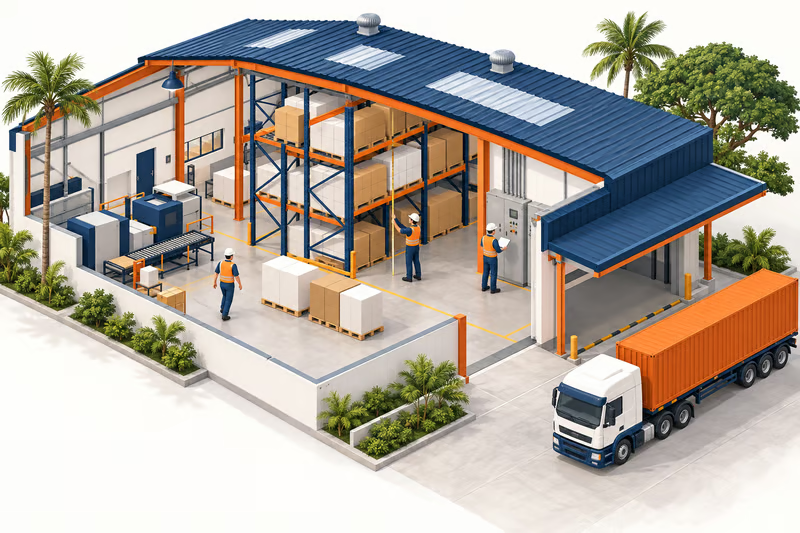
- Container access and turning circle. A 40-foot container must enter, turn and reverse onto the apron. Older small-lot estates in the central belt frequently cannot take one.
- Bumiputera quota and the minimum price. Confirm before you make an offer, not when your lawyer runs the title search.
How we work with overseas buyers and tenants
We co-broke with agents across the whole market to source stock, but we do not take the requirement second-hand.
The first step is always a meeting with the people who will actually use the building, in person or online: output plans, what the process demands in power and floor loading, clear height, container frequency, budget, timeline, and which entity will hold or sign. A brief relayed through several parties is usually already distorted, and searching against a distorted brief wastes everyone's time.
Only once the requirement is confirmed do we start matching across the market, our own listings and co-broked stock together, and present only what meets the hard criteria. On inspections we verify the six points above with you, and before any offer we map out the state consent, licensing and tax timeline so you know how long it actually takes from signing to occupation.
For companies new to Malaysia, the expensive mistake is rarely overpaying. It is choosing the wrong area or missing an approval condition and having to start again several months later.
Adam: +60 17-672 9873 · Yuki: +60 16-772 4476
FAQ
Can a foreign company buy a factory or industrial land in Malaysia?
Yes, subject to three conditions: meeting the minimum price (RM3,000,000 in Selangor for industrial buildings; Kuala Lumpur is a Federal Territory where the industrial category is assessed case by case); obtaining state consent, which is triggered at 51% or more foreign shareholding; and the property not being Malay Reserved Land, a Bumiputera quota unit or low-cost factory stock. Manufacturers licensed by MITI or formally exempt can generally acquire industrial property without separate EPU approval.
Does a foreign company need government approval to rent a factory in Malaysia?
Not for a tenancy of three years or less. It is not registered on the title and does not trigger state consent, so occupation follows once terms are agreed. A lease over three years must be registered on the title, takes about two months, and requires state consent where foreign shareholding is 51% or more.
What is the minimum price for a foreigner to buy industrial property in Selangor?
RM3,000,000 for industrial buildings across Zones 1, 2 and 3, set by the state circular dated 28 August 2014 and applying to sale and purchase agreements dated 1 September 2014 onward. Property below that value is not open to foreign acquisition, and applications go through LPHS. Kuala Lumpur is a Federal Territory where consent runs through the federal Economic Planning Unit instead; the RM1,000,000 figure commonly quoted is clearest for residential, and the industrial category is assessed case by case, so confirm with the land office and your conveyancing lawyer.
Do foreigners pay 8% stamp duty on a factory in Malaysia?
No. Foreign buyers pay a flat 4% transfer stamp duty on factories, warehouses and industrial land. The 8% flat rate applies to residential property only, so industrial is 4% versus 8% for homes.
Should a foreign manufacturer rent or buy first in Malaysia?
Renting first is usually better. A sub-three-year tenancy needs no approval and gets you operating quickly, which lets you verify that the area's power, labour and logistics actually fit your process before committing capital to a location.
What licence does a foreign company need to manufacture in Malaysia?
Under ICA 1975, a manufacturing company with shareholders' funds of RM2.5 million or more, or 75 or more full-time employees, needs a manufacturing licence from MITI, processed by MIDA. Below both thresholds you may apply for exemption and receive an ICA10 confirmation letter.
How much tax is payable when selling?
RPGT tapers by holding period: for companies 30% (years 1 to 3), 20% (year 4), 15% (year 5), 10% from year 6. For foreigners it is 30% for years 1 to 5 and 10% from year 6. Foreign parties do not drop to 0% the way citizens do.
How long does the whole purchase take?
Typically three to six months from selecting the property to completion, driven mainly by the state consent timeline. Renting is much faster: days to weeks for a tenancy under three years, about two months for a registered lease.
Can a company with 100% foreign shareholding do this?
A Sdn Bhd permits 100% foreign ownership, with local equity requirements in specific sectors such as agriculture, banking, education and oil and gas. For incorporation steps, licences and Employment Pass capital rules, see Starting a business in Malaysia as a foreigner (2026). Note that 51% or more foreign shareholding triggers state consent when buying, which needs to be built into your timeline.
Which areas suit overseas manufacturers?
It depends on the binding constraint. Heavy power and large plots: Telok Panglima Garang, Jenjarom and Banting, which have the lowest rates and the deepest heavy-power stock. Port-driven export: Port Klang and Kapar. Labour-dependent light industry and assembly: Shah Alam and Subang. See best area to buy a factory in Selangor.
Regulatory content compiled August 2026 from the National Land Code, the published acquisition guideline, ICA 1975 and LHDN's RPGT schedule, for the purpose of explaining the process. Thresholds and rates change and individual cases differ, so confirm with the state authority, MIDA/MITI and a licensed conveyancing lawyer before committing.
Can foreigners buy a factory in Selangor?
Yes, a foreign company can buy a factory in Selangor, but only at or above the state minimum price of RM3,000,000 for industrial buildings in Zones 1, 2 and 3. Only companies with 51% or more foreign shareholding need to apply for state consent, and applications go through LPHS (Lembaga Perumahan dan Hartanah Selangor).
Can a foreign company buy a factory in Malaysia?
Yes, a foreign company can buy a factory in Malaysia, but it must meet state-level minimum price thresholds and obtain state consent where foreign shareholding is 51% or more. In Selangor, industrial buildings in Zones 1, 2 and 3 require a minimum price of RM3,000,000, and foreign buyers pay a flat 4% transfer stamp duty on industrial property. Manufacturing companies licensed by MITI, or formally exempt from licensing, are generally able to acquire industrial property without separate EPU approval.
Factories and Warehouses in Port Klang
Live listings with power, ceiling height and floor loading for every unit: