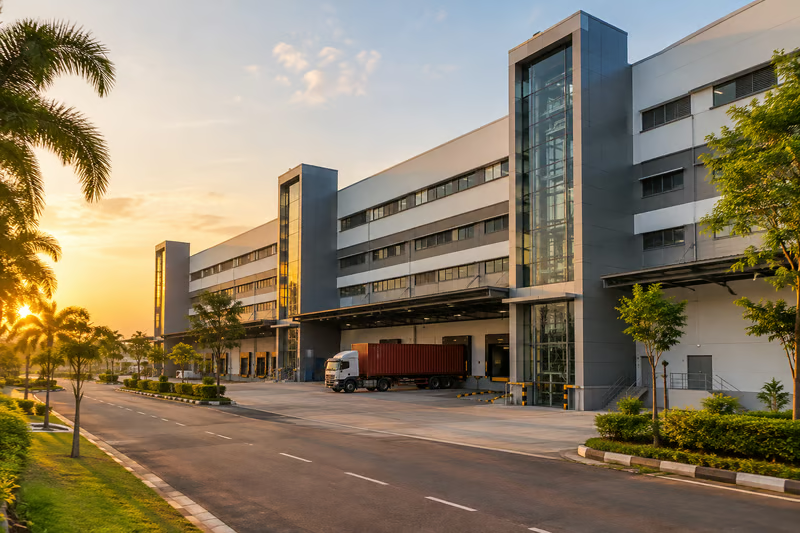
Industrial Property Loan Malaysia 2026: Factory Loan Rates, Margin & Monthly Instalment
How much you can borrow for a factory in Malaysia and at what rate: company loans priced off BR, BLR or cost of funds, published margins and tenures at five lenders, Islamic and MIDF options, and a worked RM4.9 million instalment and cash example.
Key Takeaways
With an industrial property loan in Malaysia, how much you can borrow for a factory is typically 85% to 90% of the lower of price or bank valuation, over up to 30 years ending by age 70. SME packages that add working capital go further: OCBC lends companies up to 140% (capped at RM5 million) and CIMB up to 150%.
Industrial property loan interest rates in Malaysia have no single figure: a company buying a factory pays the bank's Base Rate, BLR or cost of funds plus a spread set for its own risk. Bank Negara's average lending rate was 4.50% in August 2026, and OCBC's own commercial property loan illustration works out to the same 4.50% a year.
- A factory loan taken by a company is priced off the bank's Base Rate (BR), BLR/BFR or cost of funds plus a spread. The Standardised Base Rate (SBR) applies only to loans to individuals.
- With the OPR at 2.75% (unchanged at the 3 September 2026 meeting), Base Rates at ten major banks run from 2.75% to 3.75% and BLR/BFR from 6.40% to 6.64%. The average lending rate on all commercial bank loans was 4.50% in August 2026.
- Banks publish maximum margins of 85% to 90% for commercial and industrial property and tenures of up to 30 years, usually ending by the borrower's age 70. SME packages with working capital reach 140% to 150%, and MIDF lends SMEs up to 100% at 4% a year over up to 10 years.
- On a RM4.9 million semi-detached factory (the median in JPPH-registered deals in Selangor and Kuala Lumpur) with an 80% loan over 25 years, the instalment is about RM21,236 a month at 4.25% and RM21,789 at 4.50%.
- Budget roughly 26% of the price in cash for that purchase: the 20% deposit plus transfer stamp duty, loan stamp duty and two sets of legal fees.
A factory loan in Malaysia is not priced like a housing loan. If your Sdn Bhd is the borrower, the bank prices the loan off its Base Rate, BLR/BFR or cost of funds plus a spread set case by case; the SBR only applies to individuals. In October 2026, banks lend up to 85% to 90% of value on a plain property loan, more on SME packages that bundle working capital, and tenures run up to 30 years.
Below: the rates banks publish today, how much you can borrow on different factory types, the Islamic and development bank options, the documents a credit officer asks for, a worked instalment example and the cash you need on top of the deposit. This guide is general information, not legal, tax or financial advice.
Factory Loan Interest Rates in 2026: How Banks Price Them
Since August 2022, Bank Negara Malaysia has required banks to price new floating-rate loans to individuals off the Standardised Base Rate, which moves only with the OPR. Loans to SMEs and companies were left out of that change. So when a Sdn Bhd buys a factory, the facility is priced against one of these instead:
- Base Rate (BR): each bank's own reference rate for business lending.
- Base Lending Rate (BLR) or Base Financing Rate (BFR): the older, higher benchmark, still used for many SME term loans, usually quoted as "BLR minus x%". OCBC, for example, states that its company commercial property loans are referenced against its BLR of 6.51%.
- Cost of funds (COF): common for larger corporate facilities, where the spread is negotiated on top of the bank's funding cost.
The spread above the reference rate is where your company's risk shows up. Audited profits, existing borrowings, the property's age and title, and the size of the loan all move it. That is why two companies buying similar factories in the same park can get rates that differ by half a percentage point or more.
Reference rates at major Malaysian banks (October 2026)
The OPR has been 2.75% since Bank Negara Malaysia's 9 July 2025 decision and was held again on 3 September 2026. Every bank below revised its reference rates between 11 and 17 July 2025 and has not moved them since. Each figure links to the bank's own rates page.
| Bank | Base Rate (BR) | BLR / BFR |
|---|---|---|
| Maybank | 2.75% | 6.40% |
| Public Bank | 3.27% | 6.47% |
| RHB | 3.50% | 6.45% |
| Alliance Bank | 3.57% | 6.42% |
| OCBC | 3.58% | 6.51% |
| AmBank | 3.60% | 6.45% |
| UOB | 3.61% | 6.57% |
| Hong Leong Bank | 3.63% | 6.64% |
| Affin | 3.70% | 6.56% |
| CIMB | 3.75% | 6.60% |
These are reference rates, not offers. What you actually pay is the reference rate plus your spread. Two published numbers show where the market sits: OCBC's commercial property loan page illustrates a RM500,000 loan over 10 years at RM5,181.92 a month, which works out to 4.50% a year, and the average lending rate on all outstanding commercial bank loans was 4.50% in August 2026 (BNM table 2.1). We keep the live table, with bank-by-bank notes, on the commercial and factory loan rates page.
When will rates move? Bank Negara's next Monetary Policy Committee decision is on 5 November 2026. If the OPR changes, banks usually move BR and BLR by the same amount within about a week, and a floating-rate factory loan reprices with them.
Does the SBR ever apply to a factory loan?
Yes, if you buy the factory in your own name rather than through a company. Some banks then price the commercial property loan off SBR plus a spread; OCBC, for example, states on its commercial property loan page that it prices all new retail loans off the SBR, which has been 2.75% since July 2025, and lends individuals up to 85% of value or RM4 million, whichever is lower. Most owner-operators still buy through the company, because the business is what services the loan. If you are weighing the two, ownership also changes what you pay when you sell: our RPGT guide for factory owners compares individuals and companies.
How Much Can You Borrow? Margin of Finance and Tenure
What the banks themselves publish, checked on their product pages in October 2026:
| Product | Who it is for | Margin of finance | Tenure |
|---|---|---|---|
| CIMB BizLoan | Individuals buying commercial or industrial property | Up to 90%, including MRTA/MLTA, legal and valuation fees (fees capped at 5%) | 5 to 30 years or age 70, whichever is earlier |
| Alliance Commercial Property Loan / Financing-i | Individuals | Up to 85% plus 5% for credit insurance or entry costs | Up to 30 years or age 70 |
| OCBC Commercial Property Loan | Companies (SSM registered) | Up to 140% of value or price, or RM5 million, whichever is lower | Per letter of offer |
| CIMB SME Biz Property Financing | SMEs; covers commercial, industrial and vacant land | Up to 150% for property plus working capital, up to RM20 million | Per letter of offer |
| MIDF SME Transformation Financing | SMEs with 60% Malaysian equity and turnover above RM200,000 | Up to 100%, RM100,000 to RM5 million, at 4% a year for commercial property | Up to 10 years |
| Item | What decides your number |
|---|---|
| Margin of finance | Lower of price or bank valuation, company financials, property type and title |
| Working capital packages above 100% | Strong cash flow and the property as security; the extra above the price is working capital, not a bigger property loan |
| Tenure | Usually ends by the borrower's (or key guarantor's) age 70; older buildings and short leases get less |
| Lock-in period | OCBC charges 2% of the facility limit if you fully settle inside the lock-in; other banks set their own terms in the letter of offer |
Three points catch first-time industrial buyers:
- The bank lends on the lower of price or valuation. If you agree RM5 million and the panel valuer says RM4.6 million, an 85% margin is 85% of RM4.6 million. The gap comes out of your pocket. Read our guide on how factories are valued before you sign an offer.
- The 70% loan-to-value limit you may have heard of is a housing rule. Bank Negara's 70% cap applies to an individual's third housing loan, not to commercial or industrial property. Commercial margins are set by each bank's own credit policy.
- Bare industrial land is harder to finance than a completed factory. Some banks decline vacant land or offer a lower margin and shorter tenure, although CIMB's SME package does list vacant land as eligible. A completed building with a Certificate of Completion and Compliance is the easiest asset to finance.
How much can I borrow on a typical Selangor factory?
Using the median prices in JPPH-registered transactions over the 24 months to August 2026 (Selangor and Kuala Lumpur), and the August 2026 average lending rate of 4.50% over 25 years:
| Factory type (registered median price) | 80% loan | Monthly at 4.50%, 25 years | 90% loan | Monthly at 4.50%, 25 years |
|---|---|---|---|---|
| Terrace factory (RM1.17 million) | RM936,000 | RM5,203 | RM1,053,000 | RM5,853 |
| Semi-detached factory (RM4.9 million) | RM3,920,000 | RM21,789 | RM4,410,000 | RM24,512 |
A terrace factory at the median price needs about RM117,000 to RM234,000 as a deposit; a semi-detached unit needs RM490,000 to RM980,000. Banks will usually want the instalment covered comfortably by your operating profit, so check your audited figures against these numbers before you make an offer.
Which Factories Are Easiest to Finance?
Credit committees do not treat every industrial asset the same. The more comparable sales a valuer can find, the easier the approval.
| Property type | How banks usually see it | What to check before you apply |
|---|---|---|
| Terrace and cluster factories in managed parks | The most comparable sales, so the easiest to value, finance and resell | Individual or strata title, and the park's maintenance charges |
| Semi-detached factories | The common owner-occupier purchase; plenty of comparables in established parks | Yard depth, loading bay and whether a 40-foot trailer can turn inside |
| Detached factories | Fewer comparables, so valuations are more subjective and approval can take longer | Power supply, eaves height and any unapproved extensions |
| Warehouses and logistics buildings | Valued on clear height, column grid and docks; larger lots compete with institutional buyers | Floor loading and fire certificate for high racking |
| Strata industrial units | Some banks are cautious; ask before you sign | Strata title status, deed of mutual covenant, maintenance charges and sinking fund |
| Older buildings (20 years and more) | Shorter tenure and sometimes a lower margin | Roof, slab and structural condition, and whether the CCC or CF covers the current layout |
| Units without an individual title yet | Financed by assignment rather than a registered charge; some banks are stricter | Master title, developer consent and the deed of assignment chain |
| Vacant industrial land | The hardest; some banks decline it | Land category, express conditions and the development plan |
Valuers also look at what makes a factory usable: the TNB supply already on site, flood history, road access for heavy vehicles and whether the zoning suits your industry. If your process needs a lot of power, check the connected load first with the factory power calculator, because a supply upgrade can take months.
Islamic Financing and Development Banks: Other Ways to Fund a Factory
Islamic financing works the same way in practice. Most banks sell a Shariah-compliant version of their property loan, such as CIMB's SME Biz Property Financing-i and Alliance's Commercial Property Financing-i. The profit rate is set against the bank's Islamic Base Rate or Base Financing Rate, and at the banks we checked these sit at the same level as the conventional ones: Maybank publishes BR and Islamic Base Rate at 2.75% and BLR and BFR at 6.40%, and Hong Leong publishes BR and Islamic Base Rate at 3.63% and BLR and Islamic Financing Rate at 6.64%. Non-Muslim business owners can apply too.
MIDF is the development finance option. MIDF's SME Transformation Financing lists 4% a year on monthly rest for commercial property, up to 100% margin and RM100,000 to RM5 million, over up to 10 years. The shorter tenure means a much higher instalment than a 25 year bank loan, and the scheme is aimed at businesses that are also investing in automation, digitalisation or ESG. Eligibility includes at least 60% Malaysian equity, annual sales above RM200,000 and a valid business premises licence, and MIDF asks for three years of audited accounts.
Worked Example: Monthly Instalment on a RM4.9 Million Factory
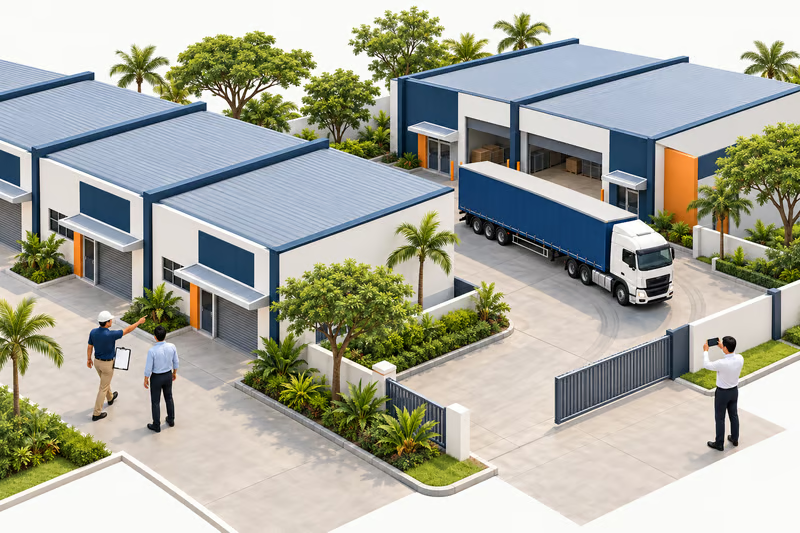
The median price of a semi-detached factory in JPPH-registered transactions in Selangor and Kuala Lumpur, over the 24 months to August 2026, was RM4.9 million (RM375 psf of land on a median 12,350 sq ft lot). Take that as the purchase price, an 80% loan of RM3,920,000 and three rates: 4.25% for a strong borrower, 4.50% (the August 2026 average lending rate) and 5.00% for a higher spread.
| Rate | 20 years | 25 years | 30 years |
|---|---|---|---|
| 4.25% | RM24,274 / month | RM21,236 / month | RM19,284 / month |
| 4.50% | RM24,800 / month | RM21,789 / month | RM19,862 / month |
| 5.00% | RM25,870 / month | RM22,916 / month | RM21,043 / month |
Over 25 years at 4.50%, total interest comes to about RM2.62 million. Stretching to 30 years cuts the instalment by roughly RM1,930 a month but adds about RM614,000 of interest. A 0.25 percentage point difference in spread (4.25% versus 4.50%) is worth about RM550 a month, or nearly RM166,000 over 25 years, which is why it pays to get at least three banks to quote.
Run your own price, margin, rate and tenure in the factory and commercial loan calculator. It uses the same instalment formula as the bank.
The cash you need on top of the deposit
Using the same RM4.9 million purchase and RM3.92 million loan:
| Item | How it is calculated | Amount |
|---|---|---|
| Deposit (20%) | Price minus loan | RM980,000 |
| Stamp duty on the transfer (MOT) | 1% / 2% / 3% / 4% scale | RM180,000 |
| Stamp duty on the loan agreement | SME borrower: 0.05% on the first RM250,000, 0.25% up to RM1 million, 0.5% above (RM19,600 at a flat 0.5% for a non-SME) | RM16,600 |
| SPA legal fee (scale) | 1.25% on the first RM500,000, 1% on the rest up to RM7.5m | RM50,250 |
| Loan agreement legal fee (scale) | Same scale on the loan amount | RM40,450 |
| Total before service tax, valuation and disbursements | RM1,267,300 |
The transfer duty follows item 32(a) of the Stamp Act 1949 as set out in LHDN's stamp duty guideline; the loan duty follows item 27(a) of the Stamp Act 1949, where the lower SME rates apply to the aggregate loans the SME takes in a calendar year. Legal fees follow the Solicitors' Remuneration Order 2023 and attract 8% service tax; paragraph 6 of the Order allows a discount of up to 25% on the scale fees for both the SPA and the loan agreement. Valuation, processing and land office disbursements come on top. The legal fees and stamp duty calculator works these out for any price, and our stamp duty guide for factory buyers explains each duty.
Documents Banks Ask For on a Factory Loan
Credit officers underwrite two things at once: your company and the building. Having both packs ready shortens approval by weeks.
Company documents
- SSM company profile, constitution (if any), and a board resolution to borrow and charge the property.
- Audited accounts for the last two to three years, plus the latest management accounts. CIMB's SME property package asks a Sdn Bhd for three years of audited and management accounts.
- Six months of bank statements for the operating accounts.
- Latest income tax return and the list of existing facilities with all banks.
- Directors' identity documents and consent for CCRIS and CTOS checks. Most banks ask for directors' personal guarantees on SME loans.
Property documents
- Letter of offer or signed SPA, and the seller's title search.
- Title category and express conditions. Under the National Land Code, land use falls into agriculture, building or industry. A factory on land still categorised for agriculture, or with an express condition that does not allow your activity, is a serious lending problem. Leasehold titles also need the remaining lease term and, often, state consent to transfer and charge.
- Approved building plans and the CCC (or the Certificate of Fitness for older buildings). Unapproved extensions reduce the valuation and can block the loan. Our CCC guide for factory buyers covers what to check.
- Latest quit rent and assessment receipts, and the TNB supply details if your process needs high power.
- For strata factories: the strata title status, maintenance charges and sinking fund statement.
Factory loan readiness checklist
- Two to three years of audited accounts that show the instalment is affordable from operating profit
- Existing borrowings listed and CCRIS clean, or explained
- Indicative valuation obtained before you sign the SPA
- Title category is industry (perusahaan), with no express condition against your use
- CCC or CF and approved plans match what is on site
- Remaining lease term checked if leasehold
- Quotes from at least three banks on rate, margin, lock-in and fees
The full list of searches to run on the property itself is in our factory due diligence checklist.
Why Factory Loans Get Stuck, and What to Do
- Valuation below the price. Get an indicative valuation before you sign, and make the SPA conditional on loan approval.
- Unapproved extensions or no CCC. Ask the seller for the approved plans early, not in the week before completion.
- Wrong land category or a restrictive express condition. Run a title search before you pay the earnest deposit.
- Short remaining lease. The shorter the lease left, the lower the margin and tenure the bank offers.
- A new company with no track record. Expect directors' guarantees, a lower margin, or a request to put the loan under a guarantee scheme.
- Undisclosed borrowings. CCRIS shows every facility, so declare them all at the start.
Company or Personal Name: Which Should Buy the Factory?
The choice changes how the loan is priced, how it is assessed and what tax you pay later. Through a company, the bank looks at the company's accounts and cash flow, prices the loan off BR, BLR or cost of funds, and the company pays the instalment from the business that uses the building. In your own name, some banks price off SBR plus a spread, but they assess your personal income and debts and want the loan repaid by about age 70. On sale, the RPGT rates published by LHDN are nil for a Malaysian citizen or permanent resident who sells in the sixth year or later, while a Malaysian company still pays 10% from the sixth year (30% within three years for both). Our RPGT guide for factory and industrial land sellers works through examples; decide the structure with your accountant.

From Offer to Drawdown: The Factory Loan Timeline
- Indicative valuation and in-principle approval. Before you commit, get a sense of what the bank's panel valuer will say and ask the bank for an in-principle view on your company. Sellers take an offer more seriously when the financing is pre-cleared.
- Letter of offer and earnest deposit. Keep it conditional on a satisfactory title search, valuation and loan approval.
- SPA. The SPA normally gives a conditional period for due diligence and financing, then a completion period. Leasehold land that needs state consent, strata titles still being issued and master titles can need much longer than an individual freehold title, so build the buffer into the completion date.
- Formal submission. Full document pack, panel valuation and credit assessment, then the letter of offer. Allow a few weeks.
- Facility agreement. Check the spread, lock-in, prepayment and default clauses before signing. The agreement is stamped under item 27(a) of the Stamp Act: 0.5% of the loan, or the lower SME scale shown above.
- Disbursement and completion. The bank releases the loan against the transfer and the charge being presented for registration.
- Handover. Transfer the TNB and water accounts, settle apportioned quit rent and assessment, and put fire insurance in place with the bank named as loss payee. Insure the building at rebuilding cost rather than the loan amount, and insure machinery and stock separately: see our factory fire insurance guide and whether the bank's fire policy is enough.
Government Guarantee Schemes for SME Buyers
Younger companies, or those short of collateral, can ask the bank whether the loan can sit under a government guarantee. Syarikat Jaminan Pembiayaan Perniagaan (SJPP) lists the Government Guarantee Scheme MADANI 2026 (GGSM4) among its 2026 schemes, covering working capital and capital expenditure for majority Malaysian-owned businesses. Guarantees are applied for through participating banks, not directly, and SJPP does not state whether a premises purchase qualifies, so ask your banker before you plan around it. Credit Guarantee Corporation (CGC) also runs guarantee schemes with banks; terms change often, so check the current scheme sheet.
Frequently Asked Questions
What is the interest rate for a factory loan in Malaysia in 2026?
There is no single rate. A company's factory loan is priced off the bank's Base Rate, BLR/BFR or cost of funds plus a spread. In October 2026, Base Rates at ten major banks run from 2.75% to 3.75% and BLR from 6.40% to 6.64%, and the August 2026 average lending rate on all commercial bank loans was 4.50%.
Is a factory loan priced off the SBR?
Only if you borrow as an individual. Since August 2022 the SBR has applied to floating-rate loans to individuals. Loans to a Sdn Bhd or other business are priced off BR, BLR/BFR or cost of funds.
How much can I borrow to buy a factory?
Banks publish maximums of 85% to 90% of the lower of price or valuation, and some SME packages that include working capital go to 140% (OCBC, capped at RM5 million) or 150% (CIMB). Your actual margin depends on your company's financials, the property and its title, so plan for a 10% to 20% deposit at minimum.
What is the maximum tenure for a factory loan?
The banks we checked publish tenures of up to 30 years, ending by the time the borrower or main guarantor turns 70. Older buildings and leaseholds with a short remaining term usually get shorter tenures, and MIDF's SME scheme runs up to 10 years.
What is the monthly instalment on a RM4 million factory loan?
At 4.25% over 25 years, a RM4 million loan costs about RM21,670 a month; at 4.50% it is about RM22,233. Use the factory loan calculator to test your own rate and tenure.
Can I get a loan for industrial land without a building?
Some banks will, on a lower margin and shorter tenure, and some decline vacant land outright; CIMB's SME Biz Property Financing lists vacant land as eligible. A completed factory with a CCC and an industry land category is much easier to finance.
Will the OPR decision on 5 November 2026 change my factory loan rate?
If the OPR moves, banks usually adjust BR and BLR by the same amount within about a week, and floating-rate factory loans reprice with them. Fixed-rate tranches, where offered, do not change until the fixed period ends.
Are OPR and SBR the same?
No, the OPR and the SBR are not the same. The SBR is the Standardised Base Rate that banks must use to price new floating-rate loans to individuals, and it moves only with the OPR, which has been 2.75% since Bank Negara Malaysia's 9 July 2025 decision. Loans to SMEs and companies are priced off the bank's Base Rate, BLR/BFR or cost of funds instead.
What is a normal interest rate on a commercial loan in Malaysia in 2026?
The average lending rate on all outstanding commercial bank loans was 4.50% in August 2026, and OCBC's own commercial property loan illustration works out to 4.50% a year. These are averages and examples, not offers, so what you actually pay depends on your company's risk. You can see the live bank by bank table on the commercial and factory loan rates page.
Is there Islamic financing for buying a factory?
Yes. Most banks offer a Shariah-compliant version of their property loan, such as CIMB SME Biz Property Financing-i and Alliance Commercial Property Financing-i, priced off the Islamic Base Rate or Base Financing Rate. At the banks we checked these sit at the same level as the conventional rates, and non-Muslim owners can apply.
Does MIDF finance factory purchases?
MIDF's SME Transformation Financing covers commercial property at 4% a year on monthly rest, up to 100% margin and RM100,000 to RM5 million, over up to 10 years. It is for SMEs with at least 60% Malaysian equity and sales above RM200,000, and is aimed at businesses investing in automation, digitalisation or ESG.
How much stamp duty is there on a factory loan agreement?
Under item 27(a) of the Stamp Act 1949, a loan agreement is stamped at 0.5% of the loan. An SME borrower pays less: 0.05% on the first RM250,000 and 0.25% up to RM1 million of its loans in the calendar year, then 0.5%. On a RM3.92 million loan that is RM16,600 instead of RM19,600.
Ready to shortlist? See factories for sale in Selangor, or send us your budget and specification through find me a factory and we will match options across the market.
Buying or renting, talk to us
Send us the numbers that decide the shortlist: required amps, built-up area, floor loading, preferred area and target date. We reply with what actually exists, including units that are not advertised publicly. For 800A to 4,000A+ requirements, see high-power factories in Selangor.
| Agent | Licence | Mobile / WhatsApp | |
|---|---|---|---|
| Adam | 60176729873 | +60 17-672 9873 | |
| Yuki | 60167724476 | +60 16-772 4476 |
Factories and Warehouses in Port Klang
Live listings with power, ceiling height and floor loading for every unit: