TNB Substation for a Factory: Types, When You Need One, Land, Cost and Timeline
TNB substation types compared by the load each serves, from compact units up to 1,000 kVA to 11kV switching stations. Plus the 350 kVA (about 505A) threshold, the land you give TNB, connection charges, siting rules and lead times.
Key Takeaways
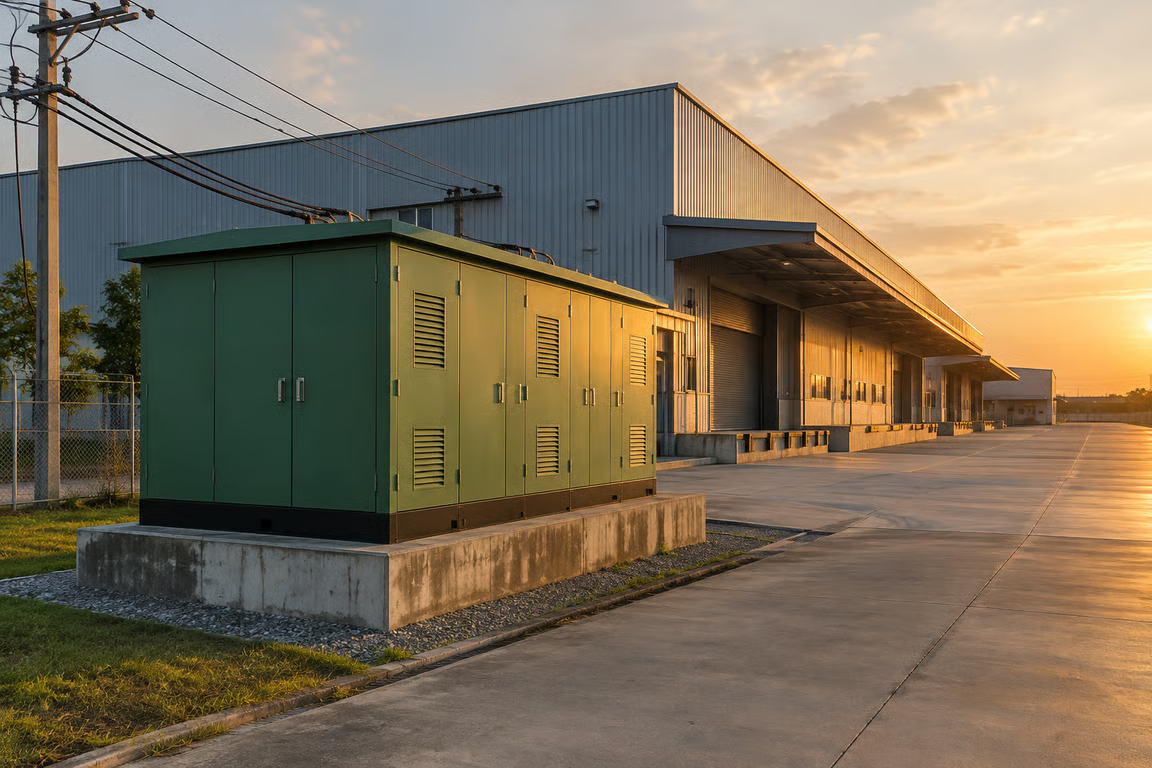
A TNB substation is the Tenaga Nasional Berhad installation that steps 11kV (sometimes 22kV or 33kV) down to the 400V and 230V a factory uses. A factory needs a new one once its maximum demand passes 350 kVA, about 505A at 400V, and it gives the substation land to TNB for a nominal RM10.
- Under TNB's Electricity Supply Application Handbook (ESAH 3.1), a factory with maximum demand above 350 kVA (about 505A at 400V) must be fed from a new substation. From 1,000 kVA (about 1,440A), supply moves to 11kV and you own the transformers.
- Between 100 kVA and 350 kVA (about 145A to 505A), TNB decides after a system study. Any load above 100A must be applied for by a BEM-registered Electrical Consultant Engineer.
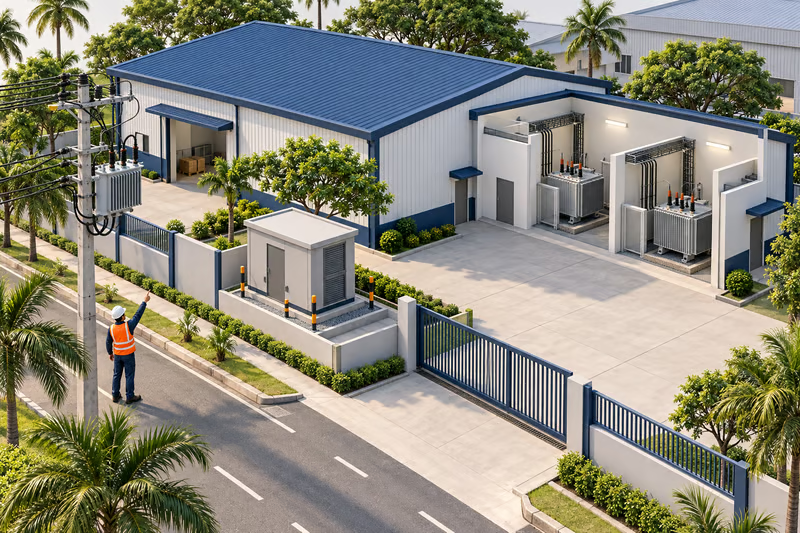
- A TNB compact substation for industry goes up to 1,000 kVA on a standard 7m x 5m plot, and for applications after 22 November 2024 TNB builds the plinth at its own cost. An indoor substation building is 7.6m x 5.7m (single chamber) or 10.6m x 5.7m (double).
- The substation land goes to TNB for a nominal RM10, and TNB may use it to supply neighbours. Connection charges run from RM4,050 to RM38,250 for low-voltage loads of 61kW to 850kW, and RM45 per kW of declared demand at medium voltage.
- TNB's typical lead time is 3 to 12 months for 400V with a new substation, 6 to 12 months at 11kV and 18 months to 2 years at 33kV.
Does an 800A or 1,000A factory need its own TNB substation? Usually yes. TNB's Electricity Supply Application Handbook (ESAH 3.1) requires supply from a new substation once a factory's maximum demand exceeds 350 kVA (about 505A at 400V), so a factory drawing 800A (about 554 kVA) or 1,000A (about 693 kVA) normally needs one, while loads of 100 to 350 kVA are decided by TNB after a system study. A TNB compact substation of up to 1,000 kVA needs a standard 5m x 7m plot under TNB's current CSU guideline, an indoor substation building 7.6m x 5.7m (single chamber), and the land is handed to TNB for a nominal RM10. TNB's typical lead time for 400V supply with a new substation is 3 to 12 months, and for any load above 100A the application must be submitted by an Electrical Consultant Engineer registered with the Board of Engineers Malaysia.
Where the rules come from
Two TNB documents govern this in Peninsular Malaysia: the Electricity Supply Application Handbook, Version 3.1 (ESAH, the current edition on TNB's website), which sets supply schemes, substation types, land sizes and lead times; and the Connection Charge Book (2025 edition, terms approved by the Energy Commission from 15 January 2021), which sets what you pay. TNB's Substation Design Booklet, Edition 2.0 (2024) adds the standard layouts and where a substation may be placed. Where they say "subject to system capability study by TNB", the final answer for your site comes from TNB through your consultant.
When does a factory need a TNB substation?
TNB plans supply around maximum demand (MD), the highest load your factory draws, declared in kVA or kW. Buyers and tenants talk in amps, so the table converts each ESAH band to amps at 400V three-phase (amps = kVA x 1,000 / (1.732 x 400)).
| Maximum demand (ESAH Table 3-1) | Approx. amps at 400V | Supply voltage | Minimum supply scheme |
|---|---|---|---|
| Up to 100 kVA (non-domestic) | Up to about 144A | 400V | Cable from the existing low-voltage network, subject to TNB study |
| Above 100 kVA to 350 kVA | About 145A to 505A | 400V | Underground cable from a feeder pillar or a new or existing substation, subject to TNB study |
| Above 350 kVA to 1,000 kVA | About 505A to 1,440A | 400V | Direct underground cable from a new substation |
| 1,000 kVA to below 5,000 kVA | Above about 1,440A | 11kV | Fed through a TNB 11kV switching station; land for a main distribution substation (PPU) may be needed |
| 5,000 kVA to 25,000 kVA | n/a | 33kV | Fed through a TNB 33kV switching station; land for a main intake (PMU) may be needed |
| 25,000 kVA to below 100,000 kVA | n/a | 132kV or 275kV | Fed from a TNB 132kV or 275kV substation |
(A 22kV scheme also exists but is being phased out for 33kV.) Three practical points follow:
- About 500A is the real dividing line. Below 350 kVA, TNB may supply you from what is already in the street. Above it, you need a new substation, so land and a building become part of your project.
- About 1,440A ends low-voltage supply. The charge book says loads above 1,000 kVA (850 kW) must take medium voltage, so you buy and maintain your own 11kV switchgear and transformers.
- 100A changes who applies. Up to 100A, a registered electrical contractor applies on the myTNB portal. Above 100A, an Electrical Consultant Engineer registered with the Board of Engineers Malaysia (BEM) must apply.
TNB requires a power factor of at least 0.85 below 132kV, so 1,000 kVA carries about 850 kW of real load. To turn a machine list into amps and kVA, use the factory power calculator. For typical amperage by industry and how to read an existing supply, see our TNB amperage guide for factories.
What is a TNB substation, and what are the types?
A substation changes electricity from one voltage to another. In TNB's network the levels run from the grid down to your switchboard, and the ESAH names four categories:
- Transmission Main Intake (Pencawang Masuk Utama, PMU): where the 132kV or 275kV transmission grid meets the distribution network (275/132kV, 132/33kV or 132/11kV). This is what people mean by a transmission substation.
- Main Distribution Substation (Pencawang Pembahagian Utama, PPU): 33/11kV, injecting capacity into the 11kV network.
- Main Switching Station (Stesen Suis Utama, SSU): at 33kV, 22kV or 11kV, either to supply one bulk consumer or to carry capacity to a load centre.
- Distribution Substation (Pencawang Elektrik, PE): steps 11kV (sometimes 22kV or 33kV) down to the 400V and 230V low-voltage network. Typical TNB ratings are 300, 500, 750 and 1,000 kVA. This is the "TNB substation" most factory owners deal with.
TNB substation types compared: the load each serves
The table puts each type a factory may meet next to the load range it serves, from ESAH 3.1 (Tables 3-1, 3-2 and 3-3), TNB's Substation Design Booklet, Edition 2.0 (2024) and TNB's CSU guidelines.
| Type | Voltage | Load range it serves | Land or building | Typical factory use |
|---|---|---|---|---|
| Compact substation (CSU), outdoor kiosk on a plinth | 11/0.4kV | Up to 1,000 kVA for commercial and industrial development (500 kVA for housing), subject to a matching metering kiosk | Land 7m x 5m (TNB's current CSU guideline; the ESAH table lists 7.0m x 4.0m) | TNB's first choice for new developments, for a 400V factory above 350 kVA |
| Indoor PE, single chamber (stand-alone building) | 11/0.4kV | One transformer, typical TNB ratings 300 to 1,000 kVA | Building 7.6m x 5.7m | Where a compact unit is not allowed, or TNB asks for a building |
| Indoor PE, double chamber (stand-alone building) | 11/0.4kV | Two transformers in two transformer rooms | Building 10.6m x 5.7m | Larger 400V loads or several consumers from one site |
| Attached PE (room in or against the factory) | 11/0.4kV | One or two transformers, to TNB layout | Room to TNB layout | Where land is tight; needs TNB-certified fire suppression and thermostat exhaust fans |
| Outdoor pole-mounted transformer | 11/0.4kV | No rating or land size given in the ESAH; check with TNB | n/a | Overhead low-voltage networks |
| 11kV Main Switching Station (SSU) | 11kV | Consumers taking 1,000 kVA up to below 5,000 kVA at 11kV | Building 7.6m x 5.7m | Feeds your own consumer substation, where you own the transformers |
| 33kV Main Switching Station (SSU) | 33kV | Consumers taking 5,000 to 25,000 kVA | Land about 30m x 30m | Large single plants |
| Main Distribution Substation (PPU) | 33/11kV | Developments above about 5 MVA (5,000 kVA), or as TNB requires | Land about 46m x 46m | Industrial parks and large estates |
| Transmission Main Intake (PMU) | 132kV or 275kV | Demand above 25,000 kVA | Land 60m x 80m to 160m x 150m | Very large plants and new townships |
Two things in the table matter most to a factory buyer or tenant. Between 350 kVA and 1,000 kVA you get a TNB distribution substation (usually a compact one) and stay a low-voltage customer. From 1,000 kVA you move to 11kV and become the owner of your own transformers, with TNB's switching station in front of them.
Compact units are TNB's standard for new developments, but the ESAH rules them out, in favour of an indoor substation, at sites marked for circuit breakers, places with more than two 11kV feeders, MSC status areas and inside attached substation buildings. They must sit near the load centre, away from a development's corners and from sewerage plants.
Bigger loads need much more land: about 30m x 30m for a 33kV switching station, 46m x 46m for a 33/11kV PPU, and 60m x 80m to 160m x 150m for a 132kV PMU. These exclude setbacks: on federal and state roads JKR requires 20.1m from the road centre plus 15.0m for a service road, and local authorities typically require a 6.1m building line.
Land and building you must give TNB
- Above 60 kW, you provide the land. The charge book says a load above 60 kW (about 100A) must provide land for a distribution substation (PE) and, where needed, a PPU. At 60 kW or below, TNB may still ask if the nearest substation cannot carry the load.
- Transfer or lease for RM10. The land is transferred or leased to TNB at a nominal RM10. Without an issued title, you give TNB a 12-month bank guarantee, renewed until the transfer or lease is registered.
- You build the building, TNB equips it. For a building-type substation you build to TNB's specification and hand over its Certificate of Completion and Compliance (CCC); TNB installs and commissions the equipment. For a compact substation applied for after 22 November 2024, TNB says you only hand over the land: TNB builds the plinth and installs the unit at its own cost.
- TNB can use it for others. The ESAH states that TNB has the right to use the substation to supply other consumers.
If you are buying industrial land in Port Klang to build, put the substation in the layout from day one. A 7m x 5m compact plot is small; a road setback or a 33kV switching station is not.
Who pays what: connection charge and capital contribution
What many still call a "capital contribution" is now the connection charge: a load charge on your declared MD, plus cable charges if the nearest supply that can meet your load is over 6km away, plus the full cost of special requests.
Low-voltage CT-metered supply, where the substation land and building go to TNB at RM10 or no substation is needed:
| Declared MD | Approx. amps (0.85 PF, 400V) | CT ratio | Connection charge |
|---|---|---|---|
| 61 to 90 kW | 104A to 153A | 150/5 | RM4,050 |
| 91 to 120 kW | 155A to 204A | 200/5 | RM5,400 |
| 121 to 180 kW | 205A to 306A | 300/5 | RM8,100 |
| 181 to 240 kW | 307A to 408A | 400/5 | RM10,800 |
| 241 to 360 kW | 409A to 611A | 600/5 | RM16,200 |
| 361 to 480 kW | 613A to 815A | 800/5 | RM21,600 |
| 481 to 600 kW | 817A to 1,019A | 1000/5 | RM27,000 |
| 601 to 720 kW | 1,021A to 1,223A | 1200/5 | RM32,400 |
| 721 to 850 kW | 1,224A to 1,443A | 1500/5 | RM38,250 |
Medium voltage (11kV, 22kV, 33kV) is RM45 per kW of declared MD, so declaring 2,000 kW means a load charge of RM90,000 before extras. High voltage (132kV and above) uses TNB's "first principle" method: you cover the gap between TNB's project cost and 15 years of electricity revenue. An upgrade pays the difference between the new and existing load charge.
On top of the connection charge, the applicant pays for:
- The substation land (transferred for RM10, but lost to you) and, for a building-type substation, the building. For compact substations applied for after 22 November 2024, TNB builds the plinth itself.
- Cable trenching to your main switchroom and the metering panel. TNB lays service cable up to 30m from its 11kV or 33kV substation; beyond that you pay (for example RM149 per metre for 240mm² 11kV underground cable).
- At 11kV and above, your own switchgear, transformers and protection.
- TNB-certified fire suppression for an attached substation.
- Special requests or local authority conditions beyond TNB's standard, such as horizontal directional drilling or a second dedicated feeder.
- Consultant and contractor fees, and a deposit of about two months' bill (bank guarantee encouraged above RM2,000).
Medium-voltage customers carry two post-supply risks. The Connected Load Charge (CLC) runs for 6 years after a new connection (5 after an upgrade): if recorded MD falls below the reference (85% of the declared yearly MD in years 1 to 4, 75% of the final MD in years 5 and 6), TNB charges RM8.50 per kW of shortfall each month. Declaring 2,000 kW and running 1,200 kW in year 5 is a 300 kW shortfall against 1,500 kW, or RM2,550 that month. Liquidated damages apply if you fail to take supply or terminate within 5 years. Do not over-declare.
How to apply for TNB supply and build a substation: step by step
For loads above 100A, ESAH runs two parts. In Part A, your development plan goes to the local authority or One Stop Centre; TNB comments within up to 14 days per stage and agrees the substation number, size and location with your consultant. Part B is the TNB application:
- Appoint one BEM-registered Electrical Consultant Engineer by letter.
- The consultant applies via the myTNB portal and the local TNB office with the ESAH Appendix 4 checklist: total load in kW, site plan with the substation site, substation layout, single line diagram, switchroom layout, motor loads, power quality declaration, Borang A for the substation land and the title copy.
- TNB checks the documents and runs a system study.
- A joint meeting fixes the substation, cable route and metering.
- TNB issues a Notice of Connection Charges and you pay.
- Large projects may sign an Electricity Infrastructure Agreement.
- You complete and hand over the substation; TNB installs and commissions the equipment.
- Your Energy Commission-registered electrical contractor applies for the meter.
- TNB energises supply.
Typical TNB lead times (ESAH 1.3.5), assuming no delay in local authority approval:
| Voltage level | Typical supply project lead time |
|---|---|
| 400V and below, no substation | Less than 3 months |
| 400V and below, with substation | 3 to 12 months |
| 11kV | 6 to 12 months |
| 33kV | 18 months to 2 years |
| 132kV and above | 3 to 5 years (fast track 12 to 24 months on conditions) |
Where TNB wants the substation on a factory lot
TNB's 2024 Substation Design Booklet sets siting rules your architect should follow before the layout goes to the council:
- Compact first. The 11/0.4kV compact substation is to be the first choice for every kind of development, domestic, commercial and industrial, because it saves space, cost and construction time.
- Front of a fenced factory, own access. For supply to a fenced factory, the substation (or 11kV switching station) goes at the front of the site with an entrance separate from the factory's main gate, so TNB can reach it at any time.
- Away from refuse and sewage. At least 15m from a refuse area or sewage plant.
- No deep drain in front. A monsoon drain or drain deeper than 1.0m in front of the substation should be avoided so the outgoing cables can keep their bending radius.
- Not on a slope. Hillside and slope sites are to be avoided, in line with the federal town planning department's hill development guideline.
Worked examples: what an 800A and a 1,500A factory must plan for
These use the formula above and TNB's published rates, so you know the order of magnitude before you buy land or sign a lease. The actual scheme still comes from TNB's system study and your consultant's design.
Example 1: a plastic injection moulding factory needing 800A. 800A at 400V three-phase is about 554 kVA, or about 471 kW at a 0.85 power factor. 554 kVA is above 350 kVA, so under ESAH Table 3-1 it falls in the band fed by direct cable from a new substation. If the site has no spare substation, reserve a 7m x 5m compact substation plot (or an indoor building if TNB asks for one). 471 kW sits in the 361 to 480 kW band, with an 800/5 CT ratio and a connection charge of RM21,600. TNB's published lead time is 3 to 12 months. Cable trenching, the main switchboard and consultant and contractor fees come on top.
Example 2: a metal fabrication factory needing 1,500A. 1,500A at 400V is about 1,039 kVA, above 1,000 kVA, so TNB requires 11kV supply. At 0.85 power factor that is about 883 kW, and at RM45 per kW the load charge is about RM39,700. The larger costs follow: your own 11kV switchgear, transformers, protection and consumer substation room, TNB's 6 to 12 month lead time at 11kV, and 6 years of Connected Load Charge exposure if your recorded demand falls well below what you declared.
The point: two "high-power factories" at 800A and 1,500A are different projects. If you need more than 1,000A, it is usually faster to start from a unit that already has the supply than to buy land or rent a low-power unit and apply for an upgrade.
Common mistakes
- "There is a substation next door, so power is not a problem." It may be fully loaded or feeding a whole row of factories. Only TNB's system study answers that.
- "Declare more now so we never need to apply again." A medium-voltage customer who over-declares pays RM8.50 per kW of shortfall each month during the CLC period, and liquidated damages apply on termination within 5 years.
- "The substation plot is still my land." Once transferred or leased to TNB for RM10, you cannot use it. Price the land and the sellable area on that basis.
- "The tenant paid for the upgrade, so the landlord owes something at the end." Not unless the lease says so. Agree it before you sign.

Renting and buying are different when you need more power
When you buy, the substation, any transfer or lease to TNB on the title, and any running CLC period all pass to you with the property. Check them before you sign the sale and purchase agreement (SPA), not after the transfer, when you may find the substation plot is outside the land area or the transformer is far smaller than you assumed.
When you rent, the electricity account is normally in the tenant's name, with a deposit of about two months' bill. The hard part is an upgrade: a new substation needs land transferred or leased to TNB, and the land belongs to the landlord. Without the landlord's signature that step cannot happen. If you already know you will need more power, write into the lease that the landlord will support the application and provide the substation land, who pays, and what happens when the lease ends.
Checklist: buying or renting a factory with a substation
The question is not "is there a substation?" but "whose is it, how big is it, and how much of it is mine?"
- TNB or consumer substation? A TNB substation (PE) holds TNB's transformer on land handed to TNB, and you take low-voltage supply metered at your switchboard. A consumer substation belongs to an 11kV or 33kV customer, who owns and maintains the transformers and switchgear.
- Title and land area. Check the title for a transfer or lease to TNB, and whether the land area sold includes the substation plot.
- Approved capacity, not hardware. Get the TNB bill (tariff and 12 months of recorded MD), the meter CT ratio, the main breaker rating and, at 11kV, the transformer nameplates. A 1,000 kVA transformer next door does not mean 1,000 kVA is approved for your unit.
- Shared substation. A TNB substation on your lot may feed neighbours. Only a TNB system study, applied for through a consultant, confirms what more you can get.
- Remaining CLC. At 11kV, a change of tenancy continues the previous consumer's CLC period if it is still running. Ask for the connection date and declared MD.
- Operation. An 11kV consumer substation needs Energy Commission-certified competent persons, such as a high-voltage chargeman (categories B0 to B4). Check who holds the role and the maintenance records.
- Standby generator. The ESAH allows standby generators subject to the law, but they must remain separate from TNB's system, connected through an approved changeover arrangement, and the applicant must declare the safe installation to TNB. If the factory has one, check the changeover and whether its capacity covers critical machines.
- Lease terms. Agree in writing who pays for any upgrade; a tenant who funds a substation cannot take it away.
If you need 1,000A or more, start from units that already have it: high-power factories for sale in Selangor, high-power factories for rent, or search factories by specs. Industry checklists, such as for a plastic injection moulding factory, are in our factory requirements by industry pages, and data centre loads are in how many amps a data centre needs. If nothing listed fits, we can find the factory for you.
Running cost matters as much as capacity: our TNB tariff 2026 guide for factories explains industrial rates, Time of Use, maximum demand and the AFA surcharge with worked examples.
Frequently Asked Questions
Does my factory need its own TNB substation at 800A or 1,000A?
Usually yes. Under TNB's ESAH 3.1, a maximum demand above 350 kVA (about 505A at 400V) must be fed from a new substation, and 800A is about 554 kVA, 1,000A about 693 kVA. Plan for a 7m x 5m compact substation plot (or 7.6m x 5.7m for an indoor single-chamber building), handed to TNB for a nominal RM10, and 3 to 12 months for TNB to connect 400V supply through a new substation.
At how many amps does a factory need its own TNB substation?
Under ESAH 3.1, a factory with maximum demand above 350 kVA, about 505A at 400V, must be fed by direct cable from a new substation. Between 100 kVA and 350 kVA (about 145A to 505A), TNB decides after a system study. Above 1,000 kVA, about 1,440A, supply moves to 11kV with your own transformers.
What is a TNB compact substation and how large can it be?
It is a factory-built 11/0.4kV kiosk on a plinth, TNB's standard for new developments. For industrial use it goes up to 1,000 kVA, subject to a matching metering kiosk, on a standard 7m x 5m plot.
How much land must I give TNB for a substation?
A standard 7m x 5m plot for a compact substation, or a 7.6m x 5.7m (single chamber) or 10.6m x 5.7m (double chamber) building for an indoor one, plus setbacks. A 33kV switching station needs about 30m x 30m. The land is transferred or leased to TNB for a nominal RM10.
How much does a TNB substation cost a factory owner?
TNB's connection charge for low-voltage CT-metered supply runs from RM4,050 (61 to 90 kW) to RM38,250 (721 to 850 kW); medium voltage is RM45 per kW of declared maximum demand. You also pay for the substation land and building, cabling, special requests and, at 11kV, your own transformers and switchgear.
How long does TNB take to supply a new factory substation?
TNB's typical lead time is 3 to 12 months for 400V supply with a substation, 6 to 12 months at 11kV and 18 months to 2 years at 33kV. These assume no delay in local authority approvals.
What is the difference between a TNB substation and a consumer substation?
A TNB substation holds TNB's equipment on land handed to TNB, which TNB may also use to supply neighbours, and you take metered low-voltage supply. A consumer substation belongs to a medium-voltage customer, who owns, operates and maintains the transformers and switchgear with Energy Commission-certified competent persons.
What is a TNB substation?
A TNB substation is a Tenaga Nasional Berhad installation that changes electricity from one voltage to another. The one most factories deal with is the distribution substation (Pencawang Elektrik), which steps 11kV down to 400V and 230V; typical ratings are 300 to 1,000 kVA. Above it sit main switching stations, main distribution substations (33/11kV) and transmission main intakes at 132kV or 275kV.
What are the types of TNB substation and what load does each serve?
For a factory, the compact substation (CSU) serves up to 1,000 kVA at 400V, and an indoor single or double chamber building holds one or two transformers of typically 300 to 1,000 kVA each. From 1,000 kVA up to below 5,000 kVA a consumer takes 11kV through a TNB switching station, 5,000 to 25,000 kVA takes 33kV, and above 25,000 kVA takes 132kV or more.
What is the typical size of a double chamber TNB substation?
Under ESAH 3.1, a stand-alone double chamber distribution substation building is 10.6m x 5.7m, against 7.6m x 5.7m for a single chamber. A double chamber holds two transformer rooms. The land must also meet the local council's setbacks, typically a 6.1m building line.
How do I apply for TNB power supply for a new factory?
Up to 100A, a registered electrical contractor applies through the myTNB portal. Above 100A, you appoint an Electrical Consultant Engineer registered with the Board of Engineers Malaysia, who submits the load, site plan, substation layout and single line diagram with the ESAH Appendix 4 checklist. TNB runs a system study, issues a Notice of Connection Charges, and energises supply after the substation and meter are in place.
What voltage does TNB supply to a factory?
Low-voltage supply is 400V three-phase or 230V single-phase, which TNB plans to hold within minus 6% and plus 10% under normal conditions. Factories above 1,000 kVA take 11kV, loads from 5,000 kVA take 33kV, and loads above 25,000 kVA take 132kV or 275kV, where TNB plans within plus or minus 5%.
Can TNB use the substation on my land to supply other buildings?
Yes. The ESAH states that TNB has the right to use the substation to supply other consumers. Its spare capacity is therefore not automatically yours; only a TNB system study confirms what more your unit can get.
If a factory already has a substation, is there enough power?
Not necessarily. What counts is the supply approved for your unit, shown on the TNB bill and supply documents, not the size of a nearby transformer. Check the recorded maximum demand, meter CT ratio and main breaker rating, and at 11kV the transformer nameplates and any remaining Connected Load Charge period.
Buying or renting, talk to us
This guide summarises TNB's published documents; it is not engineering or legal advice, and your consultant engineer and TNB have the final word for your site.
Contact Adam or Yuki to discuss your requirements. Confirm the available service, scope and terms directly before proceeding.
| Agent | Mobile / WhatsApp | |
|---|---|---|
| Adam | 60176729873 | +60 17-672 9873 |
| Yuki | 60167724476 | +60 16-772 4476 |
Factories and Warehouses in Port Klang
Archived catalogue records with power, ceiling height and floor loading for every unit: