TNB Tariff 2026 for Factories: Industrial Electricity Rates, ToU, Maximum Demand and AFA
How TNB's voltage-based tariff bills factories in 2026: energy, capacity and network charges, maximum demand, ToU hours and the monthly AFA surcharge, with worked examples and ways to cut the bill.
Since 1 July 2025, TNB has billed factories in Peninsular Malaysia by supply voltage under its tariff schedule approved by the Energy Commission: a low voltage factory (formerly Tariff D) pays 50.68 sen/kWh (27.03 sen energy, 8.83 sen capacity and 14.82 sen network) plus RM20 a month, while a medium voltage factory (formerly E1 and E2) pays 29.83 sen/kWh for energy plus a maximum demand charge of RM89.27 per kW each month (RM29.43 capacity and RM59.84 network) and RM200 a month. On top of that comes the Automatic Fuel Adjustment (AFA), set every month: a surcharge of 3.61 sen/kWh for October 2026. On supply below 132kV, a power factor under 0.85 adds a further 1.5% of the bill for every 0.01 shortfall (3% for every 0.01 below 0.75).
Key Takeaways
- Since 1 July 2025, TNB bills factories by supply voltage instead of by "industrial" or "commercial" category: Non-Domestic Low Voltage (old Tariff D), Medium Voltage (old E1 and E2) and High Voltage (old E3), each with a General and a Time of Use (ToU) option.
- A low voltage factory pays 50.68 sen/kWh before fuel adjustment (27.03 energy + 8.83 capacity + 14.82 network) plus RM20 a month. A medium voltage factory pays 29.83 sen/kWh for energy plus RM89.27 per kW of maximum demand each month (RM29.43 capacity + RM59.84 network) and RM200.
- The Automatic Fuel Adjustment (AFA) changes every month and has been a surcharge since May 2026: +3.61 sen/kWh for October 2026, with an outlook of +4.27 to +7.59 sen/kWh for November 2026 to January 2027. The 800 kWh relief announced in September 2026 is for homes only.
- ToU peak is 2pm to 10pm on weekdays. Nights, mornings, weekends and selected public holidays are off-peak, and on MV and HV ToU any maximum demand recorded off-peak is not charged.
- A power factor below 0.85 adds 1.5% to the bill for every 0.01 shortfall. At 0.80 that is a 7.5% surcharge, about RM9,000 on a RM120,000 bill.
- Before you rent or buy a factory, ask for 12 months of TNB bills. The tariff, recorded maximum demand and power factor on them decide most of your power cost.
What is the TNB tariff for factories in 2026? It depends on the voltage the factory takes supply at. Most smaller factories are on the Non-Domestic Low Voltage tariff at 50.68 sen/kWh plus the monthly AFA (+3.61 sen in October 2026), about 54.3 sen per unit all in. Larger plants on medium voltage pay 29.83 sen/kWh plus RM89.27 for every kW of maximum demand, so their bill depends as much on their peak load as on the units they use.
All rates below are from TNB's tariff schedule effective 1 July 2025, still in force in October 2026.
TNB tariff 2026: what changed for factories
The structure came in with Regulatory Period 4 (2025 to 2027), which has an average base tariff of 45.40 sen/kWh for Peninsular Malaysia, according to Suruhanjaya Tenaga. Three changes matter to industry.
- Categories follow voltage, not activity. The old commercial (B, C1, C2) and industrial (D, E1, E2, E3) split is gone.
- The bill is itemised into energy, AFA, capacity, network and retail charges. On medium and high voltage, the old maximum demand charge is now split into capacity and network charges, both billed per kW.
- Fuel costs pass through monthly. AFA replaced the six-monthly ICPT: a rebate when fuel is cheaper than the base assumption, a surcharge when it is dearer.
| Old tariff | New tariff from 1 July 2025 |
|---|---|
| D (low voltage industrial), B (low voltage commercial) | Non-Domestic Low Voltage General or ToU |
| E1 (MV general industrial), C1 | Non-Domestic Medium Voltage General |
| E2 (MV peak/off-peak industrial), C2 | Non-Domestic Medium Voltage ToU |
| E3 (HV peak/off-peak industrial), C4 | Non-Domestic High Voltage ToU |
Industrial electricity tariff Malaysia: 2026 rates
| Tariff | Energy charge | Capacity charge | Network charge | Retail charge |
|---|---|---|---|---|
| Low Voltage General | 27.03 sen/kWh | 8.83 sen/kWh | 14.82 sen/kWh | RM20/month |
| Low Voltage ToU | 28.52 peak, 24.43 off-peak sen/kWh | 8.83 sen/kWh | 14.82 sen/kWh | RM20/month |
| Medium Voltage General | 29.83 sen/kWh | RM29.43/kW | RM59.84/kW | RM200/month |
| Medium Voltage ToU | 31.32 peak, 27.23 off-peak sen/kWh | RM30.19/kW (peak MD) | RM66.87/kW (peak MD) | RM200/month |
| High Voltage General | 43.03 sen/kWh | RM16.68/kW | RM14.53/kW | RM250/month |
| High Voltage ToU | 44.52 peak, 40.43 off-peak sen/kWh | RM21.76/kW (peak MD) | RM23.06/kW (peak MD) | RM250/month |
AFA is added per kWh on top of every tariff. TNB's notes apply the 1.6% Renewable Energy Fund (KWTBB) to all non-domestic accounts; the 8% service tax is listed for domestic accounts above 600 kWh.
The key difference: on low voltage, capacity and network are charged on every kWh, so the bill rises in a straight line with usage. On medium and high voltage they are charged on maximum demand, so a plant with a steady 24-hour load pays a much lower average rate than one that runs a few hours with big peaks.
Low, medium or high voltage: which is your factory on?
TNB defines low voltage as above 50V up to 1kV, medium voltage as above 1kV up to 50kV, and high voltage as above 50kV up to 230kV. In practice the supply voltage is set by your maximum demand. TNB's Electricity Supply Application Handbook sets these minimum supply schemes:
| Maximum demand | Supply voltage | Typical arrangement |
|---|---|---|
| 12 kVA to 100 kVA | 400V three phase | Service from the existing LV network |
| 100 kVA to 350 kVA | 400V | Underground cable from a feeder pillar or substation |
| 350 kVA to 1,000 kVA | 400V | Direct cable from a new substation |
| 1,000 kVA to under 5,000 kVA | 11kV | Fed from a TNB 11kV switching station, land may be needed |
| 5,000 kVA to 25,000 kVA | 33kV | Fed from a TNB 33kV switching station, land may be needed |
| 25,000 kVA to under 100,000 kVA | 132kV or 275kV | Fed from a TNB transmission substation |
So most link, cluster and semi-detached factories sit on low voltage, and a plant that needs more than about 1,000 kVA moves to 11kV. Our guide to TNB amperage for factories explains how amps relate to kVA, and the factory power calculator turns your machine list into an amperage estimate.
TNB maximum demand: how the MD charge works
TNB defines maximum demand (MD) as twice the largest number of kWh supplied in any 30 consecutive minutes in the month. In plain terms, it is your highest half-hour average load.
On the Medium Voltage General tariff, every kW of that peak costs RM89.27 for the month (RM29.43 capacity plus RM59.84 network), however briefly you hit it. If a compressor, oven and press line all start together and push MD up by 100 kW for one half hour, that half hour adds RM8,927 to the month's bill.
MD is also tied to your supply contract. Under TNB's terms of supply, an actual MD above the declared MD becomes the new declared MD. Under the Connected Load Charge, new MV and HV consumers recording less than 85% of their declared MD (years 1 to 4) or 75% (years 5 and 6) pay RM8.50 per kW of shortfall.
TNB ToU for factories: peak and off-peak hours
| Day | Peak | Off-peak |
|---|---|---|
| Monday to Friday | 2pm to 10pm | 10pm to 2pm |
| Saturday and Sunday | None | All day |
| Selected public holidays | None | All day |
The public holiday treatment is from TNB's 2 October 2026 statement. On the Medium and High Voltage ToU tariffs, capacity and network charges are billed only on the MD recorded during peak hours. Low voltage ToU is available to customers with a smart meter.
ToU is not automatically cheaper. Off-peak energy is 4.09 sen cheaper than peak on every voltage, but the MV ToU demand rate is RM97.06 per kW against RM89.27 on MV General. ToU pays when a large share of your units falls off-peak, or when you can keep the heaviest loads out of the 2pm to 10pm window so that peak MD falls.
MV General vs MV ToU: the same factory, October 2026 rates
Assume 200,000 kWh a month, MD of 600 kW on the General tariff, 40% of units in peak hours, and AFA at 3.61 sen/kWh.
| Charge | MV General | MV ToU, peak MD 600 kW | MV ToU, peak MD cut to 500 kW |
|---|---|---|---|
| Energy | RM59,660 | RM57,732 | RM57,732 |
| AFA | RM7,220 | RM7,220 | RM7,220 |
| Capacity | RM17,658 | RM18,114 | RM15,095 |
| Network | RM35,904 | RM40,122 | RM33,435 |
| Retail | RM200 | RM200 | RM200 |
| Total before KWTBB | RM120,642 | RM123,388 | RM113,682 |
The same factory pays RM2,746 more on ToU if its afternoon peak does not change, and RM6,960 less if it moves 100 kW of peak load into the evening or the weekend.
Automatic Fuel Adjustment (AFA) in 2026
AFA started in July 2025. TNB says customers received RM3.1 billion in AFA rebates before it turned into a surcharge in May 2026 as coal prices rose. The September 2026 rate was +3.67 sen/kWh. Single Buyer reports +3.61 sen/kWh for October 2026 and an outlook of +4.27 to +7.59 sen/kWh for November 2026 to January 2027.
For a factory, AFA is simple arithmetic: every 1 sen of AFA on 200,000 kWh is RM2,000 a month. The protection that exempts homes using up to 800 kWh a month from AFA until 31 December 2026 applies to domestic customers only, so industrial accounts pay the full rate.
How to read a factory TNB bill
Look for these lines on a non-domestic bill:
- Tariff category: for example "Non-Domestic Medium Voltage ToU".
- kWh: total units, split into peak and off-peak on ToU.
- Maximum demand (kW): the half-hour peak that drives capacity and network charges on MV and HV.
- Energy, AFA, capacity, network and retail charges.
- KWTBB 1.6%: the Renewable Energy Fund contribution.
- Power factor surcharge: appears when power factor falls below 0.85 (0.90 for supply at 132kV and above).
- Connected Load Charge: appears when MD stays under the reference level during the CLC period.
- Minimum monthly charge: TNB's terms allow a minimum charge when the bill falls below the amount set in the tariff, and a project minimum monthly charge of 2% of the net supply project cost in the first five years. Check the current amount with TNB.
Late payment carries a 1% surcharge on the outstanding amount.

Worked example: a small low voltage factory
A link factory using 20,000 kWh a month on the Low Voltage General tariff in October 2026:
| Charge | Calculation | Amount |
|---|---|---|
| Energy | 20,000 × 27.03 sen | RM5,406 |
| Capacity | 20,000 × 8.83 sen | RM1,766 |
| Network | 20,000 × 14.82 sen | RM2,964 |
| AFA | 20,000 × 3.61 sen | RM722 |
| Retail | Fixed | RM20 |
| Total before KWTBB | RM10,878 |
That is about 54.4 sen per kWh. On low voltage the levers are fewer kWh, a better power factor and, with a smart meter, ToU.
How to cut an industrial electricity bill
Keep maximum demand down
On MV and HV, MD is often the largest controllable cost. TNB suggests starting motors in stages and moving heavy work off-peak. A demand controller that briefly sheds chillers or compressors stops one half hour from setting the month's MD.
Correct your power factor
Below 0.85, TNB adds 1.5% of the energy, demand and AFA charges for every 0.01 shortfall, and 3% for every 0.01 below 0.75. A factory with the RM120,442 of charges in the MV General example and a power factor of 0.80 pays a 7.5% surcharge, about RM9,033 that month. A capacitor bank sized by a registered electrical engineer usually fixes this, and the bill shows whether it is needed.
Move to ToU only if you can shift load
Run the comparison above with your own figures. Night-shift and weekend operations tend to gain; a single 8am to 5pm shift puts three working hours into the peak window.
Rooftop solar under Solar ATAP
Solar ATAP replaced net energy metering from 1 January 2026. A non-domestic consumer can install up to 100% of its maximum demand (the average of the past 12 months), capped at 1,000 kW. Solar power used on site cuts kWh, and with it the energy charge and AFA. Exports are credited at the average System Marginal Price, only within the same billing period, and the credit cannot offset AFA. The arrangement runs for up to ten years, and applications go through a SEDA registered PV service provider. On MV and HV, solar does not guarantee a lower MD, since a cloudy half hour can still set it. Our note on rooftop solar for factories in Klang and Shah Alam covers the rent-or-buy side.
Choose the right supply voltage and declared MD
Supply voltage follows your MD band, so the real choice is made when you pick a building. Steady, high loads suit medium voltage, where each extra kWh costs 29.83 sen rather than 50.68 sen; short, high peaks are expensive there. Declare an MD you will actually reach.
What tenants and buyers should check
Before signing, ask for:
- 12 months of TNB bills showing tariff category, kWh, MD and power factor
- Supply voltage and approved or declared MD (the TNB supply approval letter or contract)
- Meter type: a smart meter is needed for low voltage ToU
- Whether the previous occupier is still inside a Connected Load Charge period. If you declare a higher MD at change of tenancy, a new six-year CLC period starts
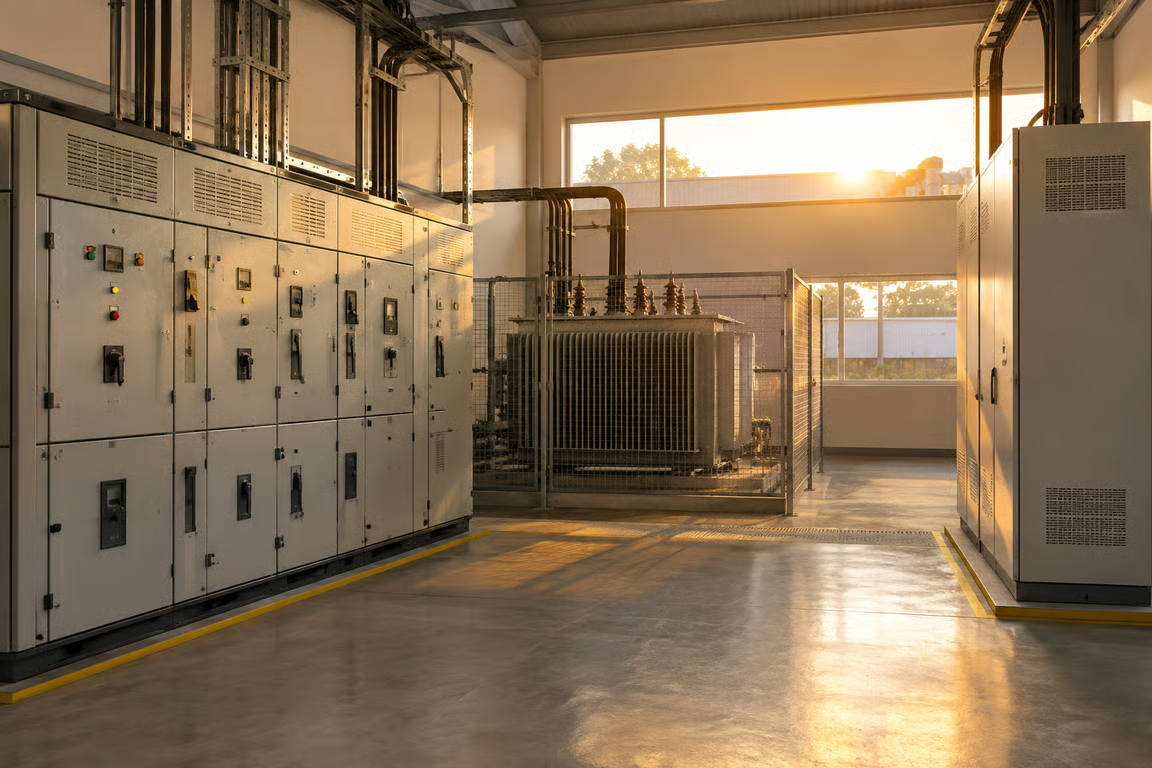
- Condition and ownership of the substation, transformer and capacitor bank on MV sites
- Any rooftop solar on the property and who holds the ATAP or NEM contract
- A clean change of tenancy: the registered account holder is liable for every bill on the account, and TNB asks for a deposit of about two months' estimated charges
If your process needs more power than a typical unit carries, filter for it from the start. Our high-power factory service in Selangor shortlists units by confirmed supply, and you can browse high-power factories for rent in Selangor or high-power factories for sale in Port Klang. For ceiling height, floor loading and land as well as power, see how to find a factory by technical specs and the factory requirements by industry pages. If you would rather hand over the brief, use find me a factory.
If your load is heading past what a low-voltage supply can carry, read our TNB substation guide for factories: when you need one, compact vs indoor substations, the land TNB needs and the connection charges.
Thinking about panels on the roof? Our Solar ATAP rooftop solar guide for factories covers self-consumption rules, roof checks and landlord consent.
FAQ
What is the TNB electricity tariff for factories in 2026, including maximum demand and AFA surcharge?
Low Voltage General is 50.68 sen/kWh (energy, capacity and network) plus RM20 a month, with no maximum demand charge. Medium Voltage General is 29.83 sen/kWh plus RM89.27 per kW of maximum demand each month (RM29.43 capacity and RM59.84 network) and RM200 a month. The AFA, a surcharge of 3.61 sen/kWh in October 2026, is added to both. Rates are from TNB's tariff schedule effective 1 July 2025.
What are TNB ToU peak hours for industrial users?
Peak is 2pm to 10pm, Monday to Friday. Other weekday hours, weekends and selected public holidays are off-peak, and on MV and HV ToU, maximum demand recorded off-peak is not charged.
How is the TNB maximum demand charge calculated?
MD is twice the largest kWh used in any 30 consecutive minutes in the month, which is your highest half-hour average kW. On MV General you pay RM89.27 for each kW of it every month. On MV ToU only the peak-period MD is charged, at RM97.06 per kW.
Is AFA charged to factories in 2026?
Yes. AFA applies per kWh to all non-domestic accounts and was +3.61 sen/kWh in October 2026. The 800 kWh exemption announced in September 2026 covers homes only.
Does a low power factor increase my TNB bill?
Yes. Below 132kV, a power factor under 0.85 adds 1.5% of the energy, demand and AFA charges for every 0.01 shortfall, and 3% per 0.01 below 0.75. A capacitor bank usually solves it.
Is medium voltage supply cheaper than low voltage?
Per kWh, yes: 29.83 sen against 50.68 sen. But medium voltage adds RM89.27 per kW of MD each month, so it suits plants with steady, long-running loads. Supply voltage is set by your maximum demand, with loads above about 1,000 kVA normally fed at 11kV.
Can rooftop solar cut a factory's TNB bill under Solar ATAP?
Yes, mainly through self-consumption, which cuts kWh, energy charges and AFA. Non-domestic systems can be up to 100% of MD, capped at 1,000 kW, and exports earn the average System Marginal Price within the same billing period.
Buying or renting, talk to us
Contact Adam or Yuki to discuss your requirements. Confirm the available service, scope and terms directly before proceeding.
| Agent | Mobile / WhatsApp | |
|---|---|---|
| Adam | 60176729873 | +60 17-672 9873 |
| Yuki | 60167724476 | +60 16-772 4476 |
Factories and Warehouses in Port Klang
Archived catalogue records with power, ceiling height and floor loading for every unit: