Factory for Sale Klang 2026: Johor Data Centre Boom, Buy or Wait?
Johor's data centre boom is surging, but does it change the case for buying a factory in Klang in 2026? We break down JPPH-registered prices and rents for Klang, the brownfield vs greenfield trade-off, and what the numbers actually mean for buyers and owner-occupiers.
Key Takeaways
- Data centres remain Malaysia's key industrial growth segment, supported by proximity to Singapore and a shift in demand toward secondary zones with more accessible land. Johor is strengthening its power and water capacity to serve these technology-based facilities.
- JPPH-registered factory prices in Klang & Port Klang are mixed: like for like (same park, same type), terrace factories +7%, semi-detached +25%, detached -13% and industrial land -2% in the 12 months to July 2026 vs the 12 before.
- Registered factory rents are rising: like-for-like rents in Selangor and KL rose 6% year on year for terrace factories and 27% for detached factories; Klang & Port Klang factories let at a median of RM1.44 psf a month.
- Johor's data centre pipeline is very large, YTL Power plans to double its data centre capacity to 2.4 gigawatts by 2032, and Vertiv has opened a manufacturing facility in Johor to serve AI and high-density computing demand across Asia. None of this displaces Klang's port-and-logistics role.
- **For a factory for sale Klang 2026 decision, the fundamentals favour acting on well-specified, correctly priced assets, while sub-scale, low-specification or short-leasehold stock still needs a genuine discount to move.
What Happened: Johor's Data Centre Boom Is Now a National Story
Malaysia's industrial property narrative in 2026 is being written in Johor, but the ink is spreading. Data centres remain the single key growth segment in the Malaysian industrial market, supported by proximity to Singapore and a clear shift in demand toward secondary zones where land is more accessible and power is more attainable. That shift is exactly why Johor has moved to strengthen its power and water capacity for technology-based facilities.
The scale of the pipeline is significant. YTL Power is planning to double its data centre capacity to 2.4 gigawatts by 2032. Vertiv has announced the opening of a manufacturing facility in Johor to support growing demand for AI and high-density computing infrastructure across Asia. And IOI Properties Group continues to advance a data centre campus in the region, although capacity, power source and total floor area details were not made available at the time of reporting.
There is an important nuance, however. Approvals for Tier 1 and Tier 2 data centres have slowed. The market is no longer in a land-grab phase, it is entering a delivery and infrastructure phase, where power, water and connectivity determine which projects actually get built.
That distinction matters enormously for anyone weighing up industrial property in the Klang Valley, because it tells you where the next wave of industrial demand will, and will not, land.
Why Johor's Boom Is Not Klang's Problem
It is tempting to read the Johor headlines and conclude that industrial capital is leaving the Klang Valley. That reading is too simple.
Johor's industrial expansion is driven by foreign investment and manufacturing diversification, anchored in spillover from Singapore, improved cross-border connectivity and institutional investment into Iskandar Malaysia. Its product is largely new-economy: data centre shells, high-tech manufacturing, business parks serving the Johor Bahru-Singapore Rapid Transit System (RTS) Link corridor and the Johor-Singapore Special Economic Zone.
Klang's product is different. It is logistics, distribution, manufacturing support and port-adjacent warehousing, the physical supply chain that feeds Port Klang's Northport and Westport terminals. According to the Port Klang Authority, Port Klang remains Malaysia's busiest container port, and that status is not something a data centre campus in Sedenak or Kulai can replicate.
So the correct framing for 2026 is not "Johor versus Klang." It is: Malaysia's industrial market is splitting into two demand engines, a capital-intensive, power-hungry data centre and high-tech engine in Johor, and a throughput-driven logistics and manufacturing engine in the Klang Valley. Both can grow at once. They are competing for different land, different specifications and, largely, different tenants.
The Numbers Behind Klang's Industrial Market
Before deciding whether to buy or wait, it helps to be precise about what the registered data shows. These are JPPH-registered transfers for Klang & Port Klang, 24 months to July 2026 (see our Klang & Port Klang transaction data).
| Segment | Registered median price | Psf of land | Like-for-like price change (12 months to July 2026) |
|---|---|---|---|
| Terrace factory | RM869,000 | RM422 | +7% (17 parks) |
| Semi-detached factory | RM4.95 million | RM334 | +25% (8 parks) |
| Detached factory | RM14.9 million | RM267 | -13% (5 parks) |
| Industrial land | RM10.07 million | RM88 | -2% (7 parks) |
Registered factory rents in Klang & Port Klang have a median of RM1.44 psf a month (662 tenancies), and like-for-like factory rents in Selangor and KL rose 6% year on year for terrace factories and 27% for detached factories.
What this data is really telling you
Two things stand out.
First, the market is moving by type, not as one. Terrace and semi-detached factory prices rose like for like, while detached factories and industrial land were lower. The figure for the type you are buying matters more than any headline trend.
Second, rents are still rising. If you are buying a factory as an investment rather than for your own operations, model your yield on the rent you can realistically achieve against the registered median price for that type, not on a headline capital value.
What This Means for Factory and Warehouse Owners in Klang, Shah Alam and Kapar
Klang, Shah Alam and Kapar sit on a very specific set of advantages: direct access to Port Klang via the Federal Highway (Route 2), the North Klang Straits Bypass (Route 20), the West Coast Expressway, KESAS and the ELITE/North-South Expressway Central Link, plus a mature base of supporting industries in Shah Alam's Seksyen 15, 16, 22, 23 and 33 industrial areas, HICOM-Glenmarie, Temasya, Bandar Bukit Raja, Meru, Telok Gong, Sungai Puloh and Pulau Indah.
That geography is not disrupted by a data centre boom 300 km away. If anything, it is reinforced, because data centre development in Johor consumes land and power that would otherwise go to logistics and light manufacturing, pushing some of that demand back toward established Klang Valley nodes.
The brownfield advantage is quietly strengthening
One of the more consequential trends in the current cycle is that adaptive reuse of older and underutilised industrial assets is gaining traction, as higher land values, improving connectivity and changing operational requirements make redevelopment increasingly viable.
For Klang, that is a direct opportunity. Older factory stock in established industrial areas, the kind of buildings that were built for a different generation of machinery and container handling, often sits on generous land plots with mature utilities. Rebuilding, retrofitting or reconfiguring that stock can be more capital-efficient than acquiring raw land and starting from zero.
This is the greenfield vs brownfield Malaysia industrial property debate in its practical form. Greenfield land gives you a purpose-built facility with modern clear heights, floor loading and power capacity, but comes with infrastructure timelines, earthworks and often a longer approval runway. Brownfield gives you speed, existing utilities and a proven location, but requires due diligence on soil conditions, building condition, outstanding quit rent and lease tenure.
| Factor | Greenfield industrial land | Brownfield industrial land |
|---|---|---|
| Time to operational | Longer (earthworks, infrastructure, approvals) | Shorter if the existing structure suits your process |
| Site control | Full design freedom | Constrained by existing building footprint |
| Utilities | May need new supply applications | Often already connected |
| Location | Typically peripheral | Typically central, established estates |
| Key risk | Infrastructure delivery timing | Condition, contamination, tenure, compliance history |
| Typical Klang-area examples | Peripheral Klang district land, Pulau Indah expansion | Older estates in Meru, Telok Gong, Kapar, Seksyen 15-23 Shah Alam |
Buy or Wait? Framing the 2026 Decision Properly
This is the question every serious buyer is asking, and it deserves a structured answer rather than a slogan.
The case for buying now
- Rents are still rising. Like-for-like registered factory rents in Selangor and KL rose year on year (terrace +6%, detached +27%), so waiting has a carrying cost. Every quarter you delay is a quarter of rent paid to someone else.
- Owner-occupiers stop being exposed to the rental market. Industrial rents in the Klang Valley are not falling. If your business needs 50,000 sq ft of production or warehouse space for the next decade, locking in ownership removes a significant operating variable.
- Prime, well-located stock is finite. Established industrial land near Port Klang, with proper access roads and adequate power, cannot be manufactured. Peripheral land can.
- Favourable financing conditions. Business financing costs are influenced by Bank Negara Malaysia's Overnight Policy Rate decisions, check current rates at BNM before committing to a facility, and stress-test your repayment at a higher rate.
The case for waiting
- Some types are softening. Registered detached factory prices in Klang & Port Klang were 13% lower like for like, and industrial land 2% lower, so buyers of those types have room to negotiate.
- Data centre approvals have slowed. If your thesis was partly built on a continued Johor-style land scramble in the Klang Valley, that thesis needs revisiting.
The honest answer
For an owner-occupier with a clear operational requirement, a stable financing arrangement and a specific shortlist of properties, buying a well-specified factory in a proven Klang location in 2026 is defensible. You are buying utility, not a yield play, and utility does not wait.
For a pure investor seeking a fast capital gain, the case is weaker. Registered prices are mixed by type, and the exit pool is narrower for lower-specification assets.
For anyone uncertain about specification, tenure or location, the right move is not "buy" or "wait", it is diligence. Get the building inspected, verify the lease tenure, confirm the power supply, and check the access road with a laden container truck before you sign anything.
Market Outlook: What to Expect Through 2026 and Beyond
Registered rents give the base case: like-for-like factory rents in Selangor and KL rose year on year (terrace +6%, detached +27%), and Klang & Port Klang factories let at a median of RM1.44 psf a month. Business parks and well-located high-tech developments could also benefit as cost-sensitive occupiers move toward decentralised alternatives.
Meanwhile, Iskandar Malaysia is expected to see a sustained growth cycle anchored in Singapore spillover, improved connectivity and institutional investment. Supply in that market is rising, vacancies are declining, and demand is shifting toward managed industrial parks offering enhanced facilities, security and greener features.
That last point is worth absorbing even if you never buy in Johor: the managed industrial park model is becoming the benchmark. Occupiers are choosing parks with security, proper estate management and modern infrastructure over standalone buildings in unmanaged estates. If you own a standalone factory in Klang, that is your competitive pressure, and it argues for investing in the asset rather than letting it depreciate.
On sustainability, new office buildings are increasingly certified green, and sustainability and asset quality are emerging as key differentiators in that sector. Tenants increasingly favour greener industrial space too, though most Malaysian factories are not certified, so the practical takeaway is to improve what you control: insulation, lighting, water management, drainage and yard condition.
What To Do Now: A Practical Checklist
If you are buying:
- Confirm the lease tenure and remaining term. Most industrial land in parts of Klang and Selangor is leasehold, and remaining tenure directly affects financing and resale.
- Verify power supply capacity against your actual machinery load, not the estate's nominal figure.
- Test the access route with the largest vehicle you will routinely use.
- Check flood history and drainage for the specific plot, not the estate average.
- Obtain a current valuation and confirm stamp duty exposure with LHDN.
- Model your numbers at a conservative rental assumption, not the most optimistic one.
If you are renting first:
If you are not yet ready to commit capital, a factory for rent in Shah Alam can give you 12-24 months to test the location, the labour market and your logistics routes before you buy. The same applies if you are looking at a factory for rent in Kapar while you evaluate brownfield redevelopment options.
If you are a land buyer:
Industrial land is priced per land area, always confirm whether a quoted figure is RM per sq ft of land or RM per sq ft of built-up area. These are completely different numbers, and mixing them is the single most common mistake in industrial property negotiation. Browse current options at industrial land for sale Selangor.
Frequently Asked Questions
Is it a good time to buy a factory in Klang in 2026?
For owner-occupiers with a genuine operational requirement, yes, provided the asset is well-specified, the tenure is long enough for financing, and the price reflects current rental reality. Registered factory rents are still rising (Selangor and KL like for like: terrace +6%, detached +27% year on year), so waiting carries a real cost. For pure investors seeking quick capital gains, the case is weaker because registered prices are mixed by type (Klang & Port Klang detached factories -13% and industrial land -2% like for like).
What happens after 99 years of leasehold in Malaysia?
When a leasehold term expires, the land reverts to the state authority unless the lease is renewed or extended. In practice, owners apply to the relevant state land office for an extension, usually paying a premium based on current land value. Do not assume automatic renewal. For industrial property, a short remaining tenure directly affects bank financing, many lenders are cautious about leases with fewer than 30 to 40 years remaining, and it affects resale liquidity.
Should I buy freehold or leasehold industrial property in Klang?
Freehold gives you perpetuity and typically stronger financing terms, but freehold industrial land in established Klang locations is scarce and priced accordingly. Leasehold is more common, often more affordable, and perfectly workable if the remaining tenure comfortably exceeds your financing period and planned holding horizon. The right answer depends on your intended use, not on principle. Verify the tenure before you negotiate price.
Can a foreigner buy commercial or industrial property in Selangor?
Foreign ownership of commercial and industrial property in Malaysia is permitted, but it is subject to conditions that vary by state and by property. In Selangor, foreign purchases generally require state authority approval and must meet minimum value thresholds, and industrial land may carry additional conditions. Foreign-owned manufacturing businesses may also need to engage with MIDA on licensing and incentive matters. Engage a licensed conveyancer and confirm current Selangor state guidelines before committing.
What is the difference between brownfield and greenfield industrial land?
Greenfield land is undeveloped, typically agricultural or vacant land that must be converted, filled, serviced and built on. Brownfield land has previously been used for industrial purposes and may already have buildings, power supply and access roads. Greenfield offers design freedom but longer timelines. Brownfield offers speed and established infrastructure but requires diligence on building condition, contamination and compliance history. In mature Klang estates, brownfield redevelopment is increasingly viable as land values rise.
Will Johor's data centre boom reduce demand for factories in Klang?
No, they serve different demand engines. Johor's growth is driven by data centres, high-tech manufacturing and Singapore spillover, while Klang's industrial base serves port logistics, distribution and manufacturing supply chains tied to Port Klang. If anything, data centre development consuming land and power in Johor pushes some logistics demand back toward established Klang Valley nodes. Both markets can expand simultaneously.
How much does a factory in Klang cost in 2026?
Market rates vary significantly by location, tenure, land area, built-up area, floor loading, clear height and power capacity. Asking prices for detached factories are typically quoted per sq ft of built-up area, while industrial land is quoted per sq ft of land or per acre, never compare the two directly. Contact +60 17-672 9873 for current quotes on specific properties, or browse listings for a factory for sale in Klang.
The Bottom Line
Johor's data centre boom is real, large and consequential, 2.4 gigawatts of planned capacity, major new manufacturing investment, and a state government actively building power and water capacity to support it. But it is not a reason to postpone a Klang factory purchase, because it is not competing for the same tenants, the same land or the same logistics function.
What should inform your 2026 decision is Klang's own registered data: factory rents still rising, and prices moving by type (terrace +7%, semi-detached +25%, detached -13%, industrial land -2% like for like in the 12 months to July 2026). That is a market with solid fundamentals and room to negotiate on some types, a good environment for owner-occupiers, and a more disciplined one for investors.
Whether you are buying a factory for sale in Klang, renting in Shah Alam, or assessing industrial land for sale in Selangor, the same rule applies: specification, tenure, access and power determine value. Everything else is noise.
Need a straight answer on a specific property? Call +60 17-672 9873 for personalised advice on Klang Valley industrial property, we will tell you what the asset is worth, what it will rent for, and whether it fits your requirement. No pressure, no inflated numbers.
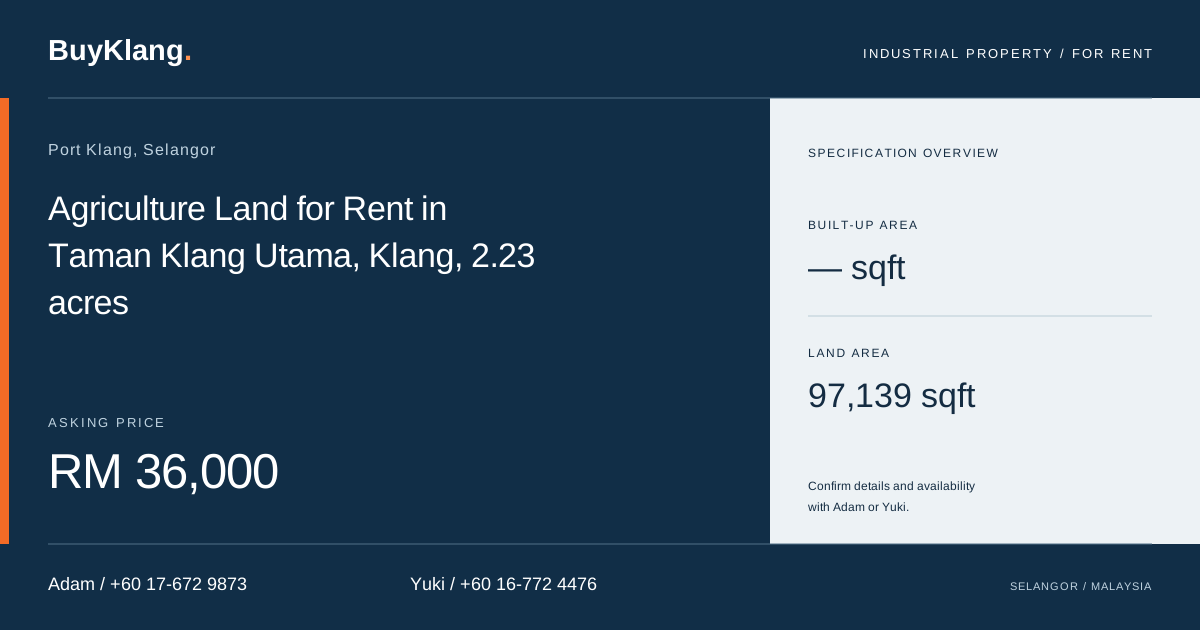
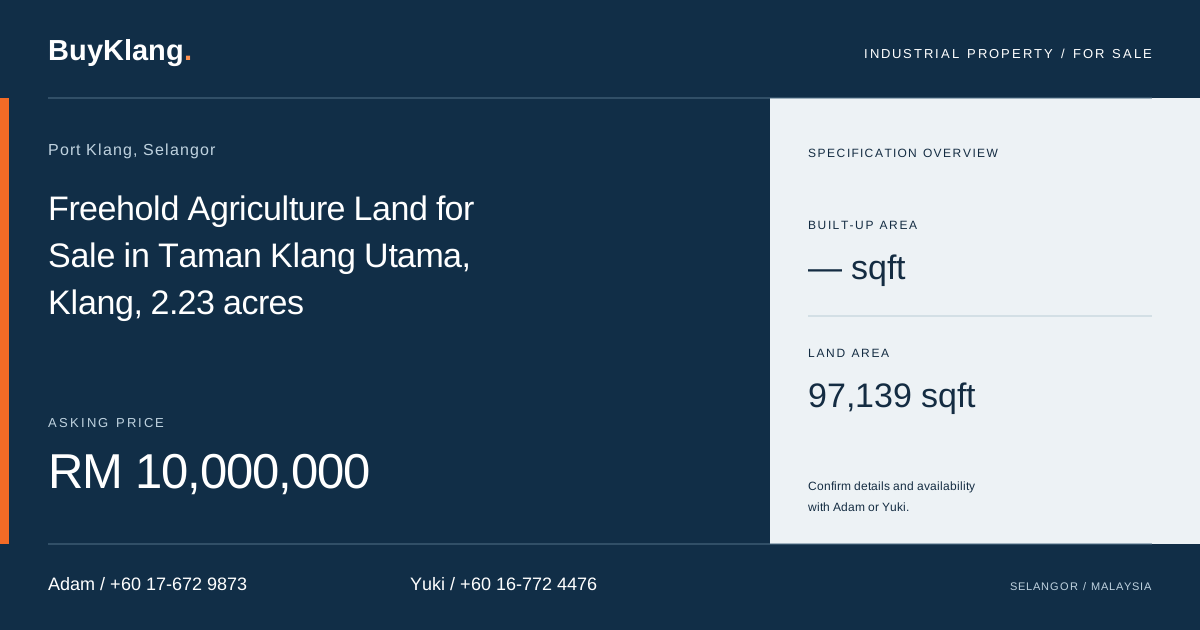
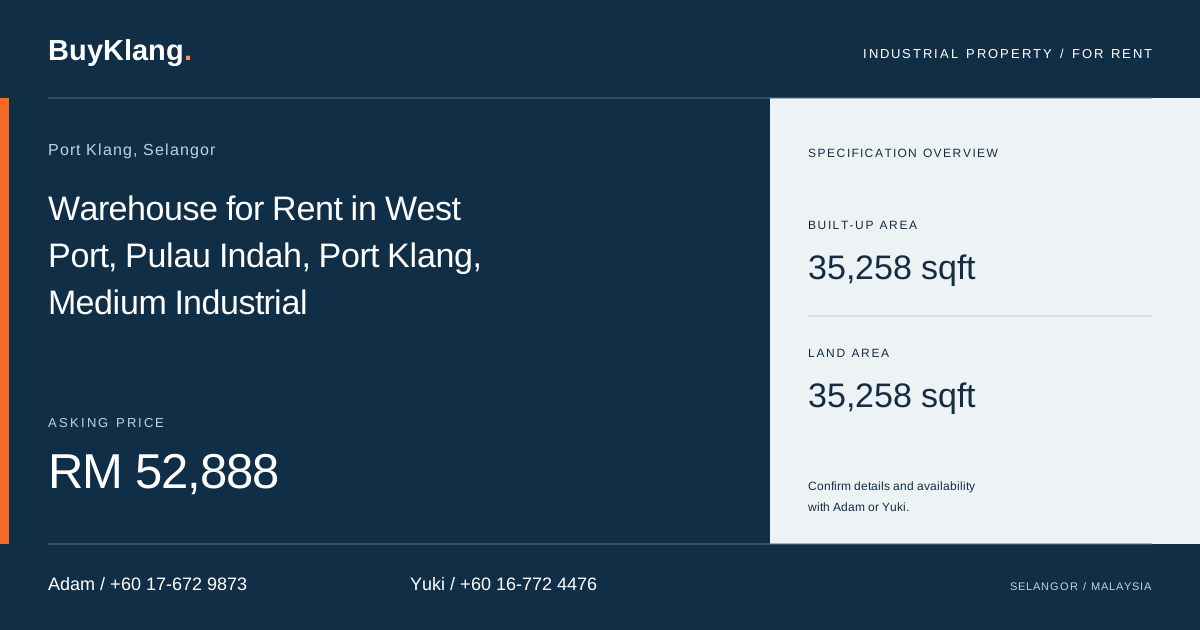
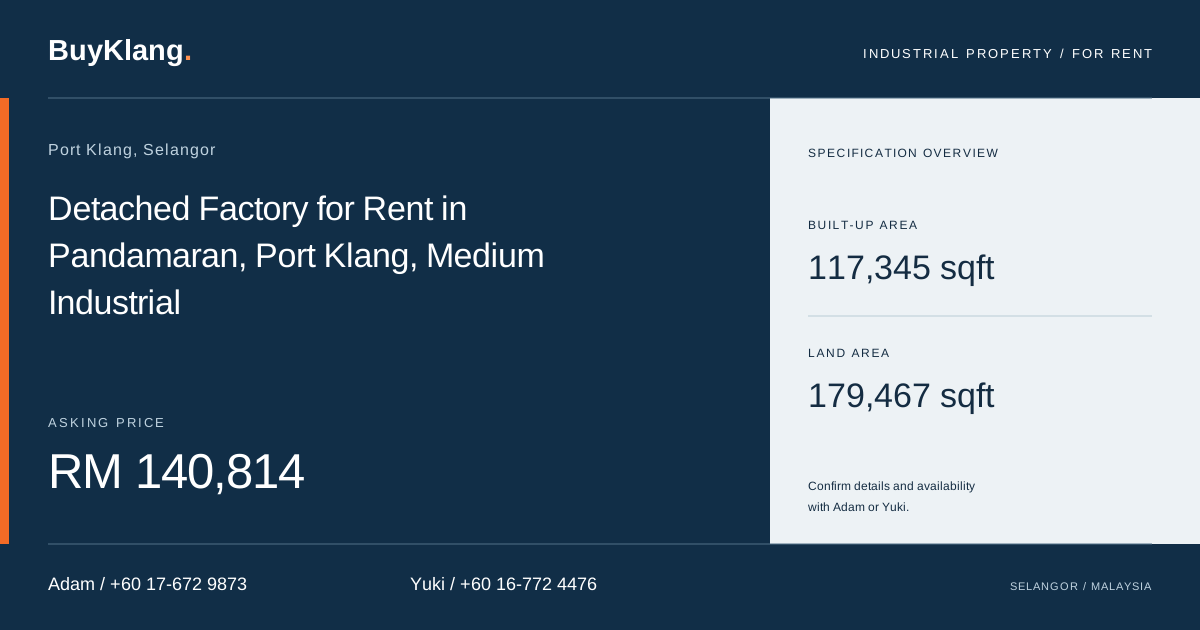
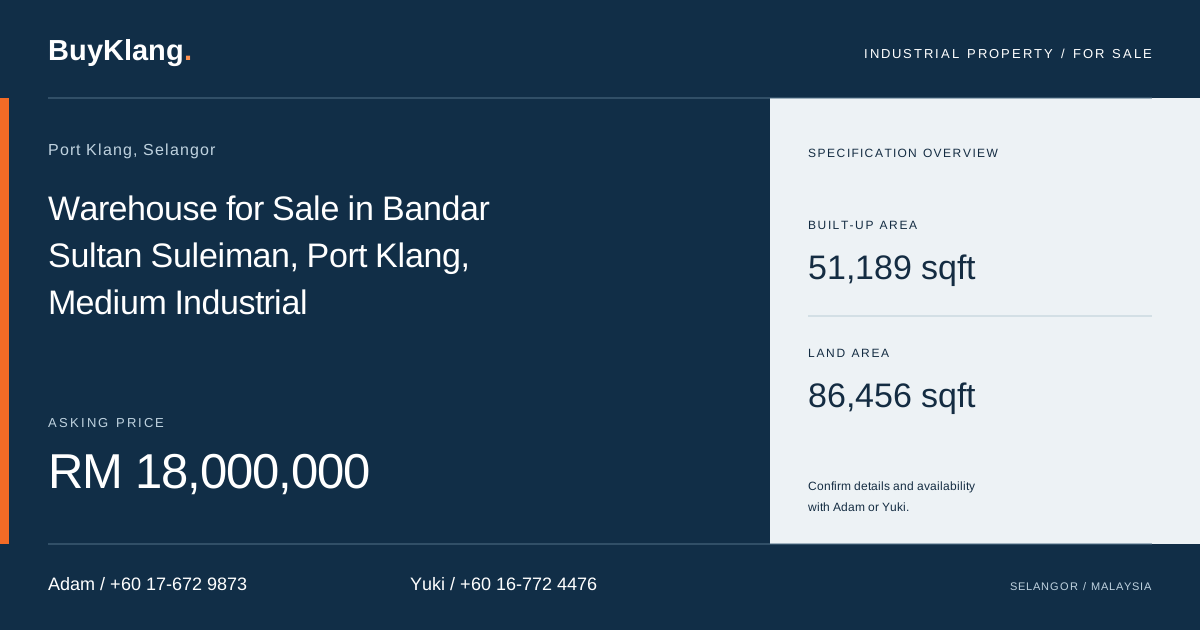
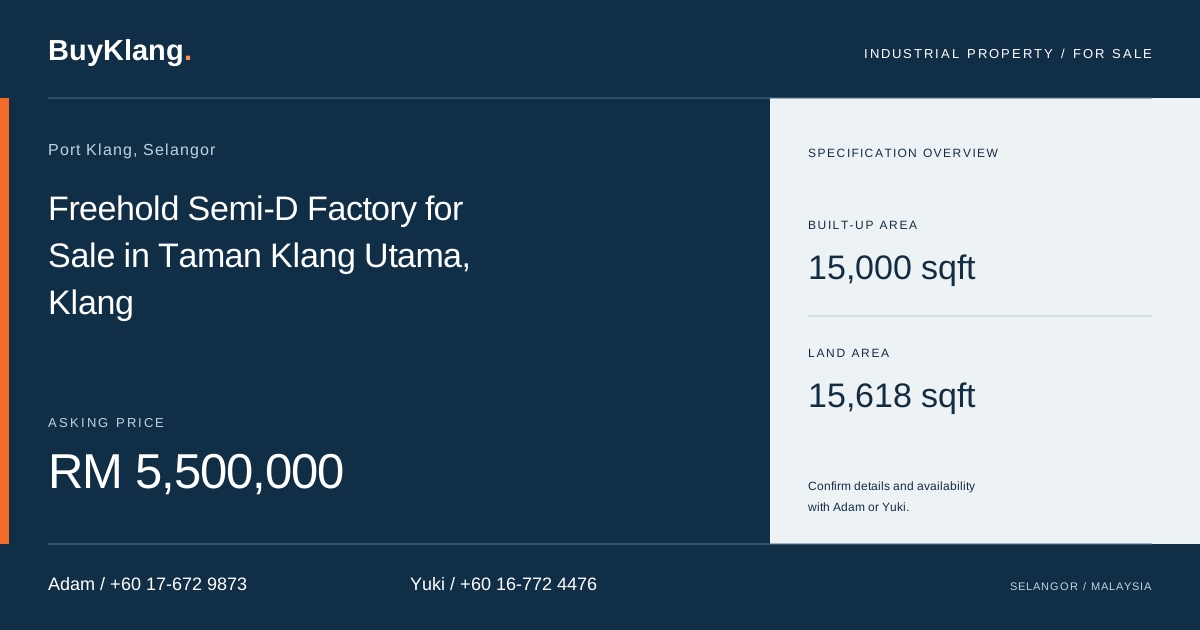
Factories and Warehouses in Port Klang
Archived catalogue records with power, ceiling height and floor loading for every unit: