New Industrial Master Plan 2030 (NIMP 2030): What It Means for Factory Owners, Tenants and Buyers
NIMP 2030 explained for factory owners, tenants and buyers: launch date, targets, priority sectors, the automation licence condition, multi-tiered levy, smart factories and the ECRL industrial parks named in Selangor.
Key Takeaways
- The New Industrial Master Plan 2030 (NIMP 2030) is Malaysia's industrial policy for manufacturing and manufacturing-related services, launched by Prime Minister Anwar Ibrahim on 1 September 2023 and running for seven years to 2030.
- It targets manufacturing value added of RM587.5 billion by 2030 (from RM364.1 billion in 2022), 3.3 million jobs and a manufacturing median salary of RM4,510, through 4 missions, 21 strategies, 62 action plans and 9 mission-based projects.
- Priority sectors are E&E (IC design and wafer fabrication), specialty chemicals, aerospace, pharmaceuticals and medical devices, plus advanced materials, EVs, renewable energy and carbon capture.
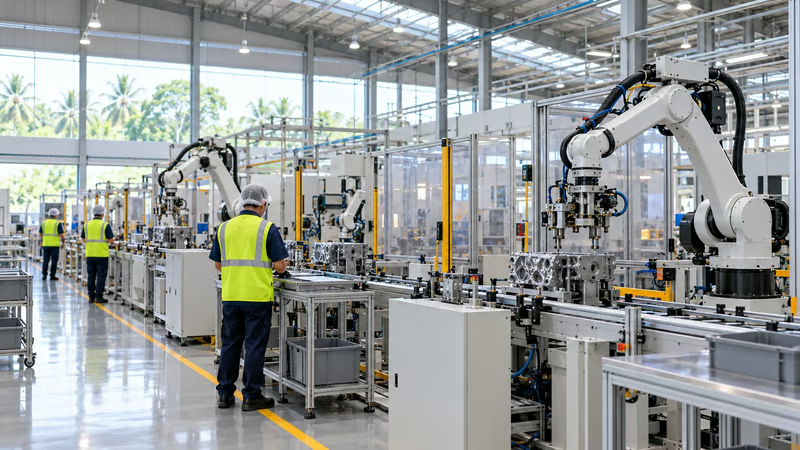
- For factory owners and tenants, the parts that matter most are the planned automation condition in new Manufacturing Licences, a multi-tiered foreign worker levy, 3,000 smart factories, and turning older industrial estates into eco-industrial parks.
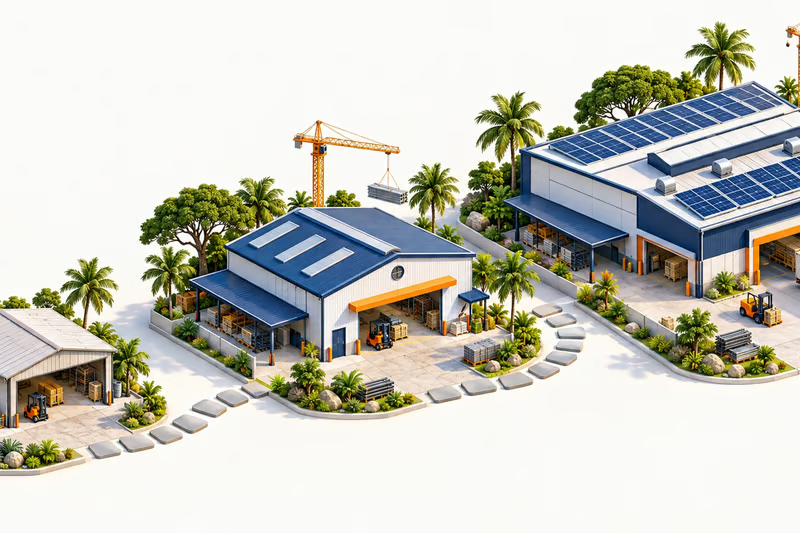
- In Selangor, the plan lists potential industrial parks at Kapar, Klang, Pulau Indah and Puncak Alam along the ECRL. "Potential" means identified, not approved, so check before paying for that story.
This guide explains what NIMP 2030 is, what it targets, and what it changes for people who own, rent, buy or sell factories and industrial land in Selangor and the Klang Valley. It is a plain-language summary, not legal, tax or investment advice.
What is the New Industrial Master Plan 2030?
NIMP 2030 is the national plan that sets the direction for Malaysia's manufacturing sector from 2023 to 2030. The official NIMP 2030 portal describes it as the industrial policy for manufacturing and manufacturing-related services, built on "moonshot thinking" and a whole-of-nation approach that brings government and the private sector together.
According to MIDA's launch summary, the plan has six goals:
- Increase economic complexity
- Create high-value job opportunities
- Extend domestic linkages
- Develop new and existing clusters
- Improve inclusivity
- Enhance ESG practices
The four missions
| Mission | What it means in practice |
|---|---|
| 1. Advance economic complexity | Move up the value chain: IC design, wafer fabs, specialty chemicals, advanced materials |
| 2. Tech up for a digitally vibrant nation | Automation, Industry 4.0, 3,000 smart factories, a national digital platform for manufacturing |
| 3. Push for Net Zero | Energy efficiency, renewable energy, an iESG framework, eco-industrial parks, carbon capture |
| 4. Safeguard economic security and inclusivity | Supply chain resilience, SMEs, state industrial programmes, clusters |
These are backed by four enablers: financing, talent, the investor journey and governance. The plan is delivered through 21 strategies, 62 action plans and nine mission-based projects (MBPs) such as a locally manufactured EV, 3,000 smart factories, a generative AI hub and large-scale carbon capture.
When was NIMP 2030 launched, and what are its phases?
The plan was launched on 1 September 2023. The Prime Minister's launch speech said it would need an estimated RM95 billion of investment over seven years, mainly from the private sector, with close to 10% from the government through the NIMP Industrial Development Fund (NIDF) and the NIMP Strategic Co-investment Fund (CoSIF). MIDA reports a proposed RM8.2 billion government allocation for the missions and enablers from 2024 to 2030, with RM200 million initial funding from Budget 2024.
The official NIMP 2030 document splits delivery into two phases:
| Phase | Years | Focus |
|---|---|---|
| Phase 1: Strengthen foundation | 2023 to 2026 | Set up governance, funding and industry deals, onboard SMEs, launch the first MBPs |
| Mid-term review | End of 2026 | Review targets and progress, recalibrate gaps |
| Phase 2: Sustain growth and resilience | 2027 to 2030 | Scale up implementation, diversify the economic base, build resilience |
We are now at the end of Phase 1, so the mid-term review is the next point where targets or programmes may change.
What are the NIMP 2030 targets?
The plan sets these headline targets for the manufacturing sector (from the official document):
| Measure | Baseline | 2030 target |
|---|---|---|
| Manufacturing value added (GDP) | RM364.1 billion (2022) | RM587.5 billion (CAGR 6.5%, +61%) |
| Manufacturing employment | 2.7 million | 3.3 million (CAGR 2.3%) |
| Manufacturing median salary | RM1,976 (2021) | RM4,510 (+128%) |
| R&D spending (GERD) to GDP | 1.0% | 3.5% |
| Share of export-oriented SMEs | 11.7% | 25% |
| Domestic value added in manufacturing | 49% (2018) | 65% |
It also aims for 700,000 high-skilled jobs created over the seven years. Early progress reported by MITI and carried by MIDA: manufacturing value added rose 4.7% (RM4.2 billion) year on year as of the second quarter of 2024, and jobs rose 0.9%.
What are the priority sectors, and what factories do they need?
MIDA lists the high-value priority sectors as E&E (IC design and wafer fabrication), specialty chemicals, aerospace, pharmaceuticals and medical devices, with four more growth sectors: advanced materials, electric vehicles, renewable energy and carbon capture, utilisation and storage (CCUS). Bernama reported in February 2026 that approved E&E investments from 2021 to September 2025 totalled RM341 billion, more than the RM298 billion recorded from 1980 to 2020.
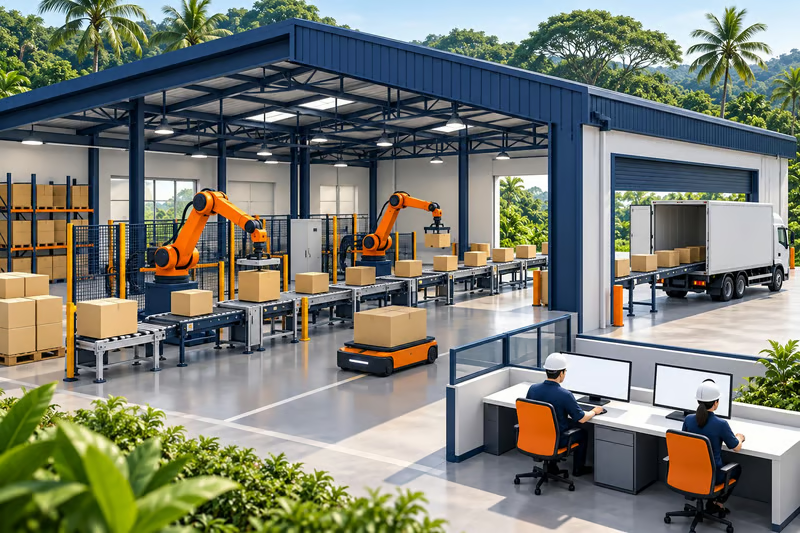
MIDA now also screens manufacturing projects against minimum thresholds under the National Investment Aspirations: a capital investment per employee of RM140,000 and value added of at least 40%, according to MIDA's 2025 investment performance report. That pushes demand toward capital-heavy operations, which in turn need buildings with:
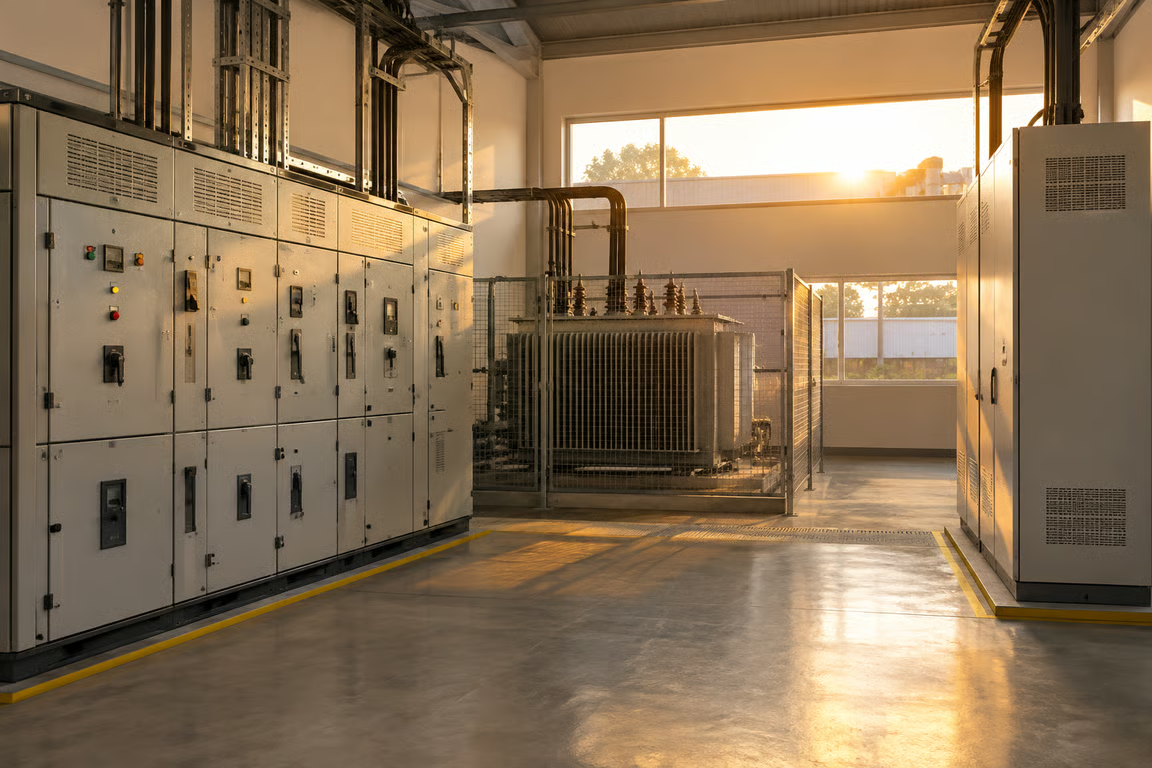
- Enough electricity: high-value lines, cleanrooms and automated equipment draw far more power than a basic assembly unit. Size your need with the factory power calculator before shortlisting.
- Floor loading and height for heavy machinery, racking and automated handling.
- Clean, dry and controlled spaces for semiconductor, pharmaceutical and medical device work.
- Correct approvals: industrial zoning, CCC, Bomba and DOE approvals, and a Manufacturing Licence where required.
How does NIMP 2030 affect factory owners and tenants?
Automation condition in new Manufacturing Licences
Action plan 2.2.2 proposes adding an automation condition to new Manufacturing Licences issued by MITI. It is phased: SMEs get a grace period to adopt automation, while MNCs and large local companies would face it with immediate effect. Companies would audit and report their automation progress.
Multi-tiered foreign worker levy
Action plan 2.2.1 proposes a multi-tiered levy for low-skilled foreign labour: higher charges for companies that employ more foreign low-skilled workers, sector-based rates, and gradual implementation, led by the Ministry of Human Resources. Our news piece on the levy and mechanisation follows how this is playing out.
3,000 smart factories
Mission-based project 2.1 aims to transform 3,000 factories into smart factories by 2030, using the Industry4WRD readiness assessment and intervention fund, with funding from the private sector and the NIDF.
Eco-industrial parks and ESG
Action plan 3.4.1 aims to turn brownfield industrial estates into eco-industrial parks with shared park management, resilient infrastructure, waste circularity, advanced wastewater treatment and renewable energy. MITI leads it with NRECC, DOE, SIRIM and MIDA. For a building owner, this points toward rooftop solar readiness, efficient services and proper wastewater arrangements.
What this means in short: older low-power, labour-heavy units will be harder to let or sell to the target sectors, while buildings that can take automation, more power and cleaner processes fit where demand is heading.
What does NIMP 2030 mean for industrial property in Selangor and Klang?
The official document notes that Selangor, Johor and Penang are the three main states contributing manufacturing value added in Peninsular Malaysia. MIDA's 2025 report shows Selangor had 410 approved manufacturing projects worth RM18,136.3 million in 2025, with 24,957 potential jobs (2024: 338 projects, RM18,736.3 million).
ECRL industrial parks named in the plan
Under Mission 4, MIDA and China Communications Construction Company signed an MOU for Economic Accelerator Projects along the East Coast Rail Link towards Port Klang. The plan's Table 7.2 lists these Selangor sites:
| Site in NIMP 2030 Table 7.1 / 7.2 | Status in the plan | Nearest ECRL station listed |
|---|---|---|
| UMW High Value Industrial Park | Identified | Serendah Baru |
| Serendah Cargo Hub (logistics) | Identified | Bandar Serendah |
| ITT Gombak Transit Gateway (logistics) | Identified | ITT Gombak |
| Puncak Alam Industrial Park | Potential | Puncak Alam |
| Kapar, Klang and Pulau Indah Industrial Parks | Potential | Jalan Kastam |
| Jalan Kastam Logistic Hub | Potential | Jalan Kastam |
For buyers, two points follow. First, a "potential" park is only an idea in the plan, so never pay a premium on the strength of it without a gazette, a state approval or a developer launch. Second, the existing belts in Kapar and around the Pulau Indah Industrial Park already sit near the rail and port corridor. You can compare JPPH-registered prices on the Kapar industrial transactions page and browse factories for sale in Kapar or the Pulau Indah Industrial Park page.
Common mistakes when reading NIMP 2030
- Thinking NIMP pays you to buy a building. Its funds (NIDF and CoSIF) target R&D, technology adoption, talent, eco-industrial park and cluster development, and the mission-based projects. Tax incentives are applied for separately through MIDA.
- Treating action plans as law. The automation condition and multi-tiered levy are proposals to be phased in. Check the current rules with MITI, MIDA and the Ministry of Human Resources before you rely on them.
- Paying for "potential" parks. Listed sites are not approvals.
- Ignoring the building. A target sector tenant needs power, floor loading, approvals and space to automate. A low-power unit does not become a semiconductor plant because the sector is a priority.
Frequently Asked Questions
What is the new industrial master plan 2030?
NIMP 2030 is Malaysia's seven-year industrial policy for manufacturing and manufacturing-related services, running from 2023 to 2030. It uses four missions, 21 strategies, 62 action plans and nine mission-based projects to move industry into higher-value, more automated and greener activities. MITI leads it.
When was NIMP 2030 launched?
Prime Minister Anwar Ibrahim launched NIMP 2030 on 1 September 2023. Phase 1 runs from 2023 to 2026, a mid-term review is scheduled for the end of 2026, and Phase 2 runs from 2027 to 2030.
What are the priority sectors for NIMP 2030?
The high-value priority sectors are E&E (IC design and wafer fabrication), specialty chemicals, aerospace, pharmaceuticals and medical devices. Four further growth sectors are advanced materials, electric vehicles, renewable energy and carbon capture, utilisation and storage.
What will happen to Malaysia's manufacturing sector by 2030 under NIMP?
The plan targets manufacturing value added of RM587.5 billion, 3.3 million manufacturing jobs and a median manufacturing salary of RM4,510 by 2030. It also aims for 3,000 smart factories, more export-oriented SMEs and a higher share of domestic value added.
Where can I download the NIMP 2030 PDF?
The full plan and the sectoral plans are published free on the official portal, nimp2030.gov.my, under its resources section. Read the official version rather than copies on file-sharing sites, as targets may be updated after the mid-term review.
Does NIMP 2030 give incentives for buying a factory?
Not directly. NIMP funds support R&D, technology adoption, talent, eco-industrial parks, clusters and the mission-based projects, while tax incentives for manufacturing activities are applied for through MIDA. Check with MIDA and your tax adviser what applies to your project.
How does NIMP 2030 affect factory tenants?
Tenants in target sectors may need more power, automation-ready floors and greener buildings, and the planned automation licence condition and multi-tiered levy push in the same direction. Check a unit's power supply, approvals and landlord consent for upgrades before signing.
BuyKlang is dedicated to helping every client find the right factory or warehouse. If you are looking for a factory that fits a NIMP 2030 sector, call or WhatsApp Adam at +60 17-672 9873 or Yuki at +60 16-772 4476.