Bonded Warehouse for Rent in Port Klang & PKFZ: Licence, Costs and Setup Guide 2026
How to rent a bonded warehouse in Port Klang: the three routes, section 65 licence types and thresholds, premises rules, setup steps and the costs to budget.
Key Takeaways
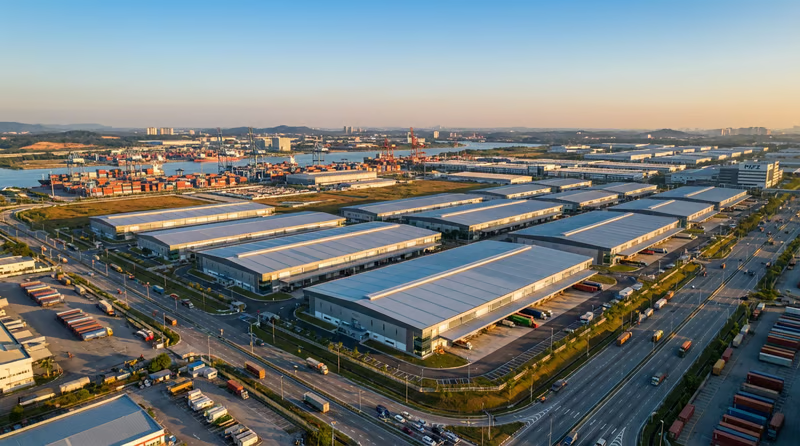
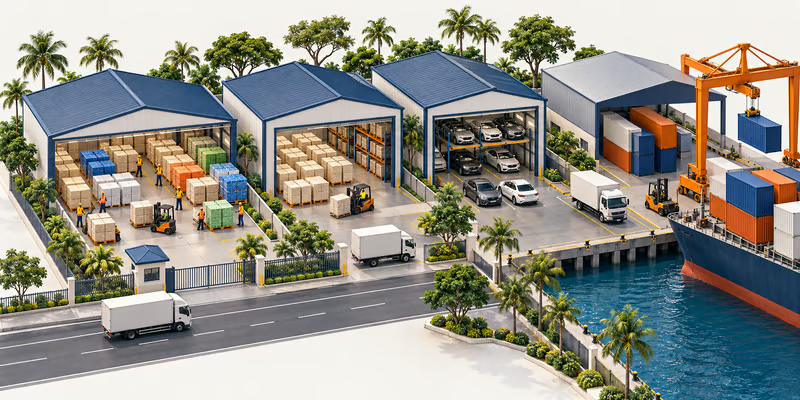
- In Port Klang, "bonded warehouse for rent" means one of three things: space in a public licensed warehouse run by a logistics operator, a building you lease and license yourself, or a unit inside the Port Klang Free Zone (PKFZ), where free zone status replaces the licence.
- A bonded warehouse is a licensed warehouse under section 65 of the Customs Act 1967. Duty and tax on stored goods are deferred until the goods are released for local use. Section 65A is the Licensed Manufacturing Warehouse (LMW), a manufacturing licence, not a storage one.
- RMCD issues four types: public (GBA), private (GBP), PEKEMA and port or airport GBA. A public licence needs a Sdn Bhd or Berhad with at least 30% Bumiputera equity, RM250,000 to RM1 million paid-up capital and 20,000 to 50,000 sq ft of floor space.
- Budget for a licence fee of RM2,400, a bank guarantee of 10% (public) or 50% (private) of estimated duty, and rent. JPPH-registered factory tenancies in Klang & Port Klang over the 24 months to July 2026 show a median rent of RM1.44 psf per month (typical RM1.01 to RM1.92 psf per month).
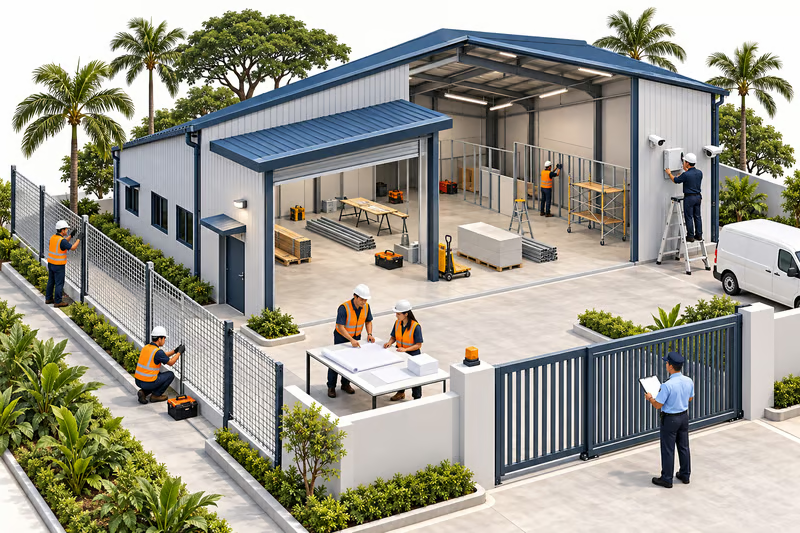
- The premises need one main entrance, fencing, CCTV that Customs can access, a 24-hour monitored alarm, a CCC or CF, and an electronic inventory system before the licence is issued.
To rent a bonded warehouse in Port Klang, you either take space in an existing public licensed warehouse (GBA) run by a logistics operator, or lease a suitable building and apply to the Royal Malaysian Customs Department (RMCD) for your own licence under section 65 of the Customs Act 1967. Inside the Port Klang Free Zone no section 65 licence is needed, because the whole zone sits outside the customs area. Plan for a policy approval valid for six to twelve months, a bank guarantee, and premises that meet Customs security rules.
Three ways to get bonded warehouse space in Port Klang
| Option | Do you need a licence? | Commitment | Best for |
|---|---|---|---|
| Space in a public licensed warehouse (GBA) run by a 3PL | No, the operator holds it | Storage contract, paid per pallet or per sq ft | Importers with changing volumes, trial runs |
| Lease a building and license it yourself (GBA or GBP) | Yes, from RMCD | Lease plus licence, bank guarantee and staff | Steady volumes of your own or clients' goods |
| A unit inside PKFZ | No section 65 licence; free zone rules apply | Lease from PKFZ or a sublease | Re-export, regional distribution |
The free zone route is a different legal regime. Our Port Klang Free Zone guide explains how PKFZ, LMW, bonded warehouses and ordinary industrial land compare, and how the PKFZ customs gate works. This guide covers the licensed warehouse route.
What the law says: section 65 and section 65A
- Section 65, Customs Act 1967: licensed warehouse. RMCD describes a licensed warehouse (Gudang Berlesen) as a licence to store dutiable or taxable goods and other goods approved by the Director General. Duty and tax are deferred until the goods are released for local use or re-exported.
- Section 65A, Customs Act 1967: Licensed Manufacturing Warehouse (LMW). An LMW is licensed under section 65A for export-oriented manufacturing. MIDA says LMWs are normally approved for companies exporting all or at least 80% of output. If you plan to make goods rather than store them, this is the licence to look at.
Activities allowed in a licensed warehouse include storage of approved goods, breaking bulk, repacking, relabelling, buying and selling, consolidation, entrepot trade, and operations under International Procurement Centre, Regional Distribution Centre or Principal Hub status.
Types of licensed warehouse
| Type | Who it is for | Key condition (RMCD) |
|---|---|---|
| Public licensed warehouse (GBA) | Operators storing goods for many owners | Sdn Bhd or Berhad; at least 30% Bumiputera equity and 30% Bumiputera directors or management |
| Private licensed warehouse (GBP) | A company storing its own goods | Registered with SSM or the local council; stores only critical goods or approved goods it owns |
| PEKEMA licensed warehouse | Members of PEKEMA, the Malay vehicle importers and traders association | Holds an open Approved Permit from MITI, with a MITI support letter |
| Port or airport GBA | Port operators, terminal operators, airlines, authorities | Only inside a port or airport and outside a free zone |
Eligibility and minimum requirements
These are the thresholds in RMCD's licensed warehouse licensing guide:
| Requirement | Public (GBA) | Private (GBP) |
|---|---|---|
| Paid-up capital, critical or mixed goods | RM1,000,000 | RM150,000 |
| Paid-up capital, non-critical goods | RM250,000 | RM100,000 |
| Minimum annual value of goods stored | RM3.5 million (critical or mixed); none for non-critical | RM5 million (critical or mixed); RM2 million (non-critical) |
| Minimum floor area | 50,000 sq ft (critical or mixed); 20,000 sq ft (non-critical); stacking does not count | Not stated |
| Bank guarantee, new licence | 10% of estimated annual duty | 50% of estimated annual duty |
| Licence fee | RM2,400 (private sector) | RM2,400 (private sector) |
| Renewal | File 90 days before expiry | File 90 days before expiry |
"Critical goods" is RMCD's category for goods it treats as high revenue risk. Ask your customs agent or the state Customs office which category your products fall into, because it changes the capital, area and guarantee you need.
Premises requirements
RMCD lists what the building must have before a licence is issued:
- Strong, secure construction with only one main entrance and exit
- Perimeter fencing at a height Customs considers suitable
- CCTV that Customs officers can access
- An alarm system monitored 24 hours a day
- A Certificate of Fitness, CF or CCC, or local council approval (why the CCC matters)
- Not located next to flammable materials
- Hazardous goods labelled and kept apart
- An electronic inventory control system
Many ordinary warehouses fail on the single-entrance rule or on fencing. Check the gate layout and any shared driveways before you sign, and add the floor loading your racking needs; our floor loading calculator helps size it.
How to set up a bonded warehouse: step by step
- Pick the type and goods category. GBA if you store for others, GBP if you store your own goods. Confirm whether your goods are critical or non-critical.
- Shortlist buildings that can pass. One main entrance, fencing, enough floor area, a CCC, and no flammable neighbours.
- Agree conditional lease terms. Ask the landlord for a lease or letter of offer that allows time for Customs approval and for the security works.
- Apply to Customs. Submit Form JKDM No. 1 with Annex A and the checklist documents to the Zone Operations Director or State Customs Director where the premises are. New applications are considered at RMCD headquarters.
- Receive policy approval. It is valid for six months, or a reasonable period of up to twelve months, to complete the conditions.
- Fit out and post the bank guarantee. Install fencing, CCTV, alarm and the inventory system, then provide the guarantee.
- Inspection and licence. The licence is issued once all conditions are met.
- Keep it active. RMCD may cancel a licence if the warehouse is inactive for a year without reason, and a move to another state or a new company number needs a fresh application.
Costs to plan for
| Cost item | Amount or basis | Source |
|---|---|---|
| Licence fee | RM2,400 | RMCD |
| Bank guarantee | 10% (GBA) or 50% (GBP) of estimated annual duty | RMCD |
| Paid-up capital | RM100,000 to RM1,000,000 by type and goods | RMCD |
| Rent, 10,000 to 30,000 sq ft | Median about RM1.22 psf, around RM20,300 a month | JPPH-recorded Port Klang tenancies to July 2026 |
| Rent, 30,000 to 60,000 sq ft | Median about RM1.21 psf, around RM54,500 a month | Same |
| Rent, above 60,000 sq ft | Median about RM1.08 psf, around RM104,000 a month | Same |
| Deposits | Commonly two months' security, one month utilities and one month advance rent; more for heavy users or new companies | BuyKlang lease experience |
| Security works and inventory system | Quote-based: fencing, CCTV, alarm, software | Contractors |
| Customs agent and compliance staff | Quote-based | Agents |
A worked example: a public warehouse for non-critical goods needs at least 20,000 sq ft. At the recorded median of about RM1.22 psf, rent is around RM24,400 a month. If estimated annual duty on the goods held is RM1 million, the bank guarantee for a GBA is RM100,000; for a GBP it would be RM500,000. The rent figures come from our Port Klang industrial transactions data, where you can see the spread by size and building type.
Where to rent a bonded warehouse in Port Klang
| Area | Status | What to know |
|---|---|---|
| PKFZ, Pulau Indah | Free zone | No section 65 licence; free zone rules, gate and forms apply. See the PKFZ guide |
| Westport and Northport port areas | Port operators' land | Port GBAs are limited to port and terminal operators, airlines and authorities |
| Pulau Indah, near Westport | Ordinary industrial titles | GBA or GBP possible if the premises pass; shortest haul to Westports |
| Northport side, north Klang | Ordinary industrial titles | GBA or GBP possible; suits cargo on Northport services |
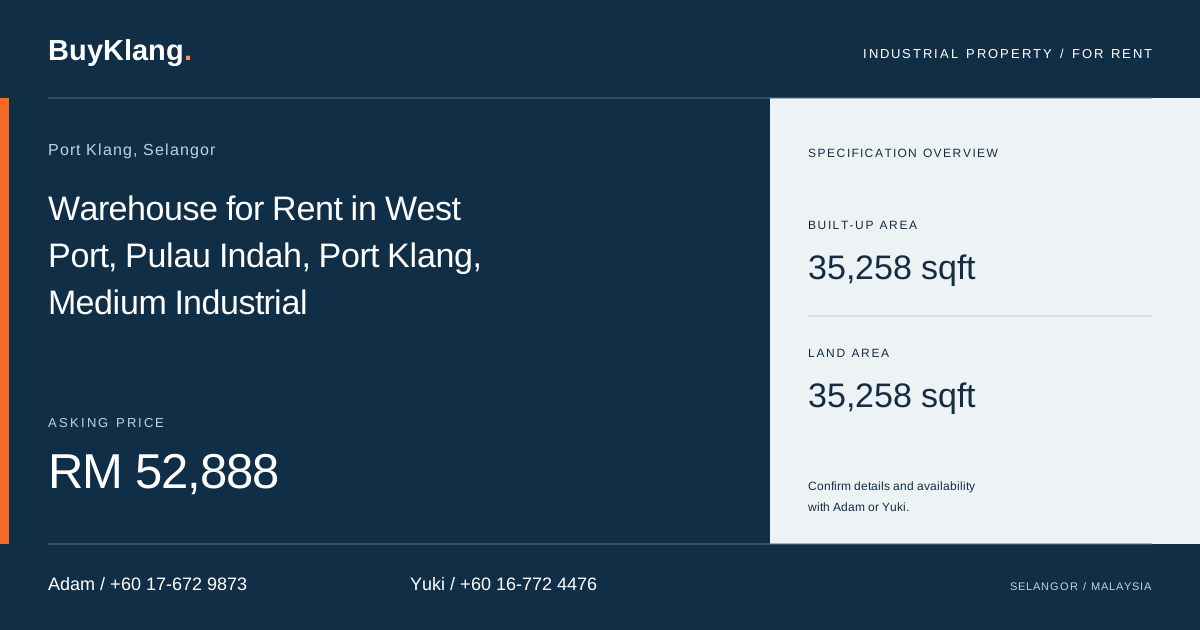
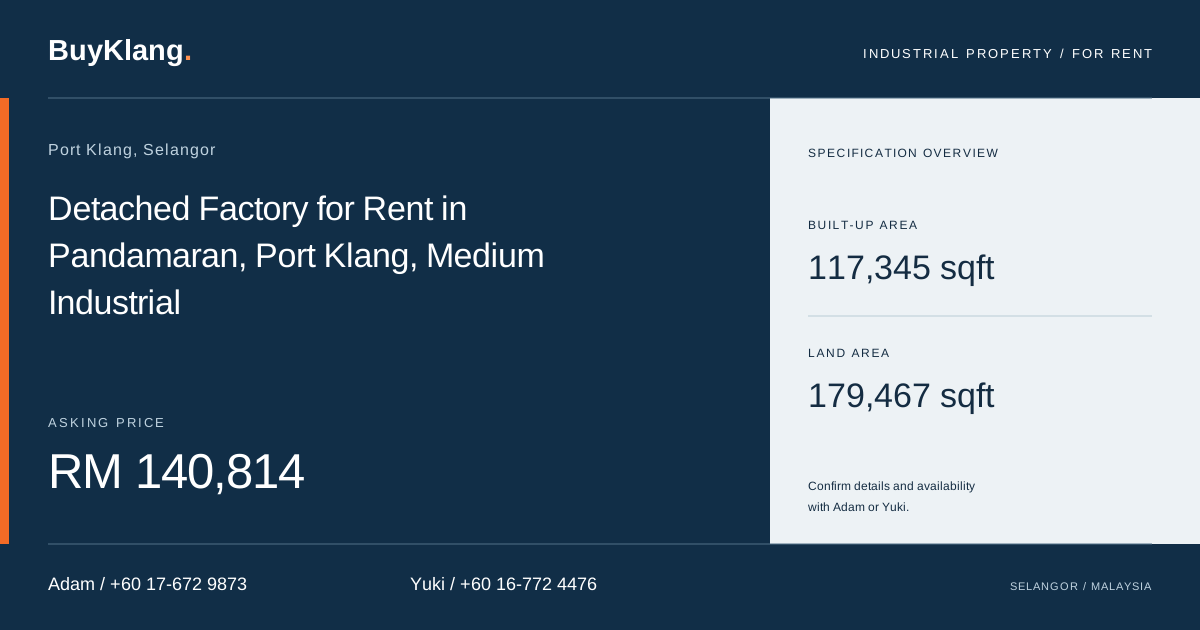
Westports handled a record 11.3 million TEUs in 2025, so units with a short, simple truck route to the terminal you use save money every week. Browse warehouses for rent near Westport, near Northport, or all warehouses for rent in Port Klang, then check each against the premises list above.
Is a bonded warehouse worth it?
It pays when you hold imported stock for weeks or months before selling it in Malaysia, or when part of it is re-exported, because duty and tax are paid only on what leaves for the local market and only when it leaves. It pays less when goods turn over within days, when most of your goods carry little or no import duty, or when volumes are too small to carry the guarantee and compliance staff. Our comparison of bonded warehouse vs standard factory for rent in Port Klang works through these trade-offs.
Checklist before you sign
- Type chosen (GBA, GBP or a 3PL's GBA) and goods category confirmed
- Paid-up capital and, for a GBA, the 30% Bumiputera equity and management rule met
- Floor area meets the minimum without counting stacking
- One main entrance, fencing, CCTV and alarm possible on this site
- CCC or CF in hand; no flammable neighbours
- Lease allows time for Customs approval and security works
- Bank guarantee arranged with your bank
- Customs agent and inventory system chosen
If you want us to shortlist Port Klang warehouses that can meet the Customs layout rules, send your size and timing through find me a factory.
Comparing areas before you shortlist? Our warehouse for rent in Selangor guide sets out rent per sq ft by district, the specs that matter and typical lease terms.
FAQ
What is a bonded warehouse in Malaysia?
It is a warehouse licensed by the Royal Malaysian Customs Department under section 65 of the Customs Act 1967, officially called a licensed warehouse (Gudang Berlesen). Imported goods are stored with duty and tax deferred until they are released for local use, and goods that are re-exported do not pay Malaysian duty.
Is a bonded warehouse the same as an LMW?
No. A bonded warehouse is licensed under section 65 for storage and related work such as repacking and consolidation. A Licensed Manufacturing Warehouse is licensed under section 65A for export-oriented manufacturing, normally for companies exporting at least 80% of output.
Do I need my own licence to rent bonded warehouse space?
Not if you rent space in a public licensed warehouse run by a logistics operator, because the operator holds the licence. If you lease a whole building to store goods under bond, you or your company must apply to RMCD for a GBA or GBP licence for that address.
Can a foreign-owned company get a public bonded warehouse licence?
A public licensed warehouse (GBA) requires at least 30% Bumiputera equity and 30% Bumiputera directors or management throughout the licence period. RMCD's private licensed warehouse (GBP) rules do not list that equity condition, so a foreign-owned company storing its own goods usually looks at a GBP or at a 3PL's GBA. Confirm with the state Customs office.
How long does a bonded warehouse licence take?
RMCD does not publish a fixed processing time. After a new application is considered at headquarters, policy approval is valid for six months, or up to twelve, while you complete the premises and guarantee conditions. Build that time into your lease negotiations.
How much does it cost to rent a bonded warehouse in Port Klang?
JPPH-recorded Port Klang tenancies to July 2026 have medians of about RM1.08 to RM1.22 psf per month for buildings above 10,000 sq ft. On top of rent, plan for the RM2,400 licence fee, a bank guarantee of 10% or 50% of estimated annual duty, security works, and customs agent fees.
Do I need a bonded warehouse licence inside PKFZ?
No. PKFZ is a free zone under the Free Zones Act 1990 and sits outside the customs area, so goods there are not charged duty until they enter the Malaysian market. Tenants deal with the zone's approvals and gate system instead.
What is the purpose of a bonded warehouse?
A bonded warehouse is a licensed warehouse under section 65 of the Customs Act 1967 where duty and tax on stored goods are deferred until the goods are released for local use. It is used to store dutiable or taxable goods and other goods approved by the Director General, and duty and tax are also deferred if the goods are re-exported.
Who is the owner of a bonded warehouse in Port Klang?
The owner depends on which of the three routes you take. Space in a public licensed warehouse (GBA) is run by a logistics operator who holds the licence, while a building you lease and license yourself is licensed to your own company, and a unit inside PKFZ is leased from PKFZ or a sublease under free zone rules.
Buying or renting, talk to us
Contact Adam or Yuki to discuss your requirements. Confirm the available service, scope and terms directly before proceeding.
| Agent | Mobile / WhatsApp | |
|---|---|---|
| Adam | 60176729873 | +60 17-672 9873 |
| Yuki | 60167724476 | +60 16-772 4476 |
Factories and Warehouses in Port Klang
Archived catalogue records with power, ceiling height and floor loading for every unit: