Warehouse for Sale Klang 2026: ECRL Rent vs Buy Factory?
The ECRL Port Klang cargo station and record port volumes are reshaping industrial property in Klang, Shah Alam, Kapar, and Meru. Here is how warehouse for sale Klang pricing, factory rents, and the rent-vs-buy decision look in 2026.
Key Takeaways
- The East Coast Rail Link (ECRL), valued at MYR 50 billion, will move an estimated 53 million tons of freight yearly between the East Coast and Port Klang once completed, directly reshaping logistics demand for warehouse for sale Klang stock and surrounding industrial zones.
- Port Klang handled a record 15.14 million TEUs in 2025, and Malaysia approved a record RM378.5 billion of investments in 2024.
- Kapar is specifically flagged for industrial and township growth tied to its ECRL cargo function, while Puncak Alam widens the industrial catchment and Serendah/Port Klang handle passenger-plus-cargo flows.
- Institutional capital is moving in: Axis REIT acquired three Klang warehouses for RM61 million and has flagged a further RM80 million warehouse in Telok Gong, Port Klang, signalling confidence in long-term yield.
- Rental economics are already reflecting this: a 1.5-acre industrial plot in Klang is reported at RM16,000 per month, and buyers/tenants should benchmark against current 2026 Klang Valley rates rather than outdated 2018-2020 quotes.
What Is Actually Happening: ECRL, Port Klang, and the Klang Industrial Belt
Malaysia's industrial property conversation in 2026 is no longer about whether Port Klang matters. It is about what the ECRL Port Klang cargo station does to the economics of owning versus renting industrial space in Klang, Shah Alam, Kapar, and Meru.
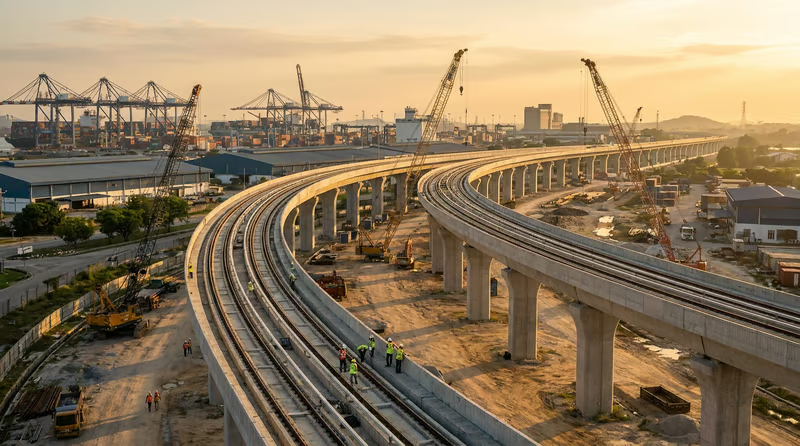
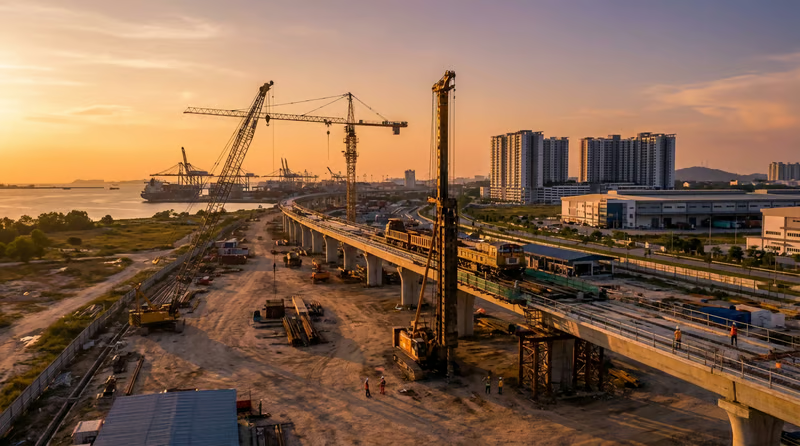
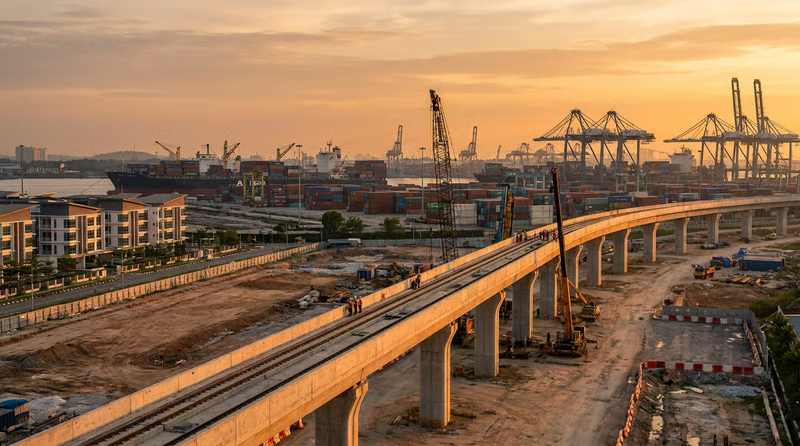
The ECRL is a 665-kilometre dual-track rail line and Malaysia's biggest transport infrastructure investment in two decades, valued at approximately MYR 50 billion. Once operational, it is projected to carry an estimated 53 million tons of freight annually between the East Coast and Port Klang. That single number is the reason industrial landlords, REITs, and manufacturers are re-pricing land along the corridor.
Rail freight changes the cost equation in three concrete ways:
- Transit time reduction for electronics, petrochemicals, and palm oil, the three commodity groups explicitly identified as beneficiaries.
- Modal shift away from long-haul road haulage, which reduces exposure to diesel price volatility.
- Volume consolidation at Port Klang, which increases the need for cross-docking, buffer storage, and specialised warehousing nearby.
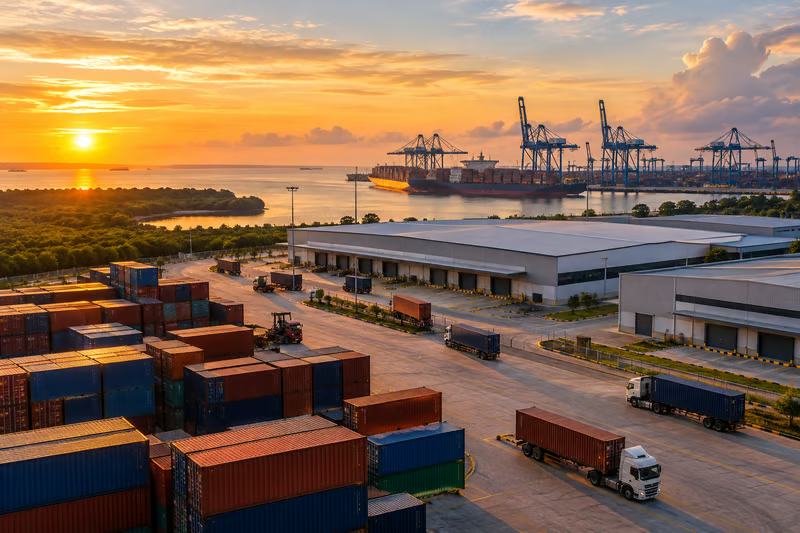
This is happening against a strong backdrop: Port Klang handled a record 15.14 million TEUs in 2025 (Malay Mail).
Investment is the fuel. Malaysia approved a record RM378.5 billion of investments in 2024, according to MIDA. You can review the current pipeline of approved manufacturing and logistics projects via MIDA. Investment of that scale translates directly into demand for advanced warehousing, cross-border forwarding capacity, and specialised carrier partnerships.
Port Klang itself remains one of the world's busiest container terminals, and throughput statistics are published by the Port Klang Authority (PKA).
Why the Station Function Matters More Than the Distance
A common mistake buyers make is assuming that proximity to any ECRL station equals value. It does not. Stations have different economic roles:
| ECRL Station / Node | Function | Industrial Property Implication |
|---|---|---|
| Bandar Serendah + Jalan Kastam / Port Klang | Passenger + Cargo | Dual-use node; strongest for logistics operators needing both labour access and freight movement |
| Puncak Alam | Wider industrial catchment | Expands the addressable tenant pool for mid-sized warehouses |
| Kapar | Industrial + township growth | Long-term land appreciation play; township spillover supports workforce housing |
| ITT Gombak | Urban connectivity | Better for last-mile urban distribution than bulk freight |
Source: ECRL station functional classification as published in industrial property market commentary.
For industrial property, function may matter more than proximity. A warehouse 3 km from a passenger-only station is worth less to a third-party logistics (3PL) operator than one 8 km from a cargo-capable node.
Impact on Klang, Shah Alam, Kapar, and Meru Industrial Property
Klang and Port Klang: The Cargo Core
The Klang corridor, particularly Telok Gong, Pulau Indah, and the West Port hinterland, is where institutional money is already moving.
Axis REIT acquired three Klang warehouses for RM61 million, and has flagged plans to acquire a further RM80 million warehouse in Telok Gong, Port Klang. When a listed REIT commits capital at that scale, it is pricing in sustained occupancy and rental reversion, not a short-term trade.
The practical implication for smaller buyers and owner-occupiers: you are now competing against institutional capital for well-located freehold stock. If you are searching for a factory for sale in Klang, expect the strongest competition in Telok Gong, Pulau Indah, and Bandar Bukit Raja, where stock is concentrated.
Shah Alam: Full, and Pushing Outward
Shah Alam's established industrial sections, Bukit Jelutong, Seksyen 22, Seksyen 26, Hicom Industrial Estate, are effectively built out. The market signal for 2026 is clear: Shah Alam is full, and the outer ring is next, Kapar, Puncak Alam, and Serendah.
That does not make Shah Alam irrelevant. Its value today is redevelopment and intensification: older single-storey detached factories on large land banks are being repositioned for higher plot ratio and modern specification. Sellers of ageing stock are seeing better interest than at any point in the last five years. If you need established infrastructure, a factory for rent in Shah Alam remains the fastest route to operational readiness, though available stock turns over quickly.
Kapar: The Growth Story to Watch
Kapar is the area most explicitly called out by market commentators as an industrial + township growth node. Three factors converge there:
- ECRL cargo function feeding Port Klang
- Land availability at a discount to Shah Alam
- Township development bringing workforce housing and amenities
For buyers with a 5-10 year horizon, Kapar offers land appreciation potential that mature industrial estates cannot. For tenants needing immediate occupancy, a factory for rent in Kapar is generally more accessible than equivalent Shah Alam stock, though specification and built-up quality vary widely across the sub-market.
Meru: The Established Alternative
Meru is Klang's established industrial address with a deep pool of detached and semi-detached factories on sizeable land parcels. Recent market activity has featured freehold detached warehouses with expansive vacant land, the type of asset that suits manufacturers needing yard space, container parking, or future expansion. For buyers needing land-plus-building in one transaction, industrial land for sale in Selangor combined with a build-to-suit is a recurring alternative to buying existing stock.
Rent vs Buy: What the Numbers Actually Say
This is the decision most Klang industrial occupiers are wrestling with in 2026.
Table 1: Rent vs Buy, Decision Framework (Qualitative)
| Factor | Rent | Buy |
|---|---|---|
| Upfront capital | Deposit + advance rental | Down payment + stamp duty + legal |
| Monthly commitment | Market rental (reviewed at renewal) | Mortgage instalment (largely fixed) |
| Exposure to rental inflation | Full exposure at renewal | Protected |
| Balance sheet treatment | Off-balance-sheet (operating lease) | Asset on books, financing facility secured |
| Flexibility to relocate | High (subject to lease break) | Low |
| Benefit from corridor appreciation | None | Full |
| Fit-out control | Landlord approval required | Full control |
| Exit cost | Lease obligations | Disposal cost, RPGT where applicable |
Table 2: Klang Valley Industrial Rental & Sale Benchmarks (2026)
| Asset Type | Rental Benchmark | Sale Benchmark | Unit Basis |
|---|---|---|---|
| Standard detached / semi-D factory | RM1.24 psf/month (JPPH-registered median, Klang & Port Klang) | RM267 (detached), RM334 (semi-D) psf of land | Rent per built-up sqft; sale per land sqft |
| Premium new project | Above the registered median of RM1.44 psf/month | Subject to specification | Per built-up sqft |
| Older / lower-spec unit | Below the registered median of RM1.44 psf/month (JPPH-registered, Klang & Port Klang) | Varies with condition | Per built-up sqft |
| Industrial land | , | RM88 psf of land | Per land sqft |
Source: rental benchmarks are consolidated Klang Valley market ranges; sale benchmarks are JPPH-registered medians for Klang and Port Klang, 24 months to July 2026. Market rates vary by location, specification, and access, contact +60 17-672 9873 for current quotes.
Critical unit note: rental benchmarks are quoted per built-up sqft (psf BU), while registered sale benchmarks, for factories and land alike, are quoted per land sqft. Never compare a rent per built-up sqft against a sale price per land sqft, they measure different things and the resulting comparison is meaningless.
Why the Rent vs Buy Math Has Shifted
Two structural changes matter.
First, rail freight re-rates land. When 53 million tons of annual freight flow is routed through Port Klang, the value of a warehouse within efficient drayage distance of the port rises. Landlords price this in at lease renewal. Tenants who rent for a decade effectively fund the landlord's capital appreciation without participating in it.
Second, financing conditions stabilise the buy case. Industrial property financing in Malaysia is influenced by the Overnight Policy Rate; current rates and financing conditions are published by Bank Negara Malaysia. When the cost of debt is predictable, the fixed instalment of a purchase compares more favourably against a rental that reviews upward.
A reported data point illustrates where the market sits: industrial land and warehouse space in Klang has been quoted at approximately RM16,000 per month for a 1.5-acre plot. That is an operating cost line, not an asset. Over a typical 3-year tenancy, an occupier at that level is committing roughly RM576,000 in rent with no equity retained.
What to Do Now: A Practical Playbook
If You Are an Owner-Occupier Manufacturer
- Model your drayage cost to Port Klang before shortlisting any site. A warehouse 5 km closer to the West Port gate can materially reduce per-container haulage across thousands of annual movements.
- Prioritise freehold wherever the business plan exceeds 8 years. In a corridor with institutional REIT participation, freehold industrial stock in Klang, Kapar, and Meru is the more defensible long-term position.
- Check the power supply and floor loading early. Rail-corridor demand is concentrated in electronics, petrochemicals, and palm oil, sectors with heavy power and load requirements. Specification gaps disqualify assets quickly.
If You Are a 3PL or Logistics Operator
- Cargo-capable nodes matter more than passenger nodes. Jalan Kastam / Port Klang and Bandar Serendah carry both passenger and cargo; ITT Gombak is urban connectivity. For 3PL operations, the cargo nodes are the ones that shorten the last leg.
- Consider Kapar for expansion capacity rather than premium Shah Alam, where available stock is thin and pricing reflects scarcity.
If You Are an Investor
- Follow the REITs. Axis REIT's RM61 million acquisition of three Klang warehouses and its planned RM80 million Telok Gong acquisition are public signals about where institutional yield expectations sit.
- Underwrite on land, not just built-up. In Kapar and Meru, a meaningful share of value sits in the land component and its redevelopment potential.
If You Are Still Renting
- Start the buy analysis 18-24 months before lease expiry. Industrial transactions involve due diligence, financing, and fit-out timelines that are unforgiving to last-minute decisions.
- Benchmark your current rent against the JPPH-registered detached factory rent of RM1.24 psf per month for Klang & Port Klang (24 months to July 2026). If you are materially above that and the specification does not justify it, the renewal conversation should be data-led.
Market Outlook: 2026 and Beyond
The trajectory is well supported by published forecasts:
- Fastest-growing corridor: the Southern Region at a projected 6.35% CAGR, driven by cross-border infrastructure with Singapore, a relevant reminder that Klang is not the only growth story, but it remains the largest.
Malaysia's macro policy environment supports the industrial thesis. The National Transport Policy 2019-2030, combined with targeted diesel subsidy restructuring, has reduced cost volatility for haulage operators, supporting steady capacity expansion across road, rail, and maritime corridors.
The clearest structural shift is the outer-ring movement. As Shah Alam reaches build-out, industrial demand migrates to Kapar, Puncak Alam, and Serendah. Investors who position in the outer ring before township infrastructure completes typically capture the steepest appreciation curve. For buyers weighing this, current pricing on industrial land for sale in Selangor remains the most direct way to participate.
Property transaction data and official market reports are published by the Valuation and Property Services Department (JPPH), which remains the authoritative source for verified industrial transaction evidence.
Frequently Asked Questions
Is a warehouse for sale in Klang a profitable investment in 2026?
Profitability depends on three variables: acquisition price per built-up sqft, achievable rent, and occupancy. Klang is currently supported by port-driven demand. Institutional participation, including Axis REIT's RM61 million acquisition of three Klang warehouses and a planned RM80 million Telok Gong acquisition, indicates that listed vehicles see defensible yield in the corridor. However, no investment is guaranteed profitable, underwrite each asset on its own access, specification, and tenant covenant.
Where is the best place to buy a warehouse in the Klang area?
It depends on your function. For logistics operators needing port proximity, Telok Gong and Pulau Indah offer direct West Port access. For manufacturers needing large land parcels with yard space, Meru and Kapar are strong. For buyers prioritising long-term land appreciation, Kapar is the node most explicitly identified with industrial and township growth tied to the ECRL. Shah Alam remains relevant but is largely built out, which means available stock is limited and pricing reflects scarcity.
What is the difference between a warehouse and a factory?
A warehouse is primarily a storage and distribution facility, its core value drivers are clear height, floor loading, dock levellers, and truck circulation. A factory is a production facility, its value drivers include power supply capacity, utility infrastructure, ventilation or extraction systems, and often compliance with specific manufacturing requirements. Many industrial buildings in Klang are hybrid, with production and storage under one roof. When comparing prices, always confirm whether the quoted figure refers to built-up area (RM/psf BU) or land area (RM/psf land).
Can foreigners buy industrial land in Malaysia?
Foreign ownership of industrial property in Malaysia is subject to state authority approval and minimum price thresholds that vary by state. Selangor has its own guidelines. Because requirements change and are assessed case by case, buyers should verify current conditions with the relevant state land office and consult a licensed property lawyer before committing. MIDA publishes investment policy guidance relevant to foreign-owned manufacturing operations, and stamp duty treatment is administered by LHDN.
How does the ECRL affect factory rent in Kapar specifically?
Kapar is identified as an ECRL node associated with industrial and township growth. The mechanism is straightforward: the ECRL is expected to move an estimated 53 million tons of freight yearly between the East Coast and Port Klang, which increases demand for warehousing and light industrial space along the corridor. Township growth simultaneously expands the local workforce pool. Together these support both rental demand and land values in Kapar over the medium term, though the timing of the uplift depends on completion and operational ramp-up.
Should I rent or buy a factory in Klang given current conditions?
If your operational horizon is under five years or your capital is better deployed in the business, renting preserves flexibility. If your horizon exceeds eight years, buying converts a recurring operating expense into an appreciating asset in a corridor with institutional capital participation. JPPH-registered factory tenancies in Selangor & Kuala Lumpur over the 24 months to July 2026 show a median rent of RM1.52 psf per month, with detached factories at RM1.39 psf per month and semi-detached factories at RM1.75 psf per month; newer, higher-spec units usually rent above the median. Market rates vary by location and specification, contact +60 17-672 9873 for current quotes specific to your requirements.
What is the most important thing to check before buying a warehouse in Klang?
Access and function. A warehouse's value is determined by how efficiently goods move in and out. Verify: distance and route to the Port Klang gates, highway connectivity, road width for 40-foot container trailers, dock leveller count and height, floor loading capacity, and power supply. Then verify the ECRL node function nearest to the site, cargo-capable nodes serve logistics differently from passenger-only stations.
Next Step: Get Advice Specific to Your Requirement
Industrial property in Klang is no longer a homogeneous market. The gap between a well-located freehold warehouse near a cargo node and a generic unit in a secondary location will widen as the ECRL approaches operation.
Whether you are comparing a warehouse for sale Klang acquisition against continued leasing, evaluating factory for rent in Kapar as a lower-cost operating base, or scouting factory for sale in Shah Alam for redevelopment potential, the decision should be built on verified specification data, real access measurements, and current market pricing, not listing headlines.
Contact +60 17-672 9873 for personalised advice on Klang, Shah Alam, Kapar, and Meru industrial property. We will help you compare rent versus buy on your actual operational numbers, screen for ECRL cargo-node access, and shortlist assets that fit your business plan.
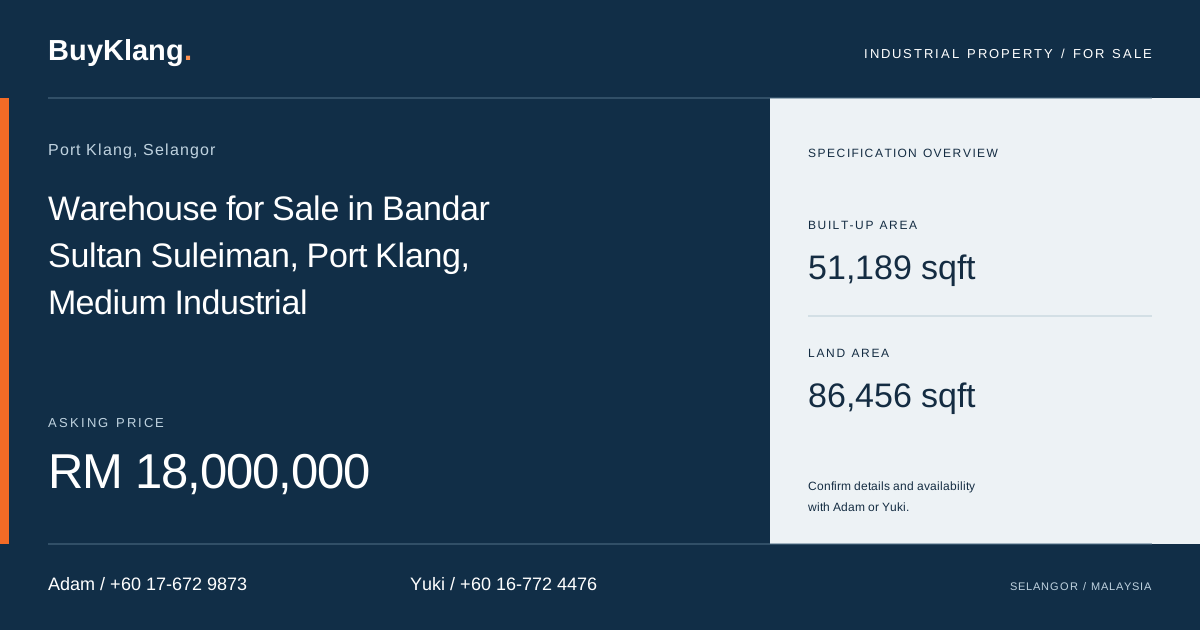
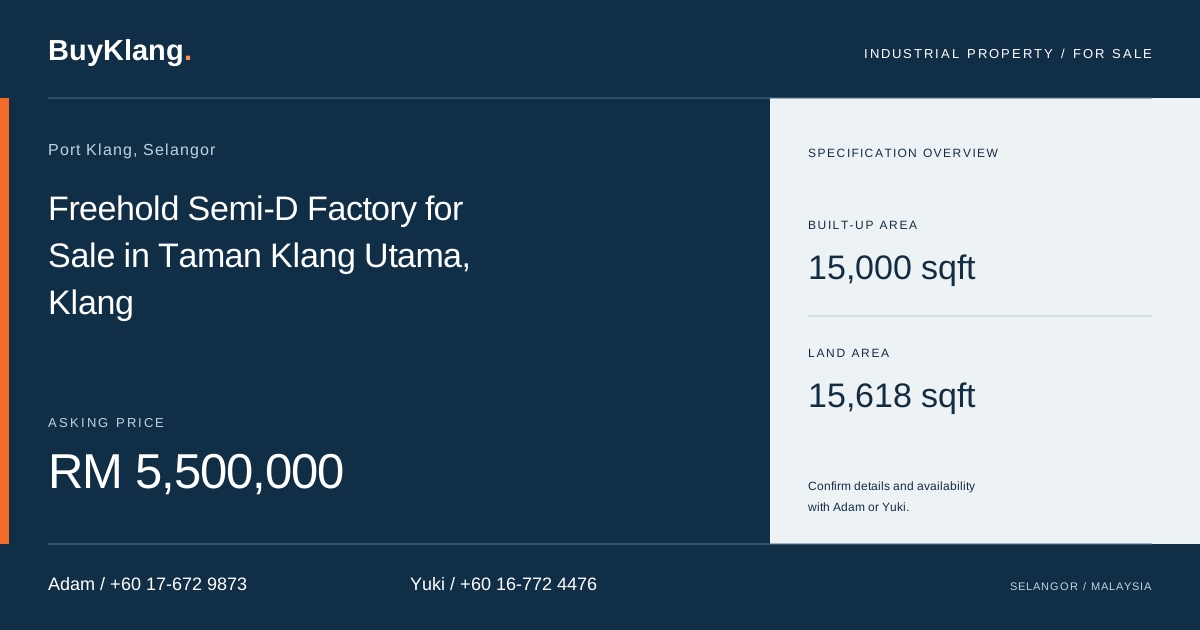
Factories and Warehouses in Port Klang
Archived catalogue records with power, ceiling height and floor loading for every unit: